Social Media Marketing for Small Companies

ATTENTION: Want to Learn Affiliate Marketing from Successful Affiliates?
You don’t need a marketing department, a five-figure ad spend, or a viral moment to win on social media. You need a plan that fits your business, your voice, and your Tuesday afternoon when you actually have twenty minutes to post something.
Somewhere between “we should really be on TikTok” and “who even has time for this,” most small business owners get stuck. Social media marketing feels like it belongs to brands with in-house creative teams, paid influencers, and budgets the size of a small country’s GDP. But that’s not the reality anymore, and it never really was. The businesses winning attention right now aren’t necessarily the ones spending the most — they’re the ones showing up consistently, speaking like actual humans, and understanding exactly who they’re talking to.
This guide is built specifically for the independent shop owner, the two-person consultancy, the local bakery, the boutique agency, and every small company that’s tired of generic advice written for enterprise marketing teams. No fluff, no jargon you need a glossary for — just a clear-eyed look at how small businesses can actually make social media work, and work hard, for them.
emmanuel EmmanuPeople worldwide now use social media, and a growing share of them research a business’s social presence before ever making a purchase or booking a service — meaning your profile is often the very first impression a potential customer forms of your company.
Why Social Media Marketing Isn’t Optional Anymore
There was a time when a solid website and a listing in the phone book were enough. That era is long gone. Today, social media marketing functions as your storefront window, your customer service desk, your word-of-mouth engine, and your brand personality — all rolled into one continuously updating feed.
For small companies specifically, social platforms level a playing field that used to tilt heavily toward whoever had the biggest ad budget. A single well-made short video from a two-person team can outperform a polished, expensive campaign from a Fortune 500 company, simply because it feels honest. People are exhausted by content that feels manufactured. They’re drawn to businesses that feel real, local, and reachable — which, conveniently, is exactly what most small companies already are.
- Customers now expect to find you on at least one platform before they’ll trust you enough to buy
- Organic reach still exists and rewards consistency over budget size
- Social proof — reviews, comments, shares — has become a modern substitute for traditional advertising
- Algorithms increasingly favor authentic, native-feeling content over anything that looks like a traditional ad
Choosing the Right Platforms for Your Business
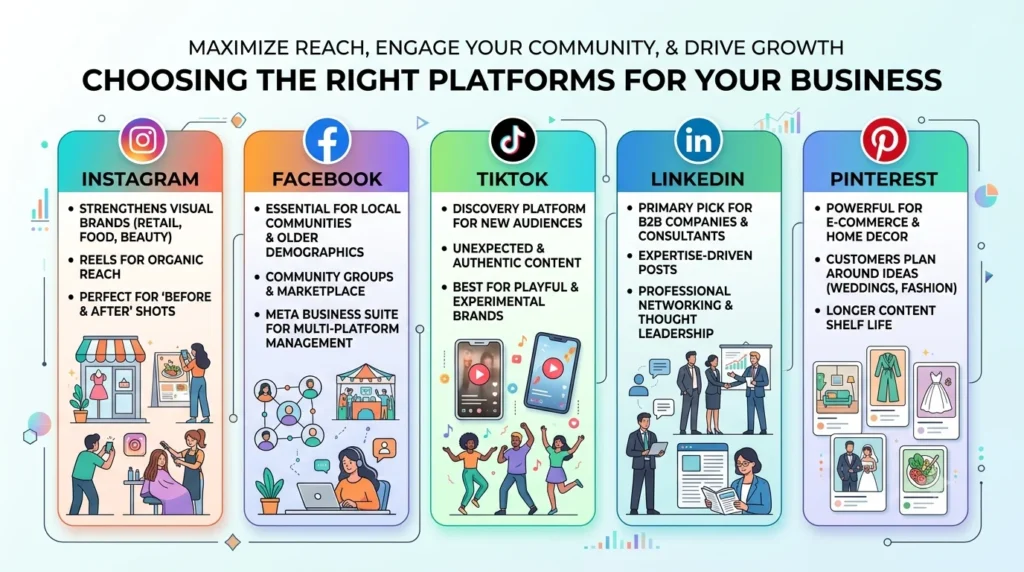
One of the biggest traps small companies fall into is trying to be everywhere at once. Five platforms, posted inconsistently, beat none of them. Better to master two platforms than to half-heartedly maintain six.
The right platform choice comes down to where your actual customers already spend their time, not where you personally enjoy scrolling.
Still the strongest all-purpose platform for visual businesses — retail, food and beverage, beauty, fitness, home services, and anything with a satisfying “before and after.” Reels currently carry the most organic reach potential on the platform.
Underrated by younger founders, but still essential for reaching local communities, older demographics, and anyone who relies on community groups and local marketplace discovery. Facebook Business Suite also makes it painless to manage both Facebook and Instagram from one dashboard: business.facebook.com/tools/meta-business-suite.
TikTok
The platform of unexpected discovery. A small company with zero followers can still land in front of hundreds of thousands of the right people if the content resonates. Best for businesses willing to be a little playful and experimental.
The obvious pick for B2B companies, consultants, agencies, and service providers. LinkedIn rewards thoughtful, expertise-driven posts far more than polished corporate content.
Often overlooked, yet quietly powerful for e-commerce, home décor, weddings, food, fashion, and any business selling something people plan around. Content here has a longer shelf life than almost any other platform.
Quick Platform Cheat-Sheet
- Selling physical products or food? Instagram + Pinterest
- Local, service-based business? Facebook + Google Business Profile
- B2B, consulting, or professional services? LinkedIn
- Younger audience, playful brand voice? TikTok + Instagram Reels
Building a Content Strategy That Doesn’t Feel Like a Chore
A content strategy sounds intimidating, but at its core it’s simply a repeatable rhythm — a handful of content types you can rotate through so you’re never staring at a blank posting box wondering what to say.
Small companies thrive with a mix of content pillars rather than one-off, disconnected posts. Pillars give structure without forcing you to reinvent the wheel every single day.
- Behind-the-scenes content — the process, the workspace, the people making it happen
- Customer stories and testimonials — real voices carry more weight than any brand claim
- Educational content — tips, how-tos, and answers to questions your customers actually ask you
- Product or service spotlights — shown in context, not just staged product shots
- Personality and culture posts — the small, human moments that make a brand memorable
- Community and local involvement — events, collaborations, and neighborhood presence
Rotating through these pillars means you always have something worth posting, and your audience gets a well-rounded picture of who you actually are — not just what you’re selling.
The Batching Habit That Saves Sanity
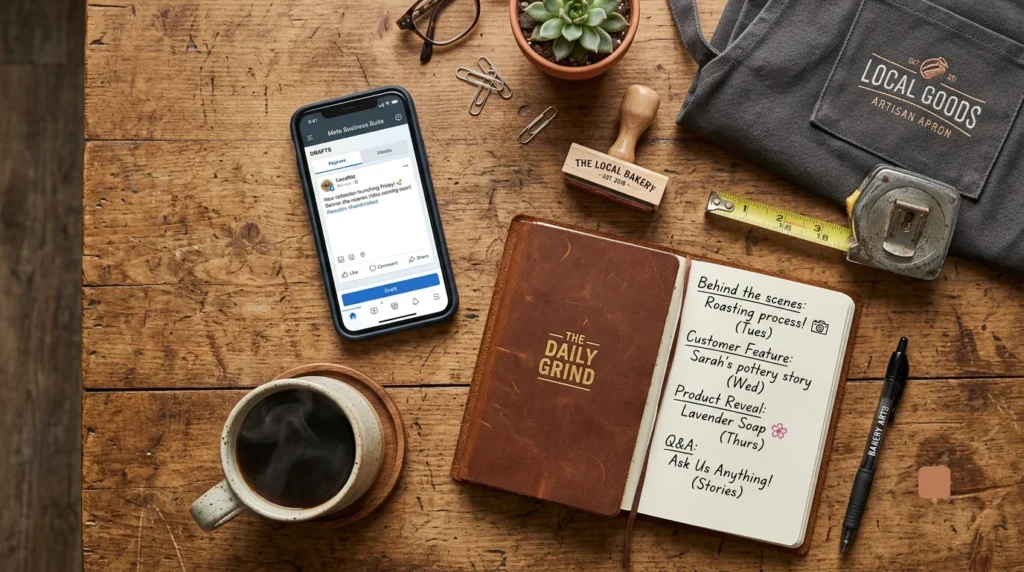
Sitting down every single day to create fresh content is a fast route to burnout. Instead, set aside one focused session — even 90 minutes — to shoot several pieces of content at once, then schedule them out across the week or month using a tool built for exactly that purpose.
Scheduling Tools Worth Exploring
Consistency Beats Perfection, Every Time
Here’s an uncomfortable truth: the algorithm doesn’t care how nervous you were filming that video, and your audience won’t remember the slightly imperfect lighting. What they will remember is whether you showed up last week, and the week before that, and the week before that too.
Consistency is the single most underrated growth lever in social media marketing, and it’s entirely within a small company’s control — no budget required, just discipline. A modest, sustainable posting rhythm you can actually maintain will always outperform an ambitious schedule you abandon after three weeks.
Authentic Storytelling: The Advantage Small Companies Actually Have
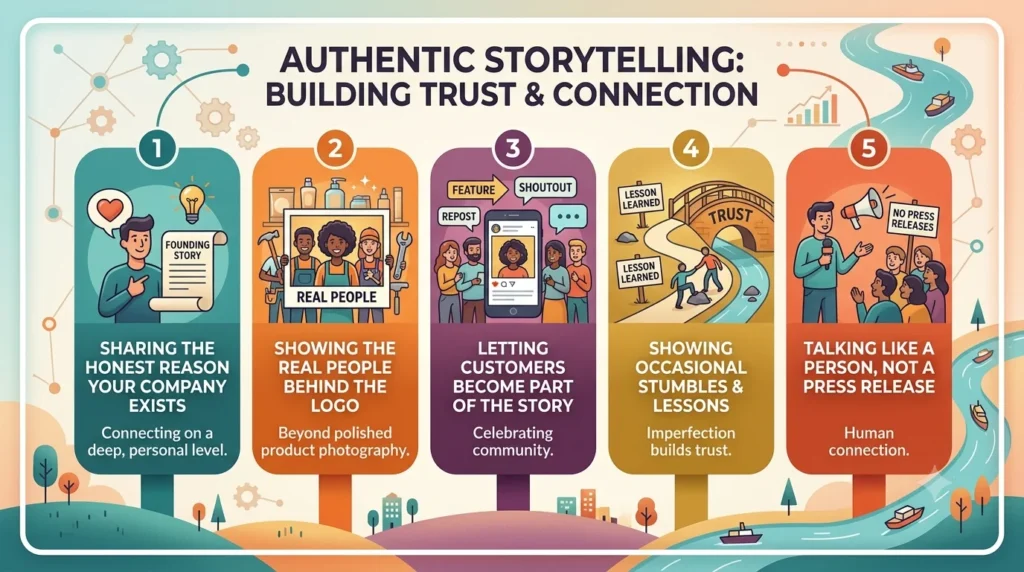
Big brands spend enormous budgets trying to manufacture the exact thing small businesses already have for free: a genuine story. You know your customers by name. You remember why you started this. You can show the actual hands making the product or the actual person answering the phone.
Storytelling in a small business context doesn’t mean elaborate video production. It means:
- Sharing the honest reason your company exists in the first place
- Showing the real people behind the logo, not just polished product photography
- Letting customers become part of the story through features, shoutouts, and reposts
- Being willing to show the occasional stumble or lesson learned — imperfection builds trust
- Talking like a person, not a press release
Audiences today are remarkably good at detecting when something feels corporate versus when it feels lived-in. Lean into the lived-in version. It’s your unfair advantage.
Paid Social Ads on a Small Business Budget
Organic content builds the foundation, but a modest, well-targeted ad budget can accelerate growth considerably — and the good news is that paid social advertising no longer requires a big spend to see meaningful results.
Platforms like Meta Ads Manager and TikTok Ads let you set daily budgets as low as a few dollars, targeted with real precision toward your local area, your ideal customer age range, or people who’ve already interacted with your business.
- Start small and specific: a $5–$10 daily budget aimed at a tightly defined local audience often outperforms a broad, expensive campaign
- Boost what’s already working: put a small budget behind an organic post that’s already performing well rather than guessing blind
- Retarget website visitors: people who’ve already shown interest convert at a far higher rate than cold audiences
- Track cost per result, not just impressions: vanity metrics don’t pay the bills
The Meta Ads platform remains the most accessible entry point for most small companies due to its granular targeting and relatively low cost of entry.
Engaging Your Community, Not Just Broadcasting to It
Posting content is only half the job. The other half — arguably the more important half — is showing up in the comments, replying to direct messages, and treating your social channels like an actual two-way conversation rather than a billboard.
Community engagement is what separates a brand people follow passively from one they actively recommend to friends. A thoughtful reply to a comment, a quick response to a question, or a genuine reaction to a customer’s tagged post all send strong signals — both to the algorithm and to the human on the other side of the screen.
- Reply to comments within the first hour whenever possible — early engagement boosts a post’s reach
- Respond to direct messages like you would a phone call, not an afterthought
- Repost and thank customers who tag your business — it costs nothing and builds real loyalty
- Ask genuine questions in captions to invite conversation rather than passive scrolling past
- Join relevant local or industry groups and contribute value before ever mentioning your business
Measuring What Actually Matters
Follower count is the most visible metric and, frankly, one of the least useful ones. A small company with 800 highly engaged local followers will often outperform one with 20,000 disengaged followers scattered across the globe.
Focus instead on metrics that connect to real business outcomes:
- Engagement rate — comments, shares, and saves relative to your audience size
- Click-through rate — how often people actually visit your website or booking page
- Conversion rate — how many of those clicks turn into an actual sale or inquiry
- Reach among your target location or demographic — not just total reach
- Saves and shares — a strong signal that content was genuinely useful or resonant
Most platforms now include built-in analytics dashboards at no extra cost — Meta Business Suite, TikTok Analytics, and LinkedIn Analytics all provide enough data for a small company to make informed decisions without needing a dedicated analyst.
Common Mistakes Small Companies Make on Social Media
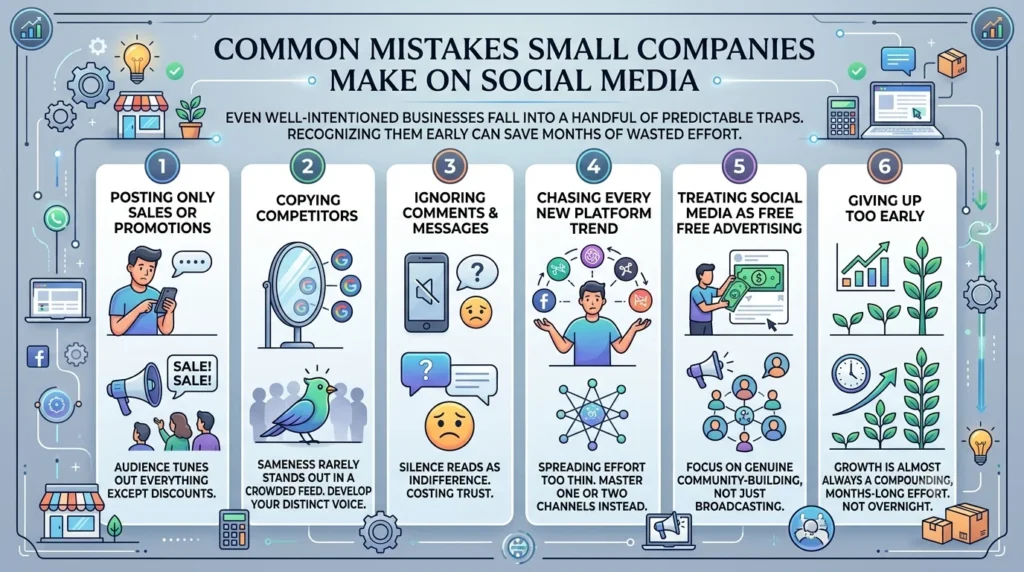
Even well-intentioned businesses fall into a handful of predictable traps. Recognizing them early can save months of wasted effort.
- Posting only when there’s a sale or promotion — this trains your audience to tune out everything except discounts
- Copying competitors instead of developing a distinct voice — sameness rarely stands out in a crowded feed
- Ignoring comments and messages — silence reads as indifference, and indifference costs trust
- Chasing every new platform trend — spreading effort too thin rather than mastering one or two channels
- Treating social media as free advertising rather than genuine community-building
- Giving up too early — meaningful growth on social platforms is almost always a compounding, months-long effort rather than an overnight event
The Rise of Short-Form Video (And Why You Can’t Skip It)
If there’s one shift that’s rewritten the rules of social media marketing over the last few years, it’s the dominance of short-form video. Reels, TikToks, and YouTube Shorts have become the default format that platforms push hardest, which means a business that leans into video, even imperfect video, tends to reach far more new people than one that only posts static images.
The good news for small companies is that short-form video rewards resourcefulness over production budget. A phone camera, decent natural lighting, and a clear idea are genuinely enough to compete. What matters far more than polish is whether the first two seconds earn someone’s attention and whether the content delivers on what it promised.
- Hook fast: the opening line or visual needs to stop the scroll within the first couple of seconds
- Keep it useful or entertaining: tips, transformations, and honest reactions consistently outperform polished sales pitches
- Repurpose relentlessly: one solid video idea can become a Reel, a TikTok, a YouTube Short, and a LinkedIn native video with minimal extra effort
- Add captions: a large share of viewers watch with sound off, especially in public or work settings
Small companies that commit to even one short video per week, filmed on a phone with zero fancy equipment, routinely see faster follower and inquiry growth than those relying solely on photos and graphics.
Micro-Collaborations: Influencer Marketing Without the Influencer Price Tag
Traditional influencer marketing conjures images of massive fees and celebrity endorsements, but the version that actually works for small companies looks completely different. Micro-collaborations — partnering with local creators, niche accounts, or even loyal customers who have modest but engaged followings — often deliver a far better return than chasing big-name partnerships.
A local food account with two thousand genuinely engaged followers in your city will typically send more real customers through the door than a national influencer with a million followers scattered across countries you don’t serve.
- Look for relevance over reach — a smaller, hyper-local audience beats a large, irrelevant one
- Offer product or service trades before jumping straight to paid partnerships
- Build ongoing relationships rather than one-off shoutouts — repetition builds trust faster than a single mention ever could
- Track referral codes or unique links so you can actually measure what a collaboration delivers
Where Social Media Meets Search: The SEO Connection
Social platforms have quietly become search engines in their own right. A growing number of people now search directly on Instagram, TikTok, and Pinterest instead of Google when looking for a local restaurant, a service provider, or product recommendations — which means your social content needs to be written with searchability in mind, not just visual appeal.
- Write descriptive captions that naturally include the words a customer might actually search for, not just clever wordplay
- Use location tags consistently so local search surfaces your business to nearby customers
- Keep your profile’s keywords current — your bio is prime searchable real estate that too many businesses leave generic
- Claim and complete your Google Business Profile, which frequently surfaces alongside social results in local searches: google.com/business
Treating captions and bios as searchable text, rather than purely creative copy, is a small adjustment that meaningfully widens how many people can discover your business organically.
A Realistic Weekly Rhythm for a Busy Small Business Owner
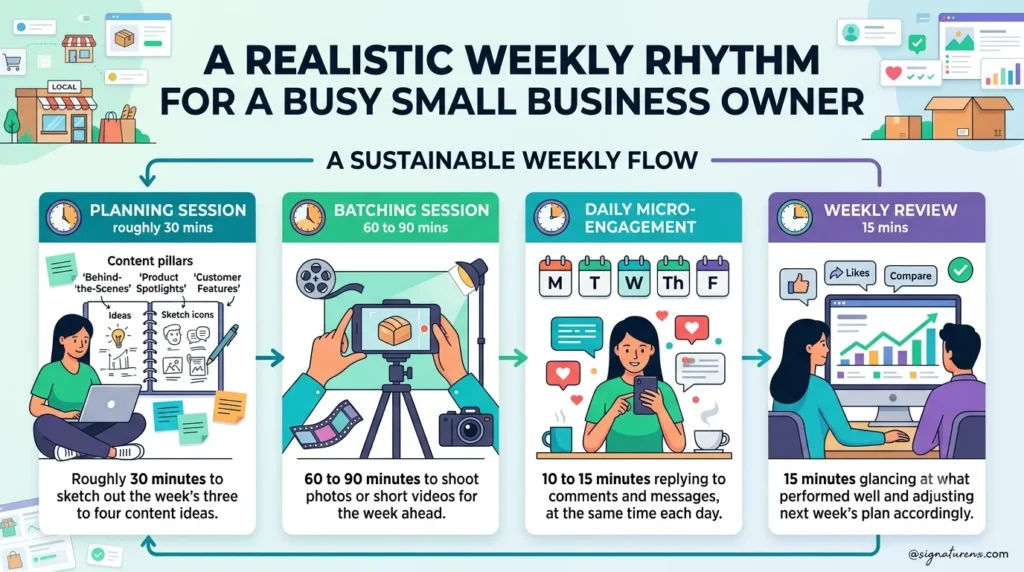
Strategy only matters if it survives contact with an actual busy week. Here’s a rhythm that many small companies find sustainable without a dedicated marketing hire:
A Sustainable Weekly Flow
- One planning session — roughly 30 minutes to sketch out the week’s three to four content ideas
- One batching session — 60 to 90 minutes to shoot photos or short videos for the week ahead
- Daily micro-engagement — 10 to 15 minutes replying to comments and messages, ideally at the same time each day
- One weekly review — 15 minutes glancing at what performed well and adjusting next week’s plan accordingly
None of this requires a large time commitment. What it requires is protecting that small block of time the same way you’d protect a client meeting, so it doesn’t quietly get pushed aside week after week.
A Quick Case in Point
Consider a small independent coffee roaster with no marketing budget to speak of. Rather than trying to compete with national chains on production value, the roaster leaned entirely into authentic, behind-the-scenes storytelling — short videos of the roasting process, honest captions about sourcing struggles, and quick replies to every single comment. Within several months of consistent, unglamorous posting, foot traffic increased noticeably, largely driven by people who said they felt like they already “knew” the business before ever walking through the door.
Nothing about that outcome required a viral moment or a lucky break. It required showing up, telling the truth about the business, and doing it often enough for trust to accumulate. That’s the version of social media marketing available to every small company, regardless of budget.
Frequently Asked Questions
How often should a small business post on social media?
Three to five times a week on your primary platform is a realistic, sustainable target for most small companies — far better to maintain that consistently than to post daily for two weeks and then disappear.
Do small businesses really need to be on every platform?
No. Mastering one or two platforms where your actual customers spend time will consistently outperform a thin, inconsistent presence spread across five or six.
How long before social media marketing shows real results?
Most small companies start seeing meaningful traction after three to six months of consistent effort. Growth tends to be gradual before it compounds, rather than instant.
Is paid advertising necessary, or can organic content alone work?
Organic content can absolutely build a strong foundation on its own, but a modest, targeted ad budget often accelerates growth considerably once you know which content already resonates.
Bringing It All Together
Social media marketing for small companies isn’t about matching the production value or budget of a national brand. It’s about showing up as exactly what you are — a real business, run by real people, solving real problems for a specific community — and doing that consistently enough for it to compound.
Start with one or two platforms where your actual customers already spend time. Build a small rotation of content pillars so you’re never scrambling for ideas. Show up in the comments as often as you show up in the feed. Track the handful of metrics that actually connect to revenue, and let go of the ones that don’t. And above all, give the strategy enough time to actually work — most meaningful social growth for small businesses happens gradually, then all at once.
Ready to Turn Followers Into Customers?
The best time to start showing up consistently was a year ago. The second-best time is your next available posting slot.