
SEO Competitor Analysis for Beginners


ATTENTION: Want to Learn Affiliate Marketing from Successful Affiliates?
Understanding SEO competitor analysis is crucial for anyone looking to improve their online presence. It enables you to see not just who your competitors are, but also how they capture their audience and rank in search engines. Let’s dive into essential techniques that will help you get started.
Identify Your Competitors
The first step is straightforward: identify your main competitors. This involves both direct competitors, who offer similar products or services, and indirect ones, who may target the same audience but with different offerings. You can start by:
- Searching your primary keywords on Google to see which websites appear on the first page.
- Using tools like Ahrefs or Moz to identify sites competing for the same keywords.
- Checking social media platforms to see which brands generate discussions and engagement around your niche.
Analyze Competitor Keywords
Once you’ve identified your competitors, the next step is keyword analysis. Knowing which keywords your competitors rank for can help you set your strategy. Here’s how to perform keyword analysis:
- Enter competitor URLs into SEO tools like SEMrush to view their top keywords.
- Note the search volume and ranking position of these keywords.
- Look for keywords that have a high search volume but lower difficulty scores, indicating an opportunity for you to rank well.
Review Content Strategy
Assessing the content strategy of your competitors can reveal a lot about their success. Evaluate the following factors:
- Content types: Are they using blogs, videos, infographics, or podcasts?
- Frequency of posting: How often do they publish new content?
- Engagement: Check comments, likes, and shares to see how audiences respond to their content.
Using this information, you can adjust your content strategy to better meet your audience’s needs.
Backlink Analysis
Backlinks play a vital role in SEO. They are votes of confidence from other websites and significantly influence your site’s authority. To analyze your competitors’ backlinks:
- Use tools like Majestic to find out which sites link to your competitors.
- Look for high-authority domains linking to them.
- Identify any patterns or strategies that might explain their success, such as guest posting or partnerships.
Consider leveraging similar tactics to build your own backlinks.
Social Media Insights
Social media can provide excellent insights into what resonates with your target audience.
- Analyze which platforms your competitors are active on (e.g., Facebook, Instagram, Twitter).
- Look for their most engaged posts to understand what content works best.
- Monitor the frequency and timing of their posts for additional insights.
Lessons learned from their social strategies can enhance your approach.
Tracking Performance
After implementing your new strategies, tracking performance is essential. Use tools like Google Analytics to monitor improvements in traffic, bounce rates, and conversions. Consistent monitoring will allow you to adjust your approach as needed.
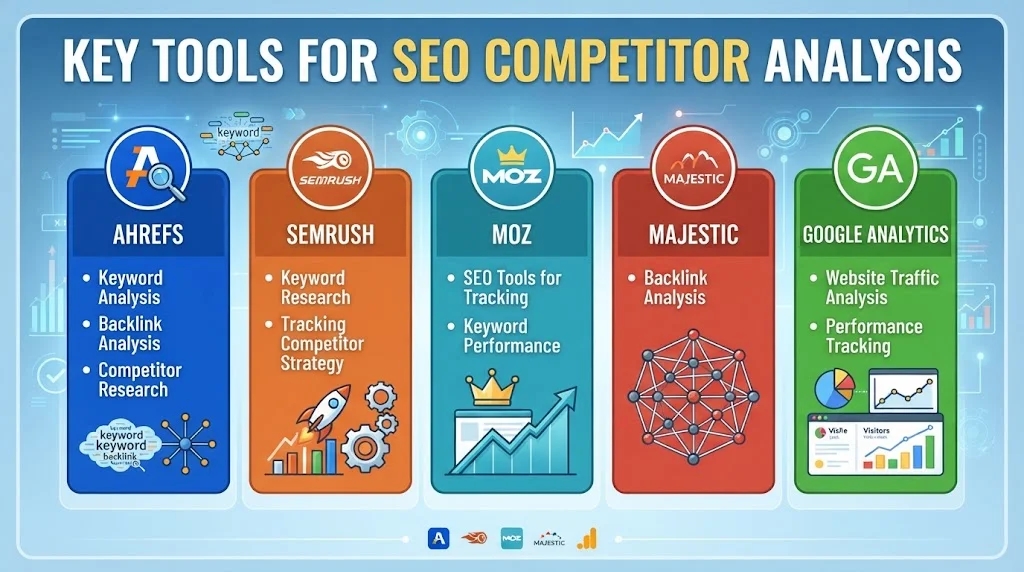
Table of Key Tools for Competitor Analysis
| Tool | Purpose |
|---|---|
| Ahrefs | Keyword analysis, backlink analysis, competitor research |
| SEMrush | Keyword research, tracking competitor strategy |
| Moz | SEO tools for tracking keyword performance |
| Majestic | Backlink analysis |
| Google Analytics | Website traffic analysis and performance tracking |
By applying these techniques for SEO competitor analysis, you’ll gain valuable insights and direction for your own SEO strategy. Start observing your competitors closely and watch how your efforts pay off in improved rankings and increased traffic.
Identifying Key Metrics for Evaluating Competitor Websites
Understanding your competitors is a crucial step for anyone looking to succeed in digital marketing. To do this effectively, you need to identify the key metrics that will give you insight into their tactics and performance. Start by focusing on the following categories to evaluate competitor websites accurately.
Traffic Analysis
Your competitors’ web traffic can reveal a lot about their strategies. Here are some key metrics to track:
- Monthly Visitors: Use tools like SimilarWeb to estimate how many visitors they attract each month.
- Traffic Sources: Identify where their traffic comes from—organic search, paid ads, social media, or referrals. This can help you determine which strategies are working for them.
- Geographic Distribution: Knowing where their traffic originates can guide your targeting options.
Keyword Rankings
Analyzing the keywords your competitors are ranking for provides insight into their content strategy and can help you identify gaps in your approach. Focus on these aspects:
- Top-performing Keywords: Use tools such as Ahrefs or SEMrush to find which keywords drive the most traffic to competitor websites.
- Keyword Difficulty: Assess the difficulty of these keywords to understand what it might take to outrank them.
- Long-tail Keywords: Discover lesser-competitive phrases that could yield high conversion rates.
On-Page SEO Metrics
Examining the on-page elements of competitor sites can uncover valuable insights into their optimization tactics. Consider these metrics:
- Page Titles and Meta Descriptions: Look at how effectively they use keywords in their titles and descriptions.
- Content Quality: Engaging content often ranks higher. Analyze their writing style, use of visuals, and length of content.
- Header Tags: Check how they structure their information using header tags (H1, H2, etc.).
Backlink Profile
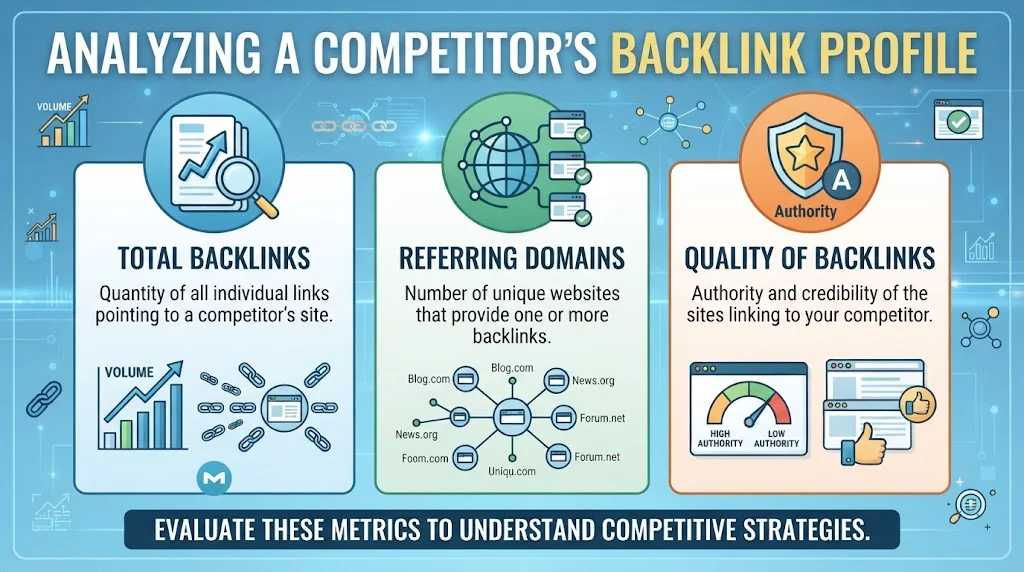
Backlinks play a significant role in SEO rankings. Assessing the backlink profiles of your competitors can provide insights into their authority and reach. Pay attention to:
- Total Backlinks: Tools like Moz can help you find how many links point to a competitor’s site.
- Referring Domains: More unique domains linking to them usually means more authority.
- Quality of Backlinks: Evaluate the authority of sites linking to your competitors to understand their link-building strategies.
Engagement Metrics
High engagement often correlates with better rankings. Key metrics to review include:
- Bounce Rate: A low bounce rate indicates that visitors find their content engaging.
- Average Session Duration: The longer users stay on their website, the better the content is likely performing.
- Pages Per Session: This shows how many pages a visitor views, indicating their level of interest.
Social Media Presence
Your competitors’ social media activity can be a goldmine of information. Focus on:
- Follower Count: More followers typically mean greater reach and brand visibility.
- Engagement Rates: Analyze likes, shares, and comments to gauge their audience’s interest.
- Content Sharing: Note which types of posts get the most interaction; this can inform your content strategy.
By focusing on these key metrics, you can get a comprehensive view of your competitors’ strengths and weaknesses. This will not only help you to fine-tune your own strategies but also to seize new opportunities in your market. For a deep dive into tools and techniques, consider visiting Search Engine Journal and exploring additional resources on competitor analysis.
Tools and Resources for Effective Competitor Research
Understanding your competitors is crucial for achieving success in any industry. By leveraging the right tools and resources, you can perform effective competitor research that provides insights into their strategies, strengths, and weaknesses. Here are some of the best tools and resources to enhance your competitor research.
SEO Tools
SEO tools are vital for analyzing how your competitors rank and perform in search engines. They provide data on keywords, traffic sources, and backlink profiles. Here are some popular SEO tools:
- Moz – Moz offers a suite of tools that allow you to see how your competitors are performing. You can analyze keywords, track rankings, and examine domains.
- SEMrush – This powerful tool lets you compare your domain with competitors, track backlinks, and view their keyword strategies. It’s excellent for depth analysis.
- Ahrefs – Ahrefs excels at backlink analysis. By entering your competitors’ domains, you can see which sites link to them and understand their link-building strategies.
Social Media Analysis Tools
Social media plays a significant role in driving traffic and engaging audiences. Evaluating your competitors on social platforms can reveal valuable insights into their engagement tactics. Effective tools include:
- BuzzSumo – This tool helps you discover which content performs best on social media for any topic. You can identify trending content related to your competitors.
- Social Blade – This platform tracks social media statistics for various platforms, giving you insights into competitor growth and engagement rates.
- Hootsuite – Hootsuite allows you to manage multiple social media accounts and track what your competitors post. You can analyze their engagement over time.
Website Analytics Tools
To see how well your competitors’ websites are performing, use analytics tools that offer insights on audience behavior, traffic, and demographics. Some popular options include:
- SimilarWeb – This tool provides traffic data and insights into competitors’ online presence and user engagement.
- Alexa – Besides measuring a site’s traffic rank, Alexa offers insights into audience demographics and engagement metrics.
- GTmetrix – Great for understanding website performance. Insights here can help you determine areas where your competitors excel, such as page load times and user experience.
Market Research Platforms
To get a broader view of your competitors’ market strategies, consider utilizing market research platforms. These services provide insights into market trends and consumer behavior:
- Statista – A fantastic resource for finding statistics and market data that can help in understanding your industry’s landscape.
- Nielsen – Nielsen provides insights on consumer behavior and market dynamics, which can inform how you position your offerings against competitors.
Competitor Websites
Regularly visiting your competitors’ websites helps you stay updated on their offerings and changes. Pay attention to:
- Content and blog posts – Analyze the topics they cover and how often they update.
- Calls to action and landing pages – See how they convert visitors into leads.
- User experience – Evaluate their site design, navigation, and overall user journey.
Search Engine Result Pages (SERP) Monitoring
Monitoring SERPs for your targeted keywords will show how your competitors rank. Use tools like:
- Ahrefs Keywords Explorer – This tool allows you to see the keywords your competitors rank for in real-time.
- Serpmetrics – This service provides insights on how SERP positions change over time, allowing you to track your competitors’ performance closely.
By utilizing these tools and resources effectively, you can gain a competitive advantage. Understanding what your rivals are doing well—and where they fall short—will help you improve your strategies, meet market demands, and ultimately achieve your business goals.
How to Use Competitor Insights to Enhance Your SEO Strategy

Understanding your competitors is crucial for enhancing your SEO strategy. Learning how they succeed online can provide you valuable insights to improve your own performance. This article focuses on practical steps for leveraging competitor insights to optimize your SEO efforts.
Identify your competitors
First, identify who your competitors are. Look for websites that target similar audiences or rank for the same keywords. You can start by searching for your primary keywords and noting the top results. These are your direct competitors. For a more comprehensive view, use tools like Moz or Ahrefs to analyze their SEO performance, backlink profiles, and organic traffic.
Assessing their keyword strategies
Once you’ve identified your competitors, the next step is assessing their keyword strategies. By analyzing the keywords they rank for, you can uncover opportunities for your own content. Begin by using keyword analysis tools that show you the keywords generating traffic to your competitors’ sites. Here’s a quick process:
- Enter your competitor’s website into a keyword tool.
- Review the list of keywords and note the ones with high search volumes.
- Identify keywords that are closely related to your niche.
- Focus on long-tail keywords where competition is not overwhelming.
Types of content
Now, let’s consider the types of content your competitors are creating. Good content is key to SEO success, so take a close look at the topics, formats, and engagement levels. Here’s how you can evaluate their content:
- Look for blog posts, videos, infographics, or podcasts.
- Check the posting frequency—are they consistent?
- Analyze the depth of their content. Does it provide in-depth information or just skim the surface?
- Note the type of language and tone they use. Is it professional, casual, or a mix?
Compiling these observations creates a picture of the content landscape in your niche. For example, if your competitor publishes long-form articles that generate high engagement, consider adopting a similar format for your own pieces. Use the insights to improve your own content quality and consistency.
Link building
Link building is another essential facet of SEO. Understanding your competitor’s backlink strategy can point you in the direction of valuable link-building opportunities. Here’s how to investigate their backlinks:
- Use tools like Majestic or SEMrush to analyze their backlinks.
- Identify the domains linking to them and note which links are delivering the most authority.
- Look for common sources. Are they getting linked from blogs, news sites, or social platforms?
- Reach out to those same sources for your website, leveraging the same topics or ideas.
Such research not only helps in acquiring backlinks but also in understanding the domain authority of your competitors. This knowledge can guide your strategy for gaining authority through your own link-building efforts.
Technical SEO
Technical SEO is critical, and competitor analysis can reveal their strengths and weaknesses in this area as well. Check aspects like:
- Site speed: Use tools like GTmetrix to analyze load times.
- Mobile optimization: Open their sites on mobile devices to see if they are responsive.
- Site architecture: Is their navigation user-friendly? Are their URLs clean and descriptive?
Track and analyze your performance
Track and analyze your own performance regularly. Use a combination of Google Analytics and Search Console to compare your metrics against your competitors. Set benchmarks and analyze monthly data to identify trends and adjust your strategy accordingly.
By employing these techniques, you can tap into the strengths of your competitors while avoiding their missteps. Competitor insights provide a roadmap for building a solid SEO strategy that drives traffic and boosts your online presence.
Common Mistakes to Avoid in SEO Competitor Analysis
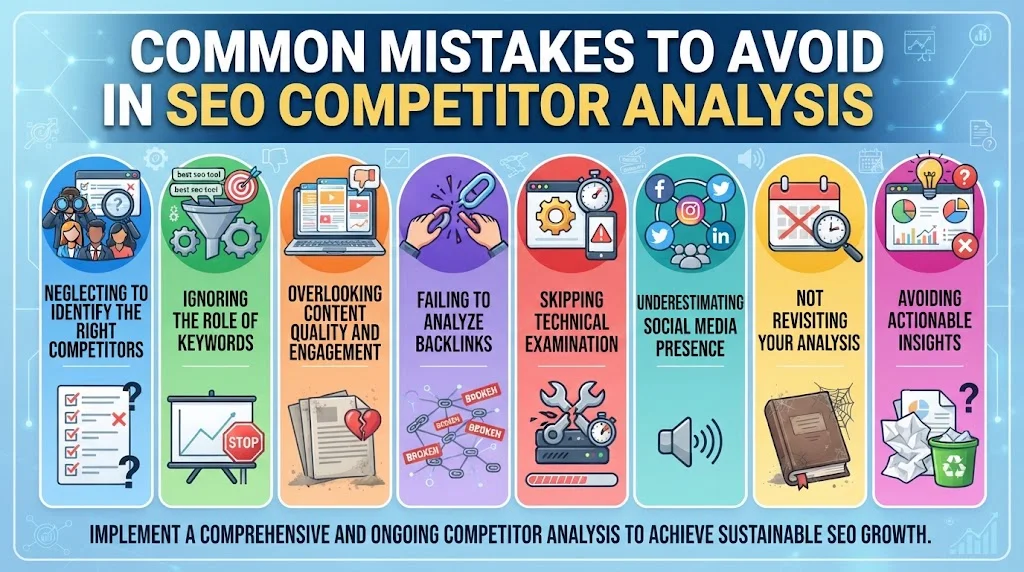
When embarking on your journey in SEO competitor analysis, steering clear of common pitfalls can set you on a path to success. Understanding your competition is essential for improving your own online presence and performance. Here are key mistakes to avoid that can hinder your efforts.
Neglecting to Identify the Right Competitors
A common mistake is failing to select the right competitors to analyze. It’s essential to distinguish between direct and indirect competitors. Direct competitors sell similar products or services and target the same audience, while indirect competitors may offer alternatives. Knowing who to analyze is the first step in conducting a meaningful competitor analysis. Ensure you create a list of at least five primary competitors within your niche.
Ignoring the Role of Keywords
Another misstep is neglecting keywords during your analysis. Competitor insights into their keyword strategy can reveal valuable information. Analyze the keywords that drive traffic to their websites and determine which ones you could also target. Tools like Moz and Ahrefs can help you with this research. Look for keywords with a balance between search volume and competition to maximize your efforts.
Overlooking Content Quality and Engagement
Focusing solely on traffic numbers without considering content quality is a big mistake. Pay attention to the type of content your competitors produce, including blog posts, videos, and infographics. Evaluate their audience engagement levels through likes, shares, and comments. This can help you understand what resonates with the audience and how to refine your content strategy. Ensure you ask questions such as:
- What topics do they cover?
- What formats do they prefer?
- How often do they publish new content?
Failing to Analyze Backlinks
Backlinks are vital for SEO success, yet many novices overlook them. Competitors’ backlinks can provide insights into their SEO tactics. Use tools like SEMrush to analyze which sites link to your competitors. By understanding their link-building strategies, you can identify potential opportunities to earn backlinks for your own site.
Skipping Technical SEO Examination
Another frequent oversight is not delving into technical SEO aspects. Check your competitors’ site structures, page load speeds, and mobile responsiveness. Tools like Google PageSpeed Insights can help here. Technical SEO can significantly impact user experience and overall performance, so be sure to benchmark your site against your competitors in this regard.
Underestimating Social Media Presence
Some often forget to include social media in their analysis. Assess how competitors engage with their audience on platforms like Facebook, Twitter, and Instagram. Review the types of posts that yield the most engagement and the frequency of their updates. Engaging effectively on social media can enhance brand recognition and drive traffic. Make a note of what strategies are working for them and consider how you can adapt those tactics for your own channels.
Not Revisiting Your Analysis
SEO is an ongoing process, and many beginners make the mistake of treating competitor analysis as a one-time task. Instead, it’s crucial to regularly revisit your analysis to keep up with changes in the market. Competitor landscapes evolve, and new industry trends emerge. Set a schedule to review your top competitors regularly to keep your strategies up to date.
Avoiding Actionable Insights
Analyzing data without deriving actionable insights is counterproductive. Ensure that you not only gather information but also develop clear strategies based on your findings. Create a plan that outlines how you will leverage your insights to improve your SEO performance. Keep your objectives SMART (Specific, Measurable, Achievable, Relevant, Time-bound).
By avoiding these common mistakes in your SEO competitor analysis, you’re more likely to enhance your online visibility and achieve your business goals. Remember, the objective is to stay informed and agile in a dynamic digital landscape. For further reading and resources, you might find sites like Search Engine Journal and Backlinko useful.
Conclusion
Mastering SEO competitor analysis is crucial for anyone looking to bolster their online presence. By implementing the essential techniques outlined in this guide, you can identify not only who your competitors are but also how they rank in the digital landscape. Focusing on key metrics allows you to measure success and pinpoints areas for improvement effectively.
Utilizing the right tools simplifies the research process and gives you access to invaluable insights. Various resources can streamline your efforts, making it easier to gather and analyze data that informs your strategies. Remember, insights from your competitors can provide a roadmap for your SEO success. By leveraging what works for others, you create a powerful strategy that sets you apart from the competition.
However, it’s vital to avoid common pitfalls in SEO competitor analysis. Relying too heavily on one metric or overlooking potential competitors can hinder your progress. Consistent evaluation and adaptability are essential in this ever-evolving field. Continue to refine your approach as you learn more about the industry standards and shifts in SEO practices.
As you embark on your SEO journey, keep these strategies and tips at the forefront of your mind. Regularly revisiting these techniques ensures you stay updated and responsive to changes. With a proactive mindset and a solid understanding of competitor analysis, you’ll be well-equipped to enhance your SEO efforts and achieve greater online visibility.