
SEO Best Practices for Ecommerce Websites


ATTENTION: Want to Learn Affiliate Marketing from Successful Affiliates?
To thrive in the competitive world of online retail, understanding SEO is crucial for ecommerce websites. Implementing SEO Best Practices for Ecommerce Websites helps improve visibility in search engine results, drawing more visitors to your site and ultimately boosting sales. Below are vital techniques to enhance your ecommerce SEO strategy.
Keyword Research
Identifying the right keywords is the first crucial step. Here’s how to do it effectively:
- Use tools like Moz or Ahrefs to find high-traffic keywords.
- Consider long-tail keywords that reflect specific buyer intent.
- Analyze competitors to discover which keywords they rank for and identify opportunities.
Optimizing Product Pages
Your product pages should be your primary focus. Here are vital elements to optimize:
- Title Tags: Include primary keywords and maintain a clear structure to attract clicks.
- Product Descriptions: Craft unique, descriptive content that includes relevant keywords while providing helpful information about the product.
- Image Optimization: Use high-quality images and optimize file names and alt tags with descriptive keywords.
Example:
| Element | Best Practice |
|---|---|
| Title Tags | Include key products and primary keywords |
| Meta Descriptions | Use compelling copy with a call-to-action and secondary keywords |
| Headings | Use H3 or H4 for subcategories under your product descriptions |
Technical SEO
A strong technical foundation is essential for an ecommerce site. Key areas to focus on include:
- Site Speed: Ensure fast loading times. Consider tools like Google PageSpeed Insights to check your speed.
- Mobile Optimization: With a growing number of users shopping on mobile, it’s vital your site is responsive.
- Secure Website: Implement SSL certificates for security, making your site HTTPS compliant for trust and ranking benefits.
User Experience & Engagement
Search engines prioritize sites that offer a good user experience. Here’s how to enhance it:
- Implement easy navigation, classifying products clearly.
- Encourage product reviews, as they can improve search rankings and increase buyer confidence.
- Create engaging and informative content such as blog posts, FAQs, and guides related to your products.
Building Backlinks
Backlinks are crucial for establishing credibility and authority in your niche. Consider these strategies:
- Collaborate with influential bloggers and industry-specific websites to share your products.
- Utilize guest blogging to present valuable content and links back to your ecommerce site.
- Participate in forums and social media discussions, providing insights and linking back to your site where relevant.
Tracking and Analytics
Use analytics to monitor the effectiveness of your SEO efforts:
- Implement Google Analytics to track visitor behavior and sales conversion rates.
- Set up goals and conversion tracking to see how well your strategies are performing.
- Utilize Google Search Console to monitor site performance and issues.
By focusing on SEO Best Practices for Ecommerce Websites, you can enhance your ecommerce website’s visibility, drive traffic, and ultimately increase sales.
The Role of Keyword Research in Ecommerce SEO
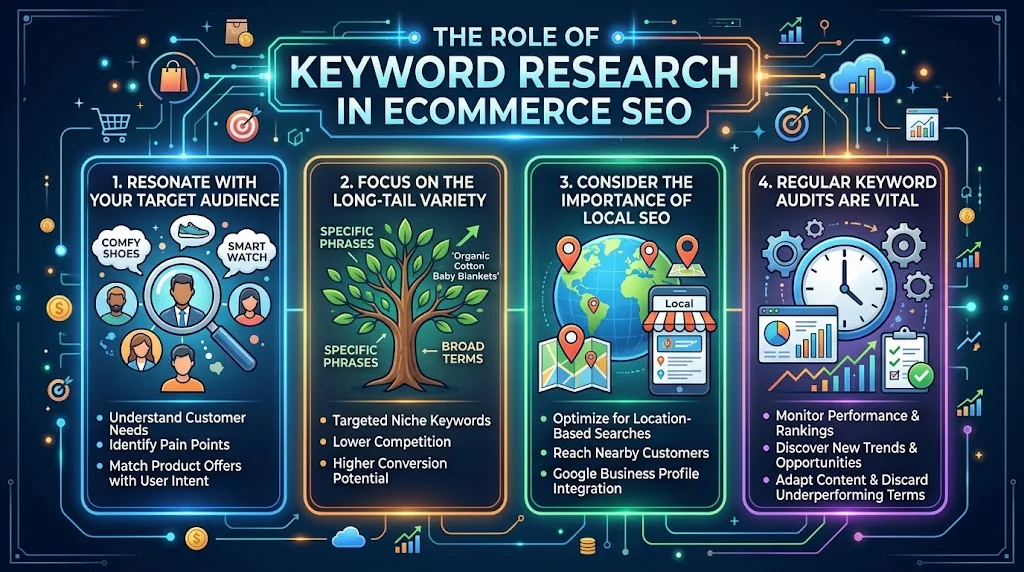
In the world of ecommerce, keyword research holds a critical position in ensuring your online store achieves visibility and attracts potential buyers. Understanding what your customers are searching for is the cornerstone of any successful SEO strategy. By accurately identifying and utilizing relevant keywords, you can drive traffic, enhance user experience, and ultimately boost sales.
Resonate with your target audience
To get started, it’s essential to know where to look for keywords that resonate with your target audience. One of the first steps in effective keyword research is leveraging tools designed specifically for this purpose. Tools like Moz, Ahrefs, and SEMrush provide insights into search volume, competition, and keyword trends. These insights enable you to make informed decisions about which keywords to target in your ecommerce content.
Focus on the long-tail variety
When selecting keywords, focus on the long-tail variety. Long-tail keywords are longer phrases that are more specific and often have lower competition. For example, instead of targeting a broad keyword like “shoes,” you could aim for a more detailed phrase such as “women’s running shoes for flat feet.” This specificity not only helps in ranking higher due to reduced competition but also attracts a more targeted audience.
Remember to keep user intent at the forefront. There are primarily three types of search intent:
- Informational: Users searching for information (e.g., “how to choose running shoes”).
- Navigational: Users looking for a specific website or brand.
- Transactional: Users ready to make a purchase (e.g., “buy women’s running shoes online”).
Understanding these intents will help you craft more effective content that aligns with what users are really looking for.
Placing these keywords strategically throughout your ecommerce site is where the magic happens. Focus on the following areas:
- Product Titles: Ensure that your product titles are both appealing and embedded with important keywords.
- Product Descriptions: Write unique and engaging descriptions that naturally include your target keywords while providing valuable information to consumers.
- Meta Descriptions: Utilize keywords in your meta descriptions to improve click-through rates from search engine result pages.
- Image Alt Text: Use descriptive alt text with keywords for your product images to enhance visibility in image searches.
Consider the importance of local SEO
Also, consider the importance of local SEO. If your ecommerce business serves local customers, use location-based keywords. This includes phrases like “best running shoes near me” or “local shoe store in [Your City].” Local keywords can elevate your visibility among nearby shoppers.
Regular keyword audits are vital
Furthermore, regular keyword audits are vital. Trends and consumer behavior change; thus, what worked last month may not be as effective now. Set aside time to review your keywords periodically, using tools to track performance. Look for new keywords to incorporate and discard ones that are underperforming.
Table: Sample Keyword Research Insights
| Keyword | Search Volume | Competition |
|---|---|---|
| buy women’s running shoes online | 2,400 | Medium |
| best running shoes for flat feet | 1,600 | High |
| affordable running shoes | 1,200 | Low |
Don’t underestimate the value of content marketing in conjunction with keyword research. Create blog posts, buying guides, and how-to articles using the identified keywords. This will not only drive organic traffic but also position your ecommerce site as an authority in your niche. For example, you can write articles like “The Ultimate Guide to Choosing the Right Running Shoes” and embed your selected keywords throughout.
Keyword research is an integral part of ecommerce SEO. By understanding your market, selecting the right keywords, and optimizing your site accordingly, you can significantly improve your search rankings and attract the right customers to your store. Invest in this process now, and watch your ecommerce business flourish.
Optimizing Product Pages for Better Search Visibility
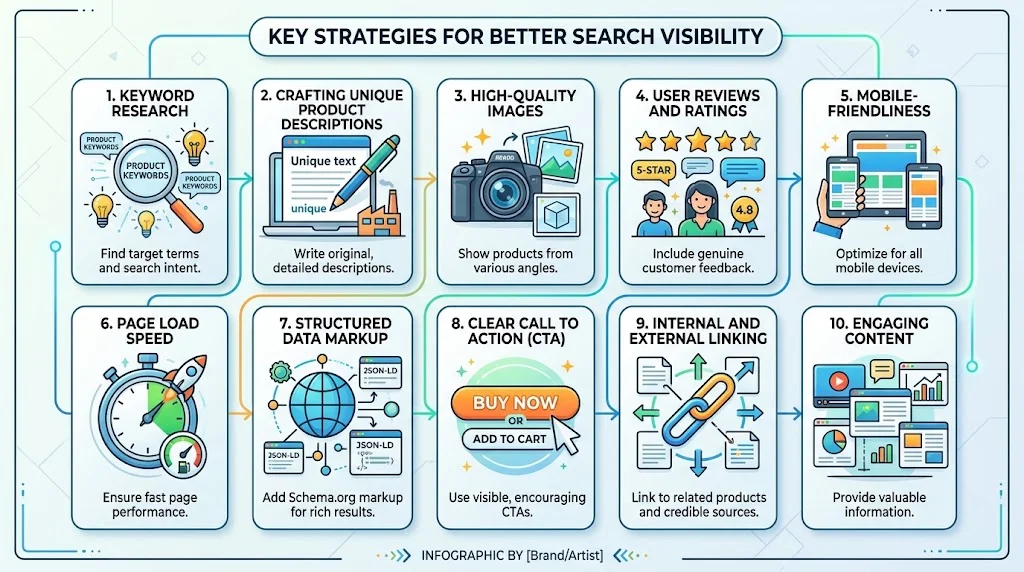
To ensure your eCommerce website stands out in today’s competitive online landscape, optimizing product pages for better search visibility is crucial. Applying specific strategies can make your products not just seen, but also compelling to potential customers. Here are some essential techniques to enhance your product pages and boost your chances of ranking higher in search results.
Keyword Research
The first step in optimization is conducting thorough keyword research. Identify relevant keywords that potential customers use when searching for products like yours. Incorporate these keywords naturally into your product titles, descriptions, and meta tags. Aim for a mix of short-tail and long-tail keywords to reach a broader audience.
Crafting Unique Product Descriptions
Each product needs a unique description that distinctly conveys its benefits. Rather than copying manufacturer descriptions, write your own with the target customer in mind. Highlight key features, specifications, and how the product solves a problem or meets a need. Search engines favor original content, which plays a vital role in enhancing visibility.
High-Quality Images
Images are pivotal in eCommerce. Utilize high-resolution images to showcase your products effectively. Include multiple images from different angles, zoomed-in shots, and even images that depict the product in use. Don’t forget to optimize your images by using descriptive file names and adding alt text. The alt text should include relevant keywords to provide context to search engines and improve accessibility.
User Reviews and Ratings
Encouraging customers to leave reviews not only enhances credibility but can also impact SEO positively. Search engines often prioritize pages with user-generated content. Displaying ratings and reviews can lead to richer snippets in search results, making your pages more attractive to potential buyers.
Mobile-Friendliness
With the growing number of users shopping on mobile devices, ensuring your product pages are mobile-friendly is non-negotiable. A responsive design that adjusts to different screen sizes provides a seamless experience. Google’s mobile-first indexing means it evaluates the mobile version of your website primarily, so don’t overlook this aspect.
Page Load Speed
Fast-loading pages improve user experience and boost SEO. Aim for a load time of under three seconds. Use tools like Google PageSpeed Insights to analyze your page speed and identify areas for improvement. Compress images, use browser caching, and consider a Content Delivery Network (CDN) to enhance load times.
Structured Data Markup
Implement structured data markup (Schema.org) to help search engines understand your product information better. This markup can assist in displaying rich snippets, such as product availability, price, and reviews directly in the search results. Having structured data can significantly improve click-through rates.
Clear Call to Action (CTA)
Every product page should feature a clear and compelling CTA. Whether it’s “Add to Cart,” “Buy Now,” or “See More,” guide users toward action. Make your CTAs stand out visually with contrasting colors and persuasive language.
Internal and External Linking
Linking is a powerful tool for SEO. Internally, link related products, categories, or guides to keep visitors exploring your site. Externally, link to high-authority sources for additional information or to validate claims about your products. This strategy not only builds authority but also nurtures a better user experience.
Engaging Content
Consider adding articles, how-to guides, or videos relevant to your products. Engaging content can boost the time users spend on your page, thus signaling to search engines that your page is valuable. Additionally, it provides an opportunity to use more keywords related to your product.
By implementing these strategies, you can optimize your product pages effectively for better search visibility. Pay attention to your customers’ needs and preferences, ensuring every aspect of your product pages resonates with them. For further reading, you can access resources such as Ahrefs’ blog on eCommerce SEO.
The Impact of Mobile Optimization on Ecommerce Performance
In today’s digital landscape, mobile optimization is not just a trend; it’s a necessity for ecommerce businesses. With an increasing number of shoppers using their smartphones and tablets to make purchases, online retailers must prioritize mobile-friendly experiences. The impact of mobile optimization on ecommerce performance can make or break a business in a competitive marketplace.
Why Mobile Optimization Matters
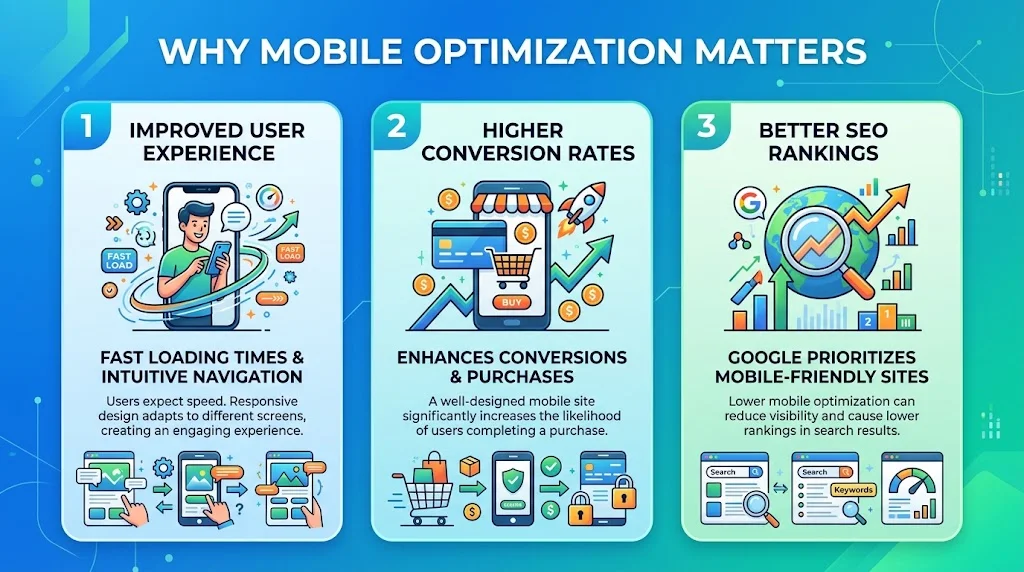
Studies show that more than 50% of online shopping is done via mobile devices. This staggering statistic highlights the importance of creating a seamless mobile experience. When consumers encounter a poorly optimized mobile site, they are more likely to abandon their shopping carts. Here are some reasons why mobile optimization is essential:
- Improved User Experience: Users expect fast loading times and intuitive navigation. A responsive design ensures your site adapts to different screens, creating an engaging experience.
- Higher Conversion Rates: Optimizing for mobile enhances the chances of conversions. A well-designed mobile site can significantly increase the likelihood of users completing a purchase.
- Better SEO Rankings: Google prioritizes mobile-friendly sites in search results. If your ecommerce site isn’t optimized for mobile, it may rank lower, reducing visibility to potential customers.
Key Elements of Mobile Optimization
To effectively enhance your mobile ecommerce site, consider incorporating the following elements:
- Responsive Design: This allows your site to adjust seamlessly to different screen sizes and resolutions, ensuring all users have an optimal experience.
- Fast Loading Speeds: Mobile users expect quick access to content. Use tools like Google PageSpeed Insights to analyze and improve your site speed.
- Simple Navigation: A clean, easy-to-use menu helps users find what they need without frustration. Implement a hamburger menu or simplified categories for mobile users.
- Touch-Friendly Elements: Ensure buttons and links are large enough and spaced out to accommodate finger taps, making navigation easier on smaller screens.
- Mobile-Friendly Checkout: Streamline the checkout process. Offer guest checkout options and minimize the number of fields to simplify transactions.
Analytics and Performance Tracking
It’s vital to track the performance of your mobile ecommerce site. Use tools like Google Analytics to measure mobile traffic, bounce rates, and conversion rates. By analyzing this data, you can make informed decisions to enhance your mobile strategy. Here’s a simplified overview of metrics to monitor:
| Metric | Importance |
|---|---|
| Mobile Traffic | Indicates the percentage of your visitors coming from mobile devices. |
| Bounce Rate | Tracks how many users leave after viewing only one page, signaling potential usability issues. |
| Conversion Rate | Measures the percentage of mobile visitors who complete a purchase. |
Understanding these metrics will help you pinpoint areas for improvement. For instance, if you notice a high bounce rate, consider optimizing your landing pages or improving page load speeds.
Best Practices for Mobile Optimization
To maximize the benefits of mobile optimization, here are some best practices your ecommerce site should follow:
- Optimize Images: Reduce image sizes without sacrificing quality to enhance loading times.
- Use Mobile-Specific Buttons: Design buttons that are easy to click and distinctly visible on mobile screens.
- Implement Active Content: Engage users with videos or interactive elements that work effectively on mobile.
- Regularly Test Mobile Usability: Use tools like Google’s Mobile-Friendly Test to identify improvements.
These strategies will improve your ecommerce performance while ensuring a more pleasant shopping experience for mobile users. As you invest in mobile optimization, monitor how these changes positively affect user engagement and sales.
For more insights into mobile optimization and ecommerce, consider exploring resources from Shopify and Moz.
Staying abreast of best practices will empower you to refine your strategies continually and maintain a competitive edge.
Utilizing Content Marketing to Drive Traffic to Your Online Store
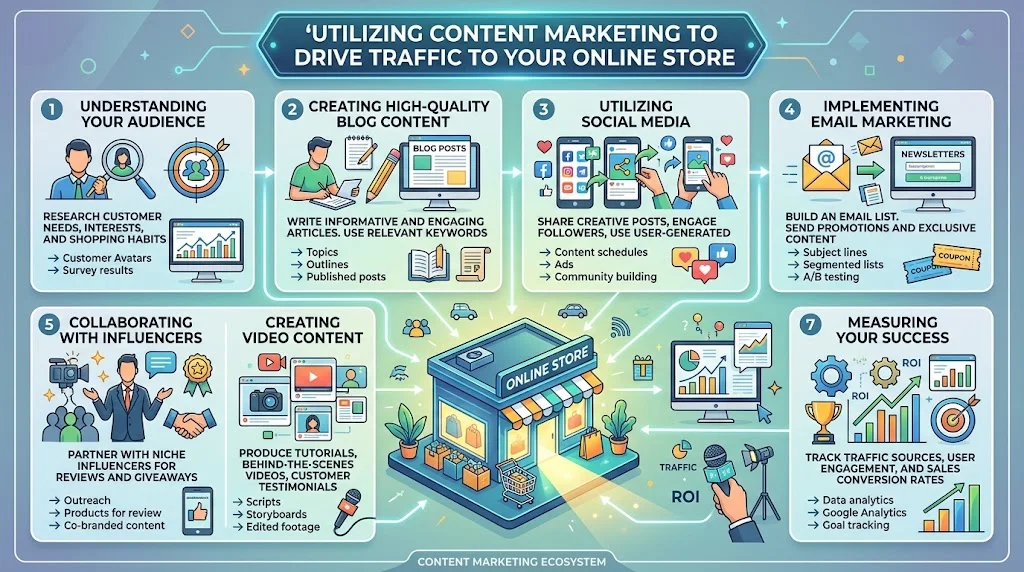
In today’s digital landscape, utilizing content marketing effectively can significantly boost traffic to your online store. By creating engaging, valuable content, you can attract potential customers, build brand loyalty, and ultimately drive sales. Here are some advanced strategies to enhance your content marketing efforts and draw traffic to your ecommerce website.
Understanding Your Audience
To create content that resonates, start by understanding your audience well. Research their interests, challenges, and shopping habits. Tools like Google Analytics and customer surveys can provide valuable insights. This allows you to tailor your content to meet the specific needs of your audience.
Creating High-Quality Blog Content
Blog posts can boost your website’s SEO and draw in organic traffic. Aim for topics that align with your products. For example, if you sell beauty products, consider writing posts about makeup tips or skincare routines. Make sure your content is:
- Informative and well-researched
- Engaging and easy to read
- Optimized for keywords without keyword stuffing
Using visuals like images or infographics can enhance the reader’s experience. For optimal SEO benefits, ensure that your images include alt tags with relevant keywords.
Utilizing Social Media
Social media platforms are powerful channels for content distribution. Share your blog posts, creative graphics, and interactive content on platforms like Facebook, Instagram, and Twitter. Each platform has its unique audience, so tailor your content accordingly. Here’s how to maximize your social media impact:
- Engage with your followers: Respond to comments and messages to build a community.
- Use social media ads: Promote your best posts to reach a wider audience.
- Incorporate user-generated content: Encourage customers to share their experiences with your products and repost them.
Implementing Email Marketing
Email marketing remains an effective way to drive traffic. Build an email list by offering special deals or free resources in exchange for subscribers’ contact information. Send regular newsletters featuring:
- Latest blog articles
- Promotions and discounts
- Exclusive news about new product launches
Make sure to personalize the emails to enhance engagement. Segment your list based on customer behavior to ensure you’re sending relevant content.
Collaborating with Influencers
Partnering with influencers in your niche can help expand your reach. Influencers already have an established audience that trusts their recommendations. You can:
- Send free samples of your products in exchange for reviews.
- Collaborate on giveaways to generate excitement.
- Request them to write guest blogs on your website.
Seek out influencers whose values align with your brand for the best results.
Creating Video Content
Video content is increasingly becoming a preferred medium for many customers. Consider integrating videos into your content marketing strategy. You could create:
- Tutorials showcasing product uses
- Behind-the-scenes videos of your production process
- Customer testimonials
Promote your video content on platforms like YouTube, or embed it on your website to keep visitors engaged longer, which is beneficial for SEO.
Measuring Your Success
Tracking and measuring the effectiveness of your content marketing efforts is crucial. Use tools like Google Analytics to monitor traffic sources, user engagement, and conversion rates. Analyze which pieces of content perform well and adapt your strategy accordingly.
With these strategies, you’re well on your way to utilizing content marketing to effectively drive traffic to your online store. For more tips and tools related to content marketing, consider visiting Moz or HubSpot as valuable resources.
Conclusion
Implementing SEO Best Practices for Ecommerce Websites is crucial for driving traffic, enhancing visibility, and ultimately increasing sales. By prioritizing keyword research, you can uncover the terms your potential buyers are using and tailor your product descriptions and blog content accordingly. This strategy not only improves your site’s relevance in search results but also helps you connect with your audience.
Optimizing product pages is another vital step. Focus on high-quality images, detailed descriptions, and compelling calls to action. All these elements must work together to enrich the user experience and encourage purchases. Furthermore, do not overlook the importance of mobile optimization. With more shoppers using mobile devices, ensuring your website performs seamlessly across all screens can significantly impact your conversion rates.
Additionally, integrating content marketing into your strategy can effectively drive traffic to your online store. Whether through engaging blog posts, videos, or infographics, valuable content helps establish your brand as an authority in your niche while attracting potential customers to your site.
Ultimately, a holistic approach that blends keyword research, page optimization, mobile responsiveness, and robust content marketing can pave the way for ecommerce success. Stay informed about evolving SEO trends and continuously refine your strategies to keep your online store competitive. By focusing on the needs and behaviors of your customers, you position your business to thrive in the ever-competitive ecommerce landscape.