
Keyword Research Methods for Bloggers


ATTENTION: Want to Learn Affiliate Marketing from Successful Affiliates?
Stop guessing what your readers type into Google. Start writing for the words they’re already searching.
Here’s an uncomfortable truth: you could write the most beautifully crafted blog post of your life, pour your heart into every sentence, and still watch it disappear into the void of page seven on Google. Not because your writing is bad. Not because your ideas aren’t valuable. But because nobody is searching for the exact words you used to describe them.
That’s what keyword research fixes. It’s the bridge between what you want to say and what people are actually typing into search bars at 11pm, half-asleep, desperately looking for an answer only you can give them. Master this skill, and you stop shouting into an empty room. You start showing up exactly when someone needs you, with exactly the words they were hoping to find.
This guide walks through the real, practical methods bloggers use to find keywords that bring in traffic that converts, not just traffic that bounces. We’ll cover the free tools worth your time, the mindset shifts that separate hobby bloggers from six-figure ones, and the small but critical details most “beginner guides” leave out entirely. No fluff, no recycled advice you’ve read a hundred times before. Let’s dig in.
Why Keyword Research Is the Backbone of Every Successful Blog
Before jumping into tools and tactics, it’s worth understanding why this matters so much. Keyword research isn’t just an SEO checkbox you tick before hitting publish. It’s market research, disguised as a technical task. It tells you, in the searcher’s own words, what they’re struggling with, what they’re curious about, and what they’re ready to buy, all without you having to run a single survey or focus group.
Think about it this way: every search query is a tiny confession. Someone typing “why does my sourdough starter smell like nail polish” is telling you exactly what’s keeping them up at night. If your blog answers that question better than anyone else on the internet, you win their trust, their time, and often their email address or their wallet. Multiply that by hundreds of searches a month, and you start to see why bloggers who take this seriously grow faster than those who simply write about whatever crosses their mind that day.
There’s also a compounding effect that new bloggers rarely appreciate until they’ve experienced it firsthand. A single well-researched, well-targeted post can continue pulling in readers two, three, even five years after you hit publish, long after you’ve forgotten you wrote it. That’s the quiet magic of ranking for the right keyword: it turns one afternoon of writing into a permanently working asset.
- It removes the guesswork from content planning, so you’re never staring at a blank page wondering what on earth to write next.
- It reveals search intent, helping you match the format and tone readers actually expect, whether that’s a quick listicle or a deep, thorough tutorial.
- It uncovers content gaps your competitors haven’t filled yet, giving you an easier, faster path to ranking on page one.
- It compounds over time, meaning a single well-researched post can keep bringing in traffic for years, not days.
- It builds real audience empathy, since you start writing from the reader’s actual vocabulary instead of your own internal jargon.
Now let’s get into the actual methods, one layer at a time.
Start With Seed Keywords: The Foundation of Everything
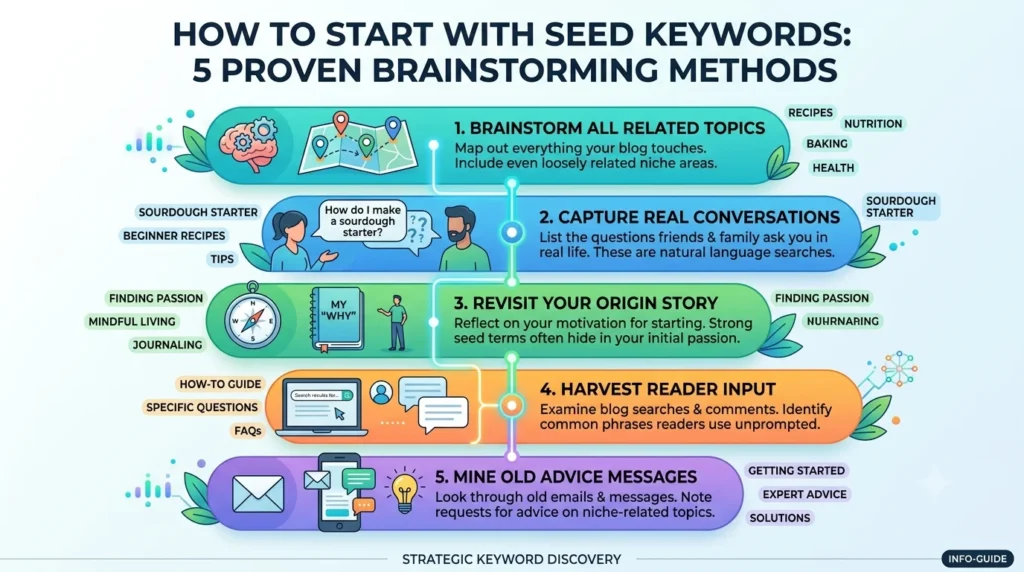
Every keyword strategy begins with a handful of broad, simple terms called seed keywords. These are the general topics your blog is about, stripped of any specificity or nuance. If you run a personal finance blog, your seeds might be “budgeting,” “credit cards,” “side hustles,” or “investing for beginners.” If you run a food blog, they might be “meal prep,” “baking,” or “gluten-free recipes.”
Seed keywords aren’t meant to be used as-is in your titles or headlines. They’re starting points, the raw ore you’ll refine into something sharper and more specific later on. The trick is thinking like your reader in this early stage, not like a marketer trying to sound clever or professional.
Most bloggers rush through this stage, jotting down two or three obvious terms and moving straight to a tool. That’s a mistake. The wider and more thoughtful your seed list, the richer everything downstream becomes, because every method that follows is essentially built on top of these initial words.
- Brainstorm every topic your blog touches, even loosely related ones you rarely write about.
- Write down the questions your friends or family ask you about your niche in real conversation.
- Revisit your own “why” for starting the blog. That origin story usually hides several strong seed terms.
- Check your blog’s search bar or comments section for recurring phrases readers already use unprompted.
- Look through old emails or messages where someone asked you for advice related to your niche.
Once you have a list of ten to twenty seeds, you’re ready to expand them into something far more valuable using the tools and methods below.
Mine Google’s Own Suggestions (They’re Free and Brutally Honest)
Google spends billions of dollars every year understanding what people search for, and it quietly hands you a slice of that data for free if you know where to look. This is, without exaggeration, one of the most underused resources in a blogger’s toolkit.
Autocomplete: The Underrated Goldmine
Type a seed keyword into the Google search bar and pause before hitting enter. The dropdown suggestions that appear aren’t random or arbitrary. They reflect real, frequently searched queries related to your topic, pulled directly from millions of actual searches. This is one of the fastest, simplest ways to find long-tail keywords that carry genuine search demand without paying for a single tool.
People Also Ask
Scroll partway down any results page and you’ll spot the “People Also Ask” box. Click one question and it expands, revealing more questions underneath, which then reveal even more when clicked. This creates an almost endless rabbit hole of exactly what your audience wants answered, often phrased in their own casual, natural language rather than stiff industry terms.
Related Searches
At the very bottom of every results page sits a section of related searches. These are adjacent topics Google associates closely with your original query, perfect for spinning off related blog posts or building out a full topic cluster around one central idea.
Search Bar on Mobile vs Desktop
It’s easy to forget that autocomplete suggestions can differ meaningfully between mobile and desktop searches. Voice search and on-the-go queries tend to be more conversational, while desktop searches skew slightly more formal. Checking both gives you a more complete, realistic picture of how real people phrase things.
- Search your seed keyword and jot down every autocomplete suggestion that appears.
- Expand at least five “People Also Ask” questions per topic before moving on.
- Scroll all the way to the bottom of the results page every single time. Don’t skip it.
- Repeat this process across different devices, since mobile and desktop suggestions sometimes differ in subtle but useful ways.
- Save your findings in a running spreadsheet so patterns become visible over time.
Use Free Keyword Tools Built for Bloggers on a Budget
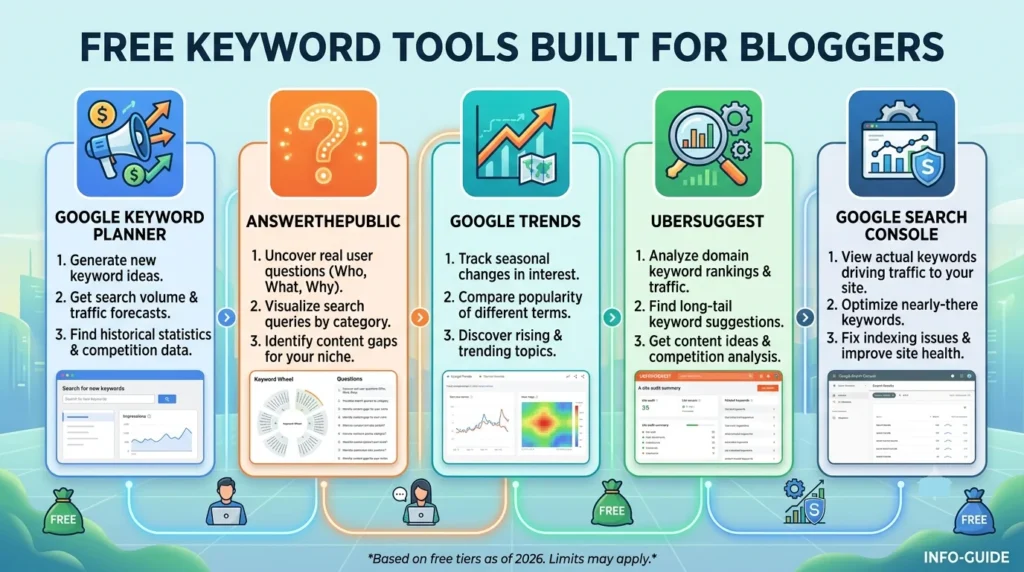
You don’t need an expensive subscription to start finding solid keywords. Several free tools give you real search volume and competition data, more than enough to build a strong content calendar without spending a single cent, especially in your first year of blogging.
Google Keyword Planner
Originally built for advertisers, this tool is still one of the most reliable sources of search volume data straight from Google itself. Create a free Google Ads account, you don’t need to run any actual ads, and you’ll get access to monthly search volume ranges along with dozens of related keyword ideas for any seed term you enter.
AnswerThePublic
This tool visualizes questions, prepositions, and comparisons people search around your seed keyword in a colorful, easy-to-scan format. It’s especially good for finding conversational, question-based phrases that make for perfect blog titles and FAQ sections readers actually search for.
Google Trends
Trends won’t give you exact search volume numbers, but it shows you the trajectory of interest over time in a clean, visual graph. This is essential for avoiding keywords that are quietly fading in popularity and for catching rising topics before your competitors even notice them.
Ubersuggest
A generous free tier that shows search volume, SEO difficulty, and content ideas based on the top-ranking pages for any keyword you type in, along with a rough traffic estimate for each competing article.
Google Search Console
If your blog is even a few months old, Search Console is quietly sitting on a goldmine of data you already own. It shows you the exact queries people used to find your existing posts, including ones you’re already ranking for on page two or three that could be pushed to page one with a bit of extra optimization.
- Combine at least three free tools rather than relying on just one, since each one surfaces slightly different data.
- Export your findings into a spreadsheet so you can compare search volume and difficulty side by side at a glance.
- Look for seasonal patterns in Google Trends before committing to a big content push around a specific topic.
- Check Search Console monthly for existing posts that are close to ranking on page one and could use a light refresh.
Study Your Competitors’ Keywords (Ethically, of Course)
Your competitors have already done a meaningful chunk of the research for you, whether they meant to or not. Every ranking blog post out there is a signal that a keyword has genuine demand and is realistically achievable to rank for, given enough effort and the right angle.
Open a handful of top-performing blogs in your niche and pay close attention to their headlines, subheadings, and the exact phrases they repeat throughout their content. Paid tools like Ahrefs and SEMrush let you plug in a competitor’s URL and instantly see which keywords are sending them traffic, along with estimated monthly search volume for each individual term.
Even without a paid tool, simply reading their content critically teaches you a lot. Notice which topics they’ve covered exhaustively and which they’ve only mentioned in passing. Those lightly touched topics are often your easiest opportunity, since you can go deeper and become the more complete, more useful resource on that exact subject.
- Identify three to five blogs that consistently outrank you or serve a very similar audience.
- Note recurring themes across their best-performing posts, not just a single lucky article.
- Look for keywords they rank for on page two or three of Google. Those are often easier opportunities you can beat them to on page one.
- Read their comment sections closely; readers often ask follow-up questions the post itself never answered.
- Never copy their content directly. Use their keyword choices purely as inspiration, then write something more useful, more current, or simply more thorough.
Chase Long-Tail Keywords for Faster, Easier Wins
New bloggers often make the mistake of targeting broad, high-volume keywords like “healthy recipes” or “make money online.” These terms are dominated by massive, established sites with years, sometimes decades, of authority behind them. Competing directly against them early on is like arm-wrestling a giant before you’ve had breakfast.
Long-tail keywords are longer, more specific phrases with lower search volume but dramatically less competition and often much higher purchase or engagement intent. Someone searching “healthy recipes” could want anything under the sun. Someone searching “healthy 20-minute dinner recipes for picky toddlers” knows exactly what they need, and if your post delivers, they’ll trust you almost instantly.
- Long-tail phrases typically contain four or more words strung together.
- They convert better because the searcher’s intent is crystal clear from the phrasing alone.
- They’re far easier to rank for, especially on newer blogs with limited domain authority so far.
- Stacking dozens of long-tail posts around one central topic gradually builds topical authority that eventually helps you rank for the broader term too.
- They tend to generate more genuine engagement, since readers feel like the post was written specifically for them.
A blog that dominates fifty specific, targeted searches will almost always outperform one chasing a single broad term nobody realistically wins in their first year.
Understand Search Intent Before You Write a Single Word
Finding a keyword with decent search volume means very little if you misjudge why people are actually searching it. This is where search intent comes in, and it’s arguably more important than volume or difficulty scores combined, because it determines whether your content even has a chance of ranking at all.
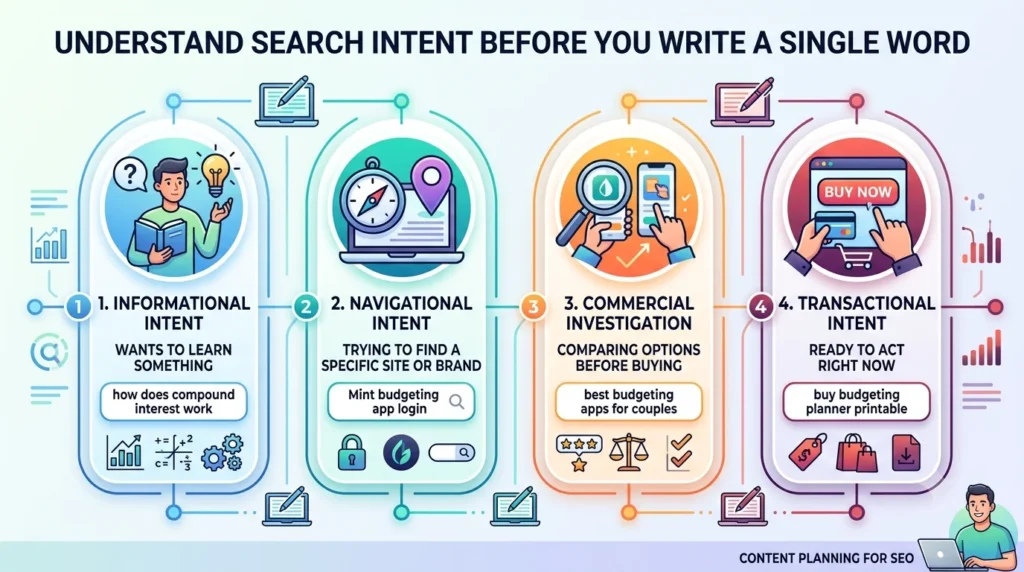
There are four broad types of intent behind almost every search query:
- Informational, where the searcher wants to learn something, like “how does compound interest work.”
- Navigational, where the searcher is trying to find a specific site or brand, like “Mint budgeting app login.”
- Commercial investigation, where the searcher is comparing options before buying, like “best budgeting apps for couples.”
- Transactional, where the searcher is ready to act right now, like “buy budgeting planner printable.”
Before writing anything at all, Google your target keyword yourself and study what’s already ranking on that first page. If the top ten results are all product pages and yours is meant to be a personal essay, you’re fighting an uphill, likely unwinnable battle no matter how well you write. Match the format Google has already decided the audience wants, whether that’s a list, a guide, a comparison table, or a product page.
Group Keywords Into Content Clusters, Not Isolated Posts
Random, disconnected blog posts rarely build lasting authority on their own. The most successful bloggers organize their keyword research into clusters, a central “pillar” post covering a broad topic in depth, surrounded by several supporting posts that each target a specific long-tail variation and link back to that pillar.
- Choose one broad seed keyword to serve as your pillar topic for a given cluster.
- List every related long-tail keyword you’ve collected so far and group them by subtopic.
- Write one comprehensive pillar post first, then create individual posts for each subtopic underneath it.
- Interlink everything generously between posts; this signals real topical depth to search engines and keeps readers browsing longer on your site.
- Update the pillar post periodically to reflect new supporting content as your cluster grows.
This structure doesn’t just help with SEO rankings. It genuinely helps readers navigate deeper into your site instead of leaving after a single article, which improves engagement metrics search engines already care about.
Evaluate Keyword Difficulty Honestly
It’s tempting to chase keywords with huge search volume, but volume without a realistic shot at ranking is a trap that quietly wastes months of writing effort. Keyword difficulty scores, available in tools like Ahrefs, SEMrush, Moz, or Ubersuggest, estimate how hard it will be to rank for a given term based on the existing authority of sites currently occupying page one.
- New or smaller blogs should generally target keywords with low to moderate difficulty scores.
- Check who’s actually ranking, not just the numerical score alone. If page one is full of massive news outlets, skip it regardless of what the tool says.
- Balance difficulty against search volume; a moderately difficult keyword with strong volume often beats an extremely easy keyword nobody actually searches for.
- Revisit difficulty scores periodically, since competition naturally shifts as more blogs enter your niche over time.
- Don’t let a single number override common sense; sometimes a “hard” keyword is worth chasing if you have a genuinely unique angle.
Listen to Your Audience Directly
Sometimes the best keyword research doesn’t come from a tool at all. It comes from actual conversations with real, breathing people who are living the exact problem your blog addresses.
- Browse relevant subreddits and note the exact phrasing people use in their questions and comments.
- Check Facebook groups or forums tied closely to your niche for recurring frustrations.
- Read the reviews and Q&A sections on Amazon product pages related to your topic; customers reveal exactly what they’re confused about, often in vivid detail.
- Look at your own blog comments, email replies, and social media DMs for recurring questions you keep getting asked.
- Try AlsoAsked, a free tool built specifically to map out these real, human question chains visually.
- Join niche-specific Discord servers or Slack communities where people ask candid, unfiltered questions daily.
These sources often reveal keywords no automated tool will ever surface, because they capture the messy, emotional, highly specific way real people talk before they’ve learned the “correct” industry terminology for their problem.
Track, Measure, and Refine Your Keyword Strategy Over Time
Keyword research isn’t a one-and-done task you complete before launching your blog. Search behavior shifts constantly, driven by trends, seasons, algorithm updates, and simply how language evolves over time. What worked beautifully last year might quietly stop working this year without any obvious warning sign.
- Set a recurring reminder to revisit your top keywords every three to six months.
- Track which posts are climbing or falling in Google Search Console over time.
- Refresh older posts with updated statistics, examples, and newly discovered related keywords.
- Pay attention to click-through rate as well as ranking position; a high ranking with a weak title still underperforms.
- Treat your keyword spreadsheet as a living document, not a one-time deliverable you file away and forget.
Common Keyword Research Mistakes to Avoid
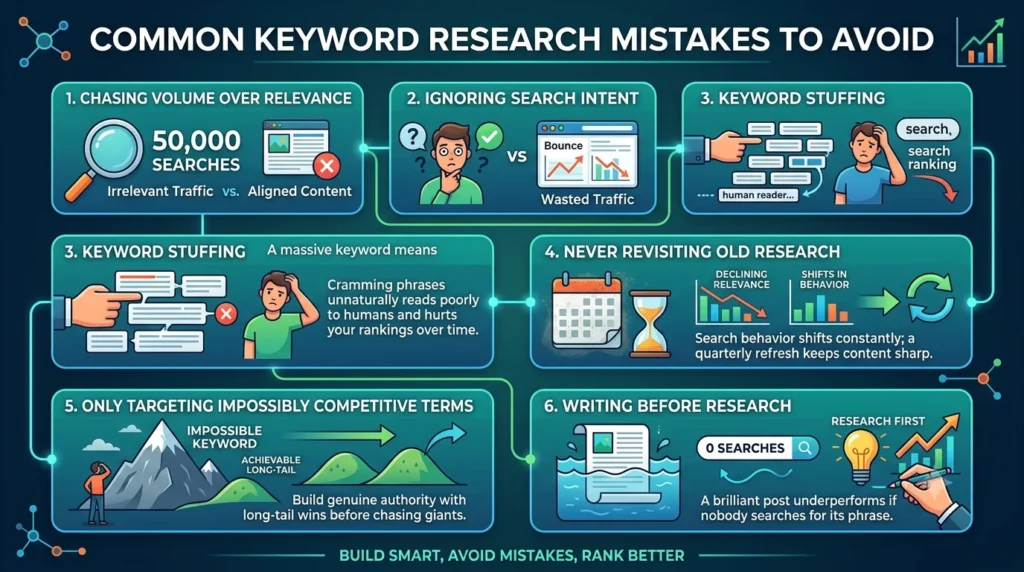
- Chasing volume over relevance. A keyword with fifty thousand searches a month means nothing if it doesn’t genuinely align with what your blog offers.
- Ignoring search intent. Ranking for a keyword you’ve misjudged leads to high bounce rates, low time on page, and wasted traffic that never converts.
- Keyword stuffing. Cramming your target phrase unnaturally into every sentence reads poorly to humans and can actively hurt rankings over time.
- Never revisiting old research. Search behavior shifts constantly; a quarterly refresh keeps your content calendar sharp and relevant.
- Only targeting impossibly competitive terms. Build genuine authority with achievable long-tail wins first before chasing the giants.
- Writing before researching. Even a brilliant post can underperform if it’s built around a phrase nobody actually searches for.
Bringing It All Together
Great keyword research isn’t a one-time task you check off before writing. It’s an ongoing conversation with your audience, one where Google’s own tools, your competitors’ visible successes, and your readers’ own unfiltered words all feed into what you create next. The bloggers who grow fastest aren’t necessarily the most talented writers in their niche. They’re the ones who genuinely understand what their audience is searching for, and who show up with the answer at exactly the right moment, in exactly the right words.
Start small. Pick one seed keyword today, run it through a couple of the free tools mentioned above, skim the “People Also Ask” box, and see what surfaces. You’ll likely walk away with enough long-tail ideas to fill your next month of content, all rooted firmly in what real people are actually typing into that search bar right now, at this very moment, hoping someone like you is out there ready to answer.
Your next step: Open Google Trends or AnswerThePublic right now and search your blog’s main topic. Write down the first five questions that surprise you. That’s your next blog post, already halfway written.