
How to Improve Website Ranking Organically

ATTENTION: Want to Learn Affiliate Marketing from Successful Affiliates?
A real-world roadmap to climbing the search results using strategy, patience, and the fundamentals Google actually rewards.
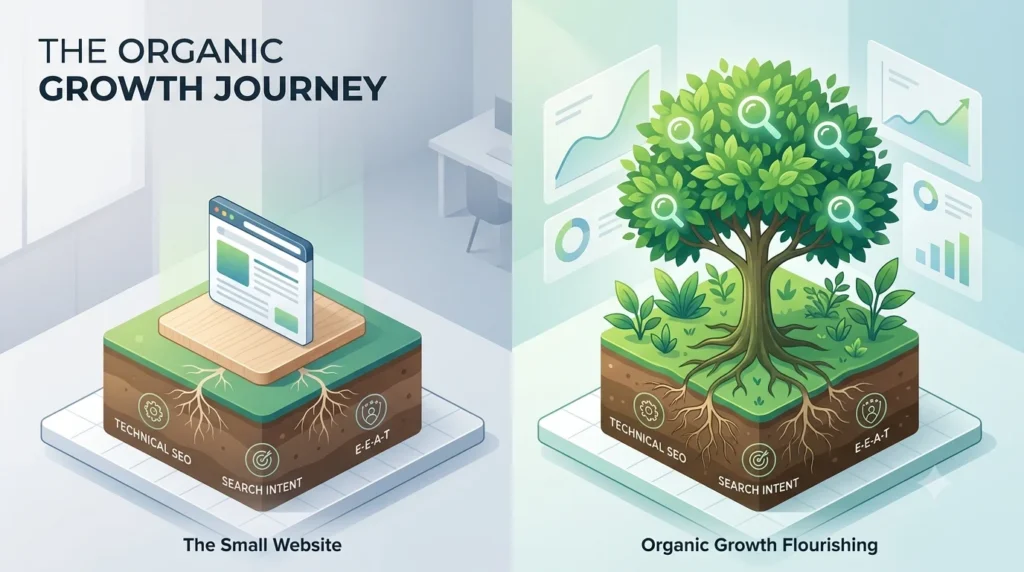
Somewhere out there, right now, someone is typing the exact question your website answers into Google — and landing on a competitor instead of you. That’s the quiet, maddening reality of the internet. It’s not that your content isn’t good enough. It’s that organic ranking is a game with very specific rules, and most websites are playing it by accident instead of on purpose.
The good news? You don’t need a massive ad budget or a team of ten to fix that. Organic search traffic rewards consistency, relevance, and technical soundness far more than it rewards deep pockets. This guide breaks down exactly what actually moves rankings in today’s search landscape — no fluff, no outdated 2015 tricks, just the strategies that genuinely work right now.
What makes organic ranking so worth the effort is how durable it is once you get it right. A page built on solid fundamentals doesn’t just rank for a week and disappear — it can sit at the top of the results for months or years, quietly bringing in visitors while you focus on other parts of the business. That kind of compounding return is rare, and it’s exactly why understanding these strategies deeply is worth the time investment.
Why Organic Ranking Still Beats Paid Traffic in the Long Run
Paid ads can get you to the top of the page in an afternoon. But the moment your budget runs out, so does your traffic. Organic SEO works differently — it compounds. A well-optimized page you publish today can keep sending visitors your way for years without another dollar spent.
- Long-term compounding value — a single ranking blog post or landing page can keep generating traffic and leads for years with minimal upkeep.
- Higher trust from users — studies consistently show searchers click organic results more than they click ads, especially for research-driven queries.
- Lower cost per acquisition over time — while SEO takes longer to pay off, the cost per visitor drops dramatically once a page ranks well.
- Compounding authority — every well-optimized page strengthens your entire domain’s credibility in the eyes of search engines, making future pages easier to rank too.
None of this means paid traffic is worthless — it just means organic search deserves to be treated as a long-term asset, not an afterthought squeezed in whenever there’s spare time.
Start With Search Intent, Not Keywords
Here’s where most websites go wrong before they’ve even published a single page: they chase keywords without understanding search intent — the actual reason someone is typing that phrase into Google in the first place.
Someone searching “best running shoes” wants a comparison. Someone searching “buy Nike running shoes size 10” wants a product page. Someone searching “how to choose running shoes” wants an educational guide. Three completely different intents, three completely different pages needed to satisfy them.
- Study the current top-ranking pages for your target keyword — their format (list, guide, product page, video) tells you exactly what Google believes searchers want.
- Match your content type to intent — don’t publish a blog post trying to rank for a keyword that every top result answers with a product page, and vice versa.
- Use free tools like Google Search itself to check autocomplete suggestions and the “People also ask” box for related intent clues.
- Check Google Search Console for queries you’re already ranking for but not targeting directly — these are often hidden opportunities.
Get intent right, and everything downstream — your title, your structure, your calls to action — becomes dramatically easier because you’re no longer guessing what the reader actually wants.
On-Page SEO Fundamentals That Actually Move Rankings
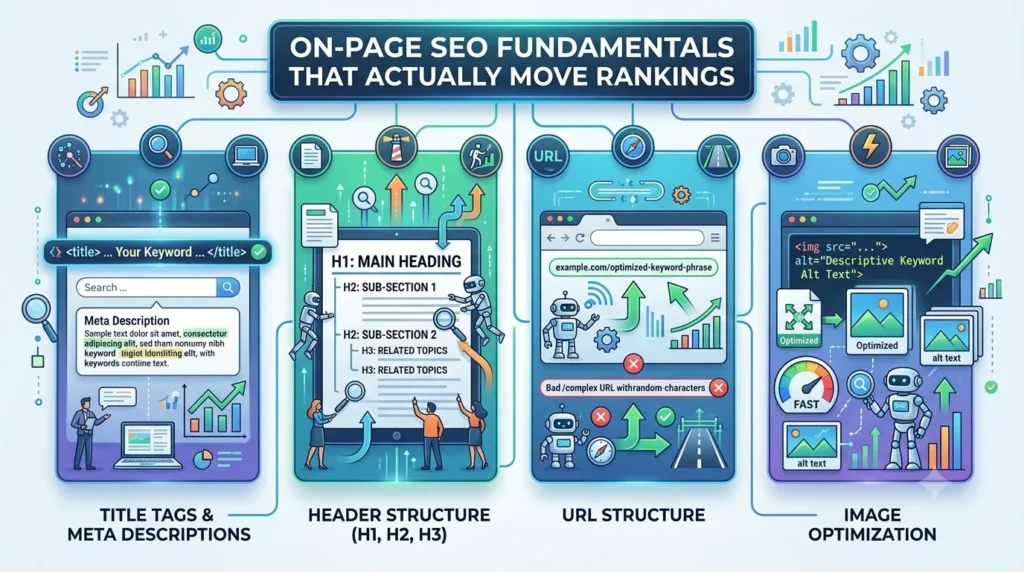
On-page SEO is the foundation everything else is built on. It’s not glamorous, but skipping it is like building a house on sand — nothing else you do will hold up without it.
Title Tags and Meta Descriptions
- Keep title tags under 60 characters so they don’t get cut off in search results, and place your primary keyword as close to the front as naturally possible.
- Write meta descriptions that earn the click — think of them as ad copy, not a summary; aim for 130–155 characters with a clear reason to click.
- Make every title unique across your site; duplicate titles confuse search engines about which page to actually rank.
Header Structure (H1, H2, H3)
- Use exactly one H1 per page that clearly states the topic, and let H2s and H3s break the content into logical, scannable sections.
- Include relevant keywords naturally in your subheadings — this helps both readers and search engines understand your content’s structure at a glance.
- Never skip heading levels just for visual styling; a clean hierarchy helps accessibility tools and search crawlers alike.
URL Structure
- Keep URLs short and descriptive, such as yoursite.com/organic-seo-guide rather than a string of random numbers or parameters.
- Use hyphens, not underscores, to separate words — search engines read hyphens as word breaks, not underscores.
- Avoid changing URLs after publishing whenever possible; if you must, always set up a proper 301 redirect to preserve any ranking equity.
Image Optimization
- Compress every image before uploading to keep page load times fast — large, unoptimized images are one of the most common speed killers.
- Write descriptive alt text for every image, both for accessibility and for a small but real ranking signal.
- Use descriptive file names like organic-seo-checklist.jpg instead of IMG_4821.jpg before uploading.
Content Strategy: Depth, Freshness, and E-E-A-T
Google has been increasingly explicit about what separates content that ranks from content that doesn’t: E-E-A-T — Experience, Expertise, Authoritativeness, and Trustworthiness. It’s not a checkbox you tick once; it’s a standard you build into every page you publish.
- Write from real experience whenever possible — first-hand insight, original data, and specific examples consistently outperform generic, recycled advice.
- Go deeper than the competition — if the top-ranking pages cover a topic in 800 words, a thorough 2,000-word resource that actually answers every follow-up question has a real shot at outranking them.
- Update old content regularly — refreshing statistics, examples, and outdated advice on existing pages is often faster and more effective than publishing something brand new.
- Show credentials and sourcing — linking to credible sources and including author bios builds the trust signals search engines are explicitly designed to look for.
- Avoid thin, filler content — pages that exist purely to target a keyword without offering real value tend to plateau or decline over time.
It helps to think of every page on your site as a small pitch to Google’s algorithms: “trust me enough to show this to your users.” Pages that clearly demonstrate real experience and genuine expertise make that pitch far more convincing than pages stitched together purely to hit a word count.
Quick tip: before publishing, ask yourself honestly — “If I were the searcher, would this page fully satisfy what I came here for?” If the answer is no, it’s not ready yet.
Technical SEO: The Foundation Search Engines Actually Trust
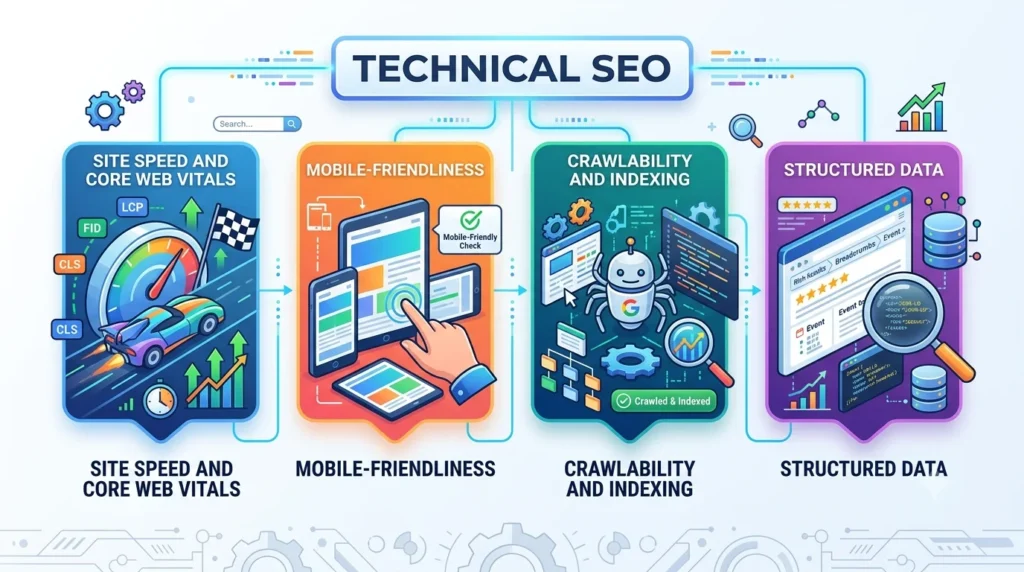
You can write the best content in the world, but if search engines can’t crawl, load, or understand your site properly, none of it matters. Technical SEO is the unglamorous work that makes everything else possible.
Site Speed and Core Web Vitals
- Test your site regularly using Google PageSpeed Insights, which measures the exact Core Web Vitals metrics Google uses as ranking signals.
- Prioritize Largest Contentful Paint (LCP) by compressing images, using a content delivery network, and minimizing render-blocking scripts.
- Reduce Cumulative Layout Shift (CLS) by setting explicit dimensions for images and ads so the page doesn’t jump around as it loads.
Mobile-Friendliness
- Design mobile-first, since Google now uses mobile-first indexing, meaning the mobile version of your site is what actually gets evaluated for ranking.
- Test tap targets and font sizes to make sure buttons and text are usable without pinching or zooming.
Crawlability and Indexing
- Submit an XML sitemap through Google Search Console so search engines can discover your pages efficiently.
- Check your robots.txt file to make sure you’re not accidentally blocking important pages from being crawled.
- Fix broken links and redirect chains regularly — both waste crawl budget and create a frustrating experience for visitors.
Structured Data
- Add schema markup using guidance from Schema.org to help search engines understand your content and potentially earn rich results like star ratings or FAQ dropdowns.
- Validate your markup with Google’s Rich Results Test before publishing to catch errors early.
Don’t Publish and Pray — Promote Your Content Strategically
One of the quiet myths in SEO is that great content ranks purely on merit, all on its own, given enough time. In reality, early traction — even a modest amount — can help a new page get discovered and crawled faster, and it often kickstarts the kind of natural sharing that eventually turns into backlinks.
- Share new content across your existing channels — email newsletters, social profiles, and relevant online communities can all drive early visitors to a freshly published page.
- Repurpose long-form content into smaller formats — a detailed guide can become a short video script, a carousel post, or a handful of social captions, extending its reach far beyond the original page.
- Notify sites that might genuinely benefit from linking to your resource, especially if you’ve created something more comprehensive or up-to-date than what they’re currently citing.
- Engage authentically in relevant communities — forums, niche groups, and Q&A platforms can be a source of both direct traffic and, over time, organic backlinks from people who found your content useful.
Promotion doesn’t replace strong SEO fundamentals, but it accelerates them. Think of it as giving a well-built page the initial push it needs to start climbing on its own.
Build Authority With Genuine Backlinks
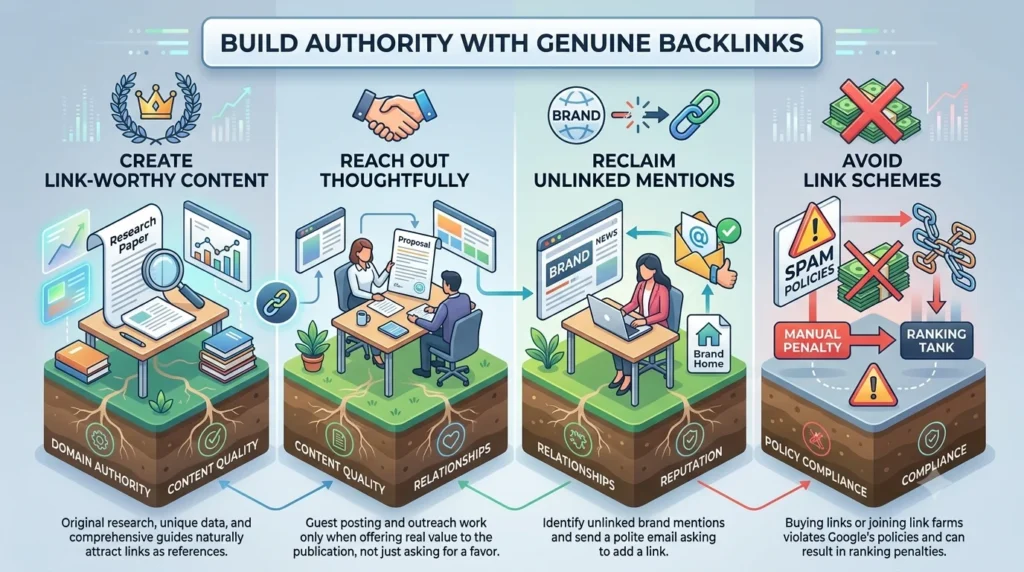
Backlinks remain one of the strongest ranking signals search engines use — but not all links are created equal. A single link from a respected, relevant site can outweigh dozens of low-quality ones.
- Create genuinely link-worthy content — original research, unique data, and comprehensive guides naturally attract links because people want to reference them.
- Reach out thoughtfully — guest posting and outreach still work, but only when you’re offering real value to the publication, not just asking for a favor.
- Reclaim unlinked mentions — if a site mentions your brand without linking to you, a polite email asking them to add the link can be surprisingly effective.
- Avoid link schemes — buying links or joining link farms violates Google’s spam policies and can result in a manual penalty that tanks your rankings overnight.
Think of backlinks the way you’d think of a reputation in real life — earned slowly, through genuine value, not manufactured overnight.
Leverage Internal Linking and Site Architecture
While external backlinks get most of the attention, internal linking is one of the most underrated levers you control entirely on your own. It helps search engines understand your site’s structure and helps visitors find more of what they came for.
- Link from high-authority pages to newer or underperforming pages to help pass along some of that ranking strength.
- Use descriptive anchor text instead of generic phrases like “click here,” since anchor text gives search engines context about the linked page’s topic.
- Build topic clusters — group related content around a central “pillar” page, linking outward to supporting articles and back again, to signal topical authority.
- Fix orphan pages — any page with zero internal links pointing to it is far harder for both users and search engines to discover.
User Experience Signals That Influence Rankings
Google has repeatedly emphasized that a page’s performance in search is tied not just to its content, but to how real people experience it once they arrive. User experience and SEO are no longer separate disciplines — they’re deeply intertwined.
- Reduce bounce rate by matching your content precisely to what the title and meta description promised — mismatched expectations send visitors straight back to the results page.
- Improve dwell time with genuinely engaging, well-organized content that keeps readers scrolling instead of skimming and leaving.
- Make navigation intuitive — a confusing menu or buried content frustrates users and increases the odds they’ll abandon your site entirely.
- Eliminate intrusive pop-ups — aggressive interstitials, especially on mobile, can actively hurt rankings under Google’s page experience guidelines.
Track, Measure, and Refine With Data
SEO is never a “set it and forget it” effort. The sites that consistently climb the rankings are the ones treating it as an ongoing feedback loop rather than a one-time project.
- Monitor rankings and clicks through Google Search Console, paying close attention to pages with high impressions but low click-through rates — these often just need a better title or meta description.
- Use Google Analytics to track which pages actually convert visitors into leads or customers, not just which ones get the most traffic.
- Review your top pages quarterly to identify content that’s slipping and needs a refresh before it loses its ranking entirely.
- Test incrementally — change one major element at a time (a title, a header structure, an internal linking pattern) so you can actually tell what caused a ranking shift.
Rankings rarely move in a straight line. Expect fluctuation, algorithm updates, and the occasional unexplained dip — and use your data to respond calmly rather than reactively overhauling your entire strategy every time a graph moves.
Common Mistakes That Sabotage Organic Rankings
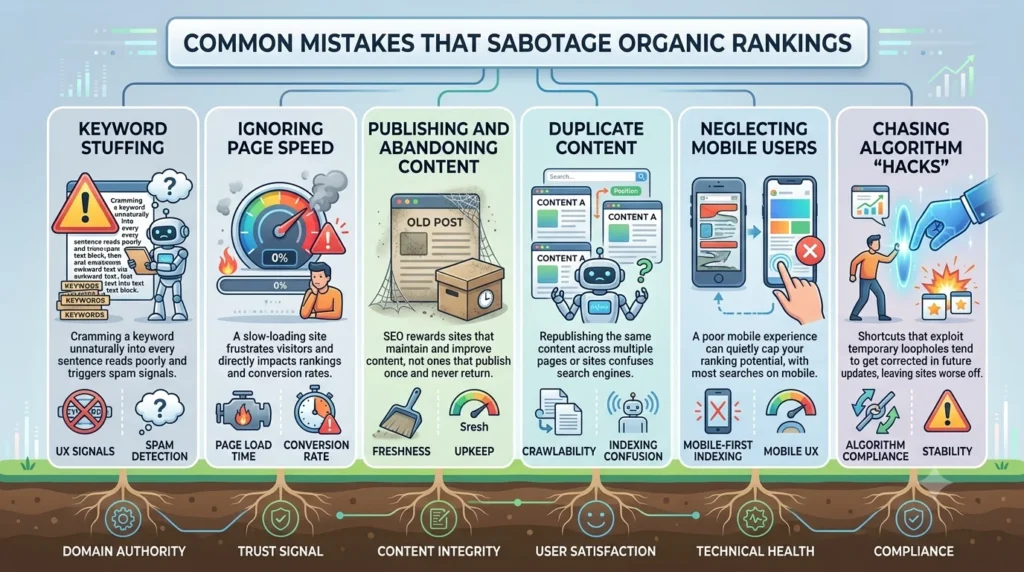
Even well-intentioned website owners fall into a handful of avoidable traps. Watch out for these:
- Keyword stuffing — cramming a keyword unnaturally into every sentence reads poorly to visitors and can trigger spam signals in search algorithms.
- Ignoring page speed — a slow-loading site frustrates visitors and directly impacts both rankings and conversion rates.
- Publishing and abandoning content — SEO rewards sites that maintain and improve their content over time, not ones that publish once and never return.
- Duplicate content — republishing the same content across multiple pages or sites confuses search engines about which version to rank.
- Neglecting mobile users — with the majority of searches now happening on mobile devices, a poor mobile experience can quietly cap your ranking potential.
- Chasing algorithm “hacks” — shortcuts that exploit temporary loopholes tend to get corrected in future updates, often leaving affected sites worse off than before.
Frequently Asked Questions About Organic Website Ranking
How long does it take to rank organically?
Most competitive keywords take anywhere from three to twelve months to show meaningful movement, depending on your domain’s existing authority and the competitiveness of the topic. Less competitive, long-tail keywords can rank noticeably faster — sometimes within a few weeks of publishing well-optimized content.
Do I need to hire an SEO agency to rank organically?
Not necessarily. Many of the highest-impact strategies — solid on-page structure, genuinely helpful content, and basic technical health — can be handled in-house with the free tools mentioned throughout this guide. Agencies can accelerate results, especially for competitive industries, but they’re not a strict requirement for meaningful organic growth.
How often should I publish new content?
Consistency matters more than raw frequency. A site publishing one genuinely excellent, well-researched article per week will typically outperform one publishing five thin, rushed posts in the same period. Quality and depth consistently win over sheer volume.
Does social media activity affect organic rankings?
Not directly — social signals aren’t a confirmed ranking factor. However, social distribution increases visibility, which can indirectly lead to more backlinks, more brand searches, and more traffic, all of which support your broader SEO efforts.
Final Thoughts: Organic Ranking Rewards the Patient and the Precise
Improving your website ranking organically isn’t about finding one clever trick that outsmarts Google overnight. It’s about consistently doing the fundamentals well — understanding what searchers actually want, building pages that genuinely satisfy that intent, keeping your technical foundation healthy, and earning trust one useful page at a time.
There will be slow months where nothing seems to move, and there will be sudden jumps that feel like they came out of nowhere. Both are normal parts of the process. The websites that win long-term aren’t the ones chasing every algorithm rumor — they’re the ones that quietly kept publishing, kept refining, and kept treating their visitors’ experience as the whole point, not an afterthought.
Start with one page. Optimize it thoroughly using everything covered here — intent-matched content, clean structure, solid technical health, and genuine value. Then repeat that process, page after page, month after month. That’s not a shortcut. It’s simply what actually works.
And if you ever feel unsure whether your efforts are paying off, remember that organic ranking rarely announces itself loudly. It shows up gradually — a few more impressions in Search Console this month, a slightly better average position next month, a new keyword you didn’t even target starting to send traffic the month after that. Keep showing up for your readers and for the search engines trying to serve them well, and the rankings tend to follow.