
Content Marketing Metrics That Matter

ATTENTION: Want to Learn Affiliate Marketing from Successful Affiliates?
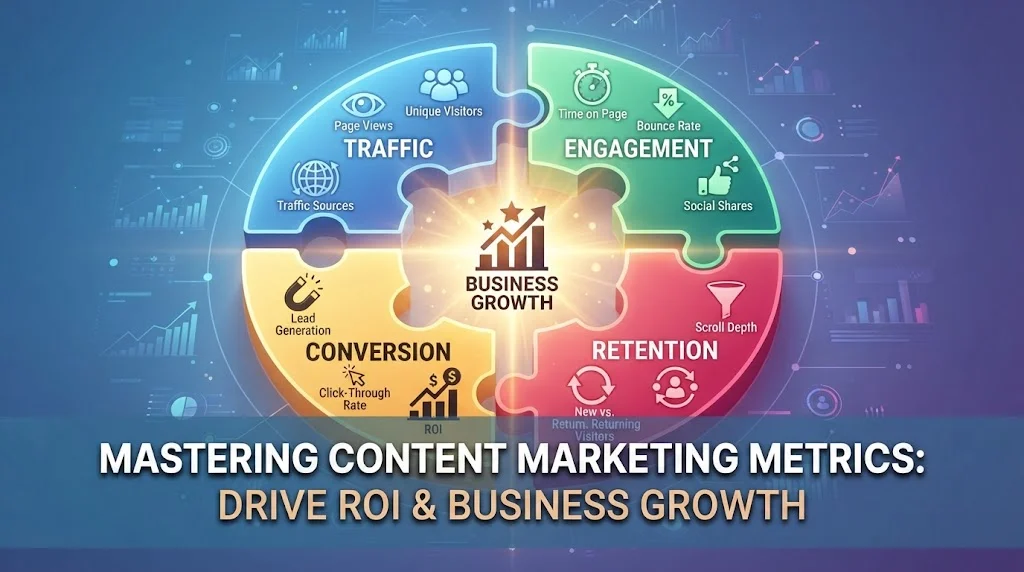
In today’s digital landscape, tracking the right metrics is essential for the success of any content marketing strategy. Understanding Content Marketing Metrics That Matter can significantly drive business growth. Let’s explore some key metrics that should be on your radar.
Traffic Metrics
Traffic metrics serve as a foundation for evaluating the effectiveness of your content. Here are some critical metrics to monitor:
- Page Views: This indicates how many times a specific page was viewed. A high number suggests that your content is engaging and relevant.
- Unique Visitors: Unique visitors track individual users to your site. This metric helps you understand your audience size and growth.
- Traffic Sources: Understanding where your traffic comes from (organic search, social media, referrals, etc.) is vital for optimizing your marketing efforts.
Engagement Metrics
Engagement metrics reveal how effectively your audience interacts with your content:
- Time on Page: This indicates how long people spend on your content. Longer times generally suggest that readers find your content helpful.
- Bounce Rate: A high bounce rate might indicate that visitors do not find what they expect on your page. Strive for a low bounce rate by delivering valuable content.
- Social Shares: Tracking how often your content is shared on social media platforms can provide insights into its value and relevance.
Conversion Metrics
Conversions are essential for measuring the success of your content marketing. Here are some crucial conversion metrics:
- Lead Generation: How many leads does your content create? This metric helps gauge your content’s effectiveness in attracting potential customers.
- Click-Through Rate (CTR): This metric measures the percentage of visitors who click on a call-to-action (CTA). Analyzing CTR can help you improve your CTAs for better conversion.
- Return on Investment (ROI): Calculating ROI allows you to evaluate the financial return generated from your content marketing efforts. Compare the cost of creating content with the revenue it generates.
Search Engine Performance
SEO metrics are vital for determining how well your content performs in search engines:
- Keyword Rankings: Track how your content ranks for target keywords. High rankings can lead to more visibility and traffic.
- Organic Search Traffic: This measures the number of visitors who find your content through search engines. It’s a key indicator of your SEO success.
User Behavior Metrics
Understanding user behavior can provide insights into how your audience interacts with your content:
- Scroll Depth: This metric tracks how far down the page users scroll. It helps identify whether users read your content thoroughly or lose interest.
- Returning Visitors vs. New Visitors: This metric shows the balance between new and repeat visitors, which is crucial for nurturing brand loyalty.
Utilizing Analytics Tools
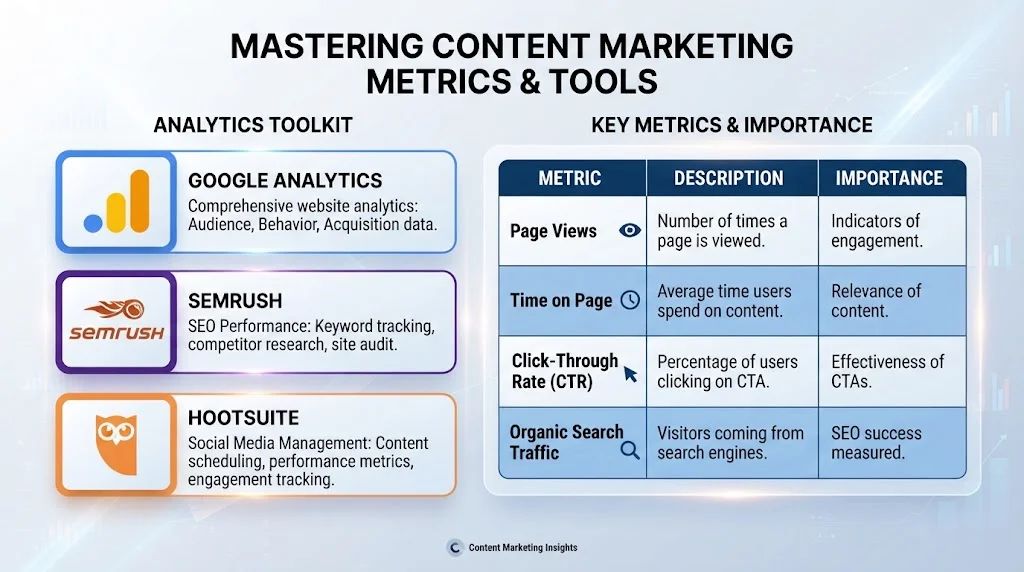
To effectively track these metrics, utilizing analytics tools is essential. Popular tools include:
- Google Analytics for comprehensive website analytics.
- SEMrush for tracking SEO performance.
- Hootsuite for social media metrics and engagement.
| Metric | Description | Importance |
|---|---|---|
| Page Views | Number of times a page is viewed | Indicators of engagement |
| Time on Page | Average time users spend on content | Relevance of content |
| Click-Through Rate | Percentage of users clicking on CTA | Effectiveness of CTAs |
| Organic Search Traffic | Visitors coming from search engines | SEO success measured |
By focusing on these essential metrics, you can better understand your audience and how to create content that meets their needs. In turn, this strategic approach will drive your business growth and accomplish your marketing goals. Always remember, the ultimate goal is to provide valuable content that resonates with users while achieving your business objectives.
Understanding the Role of Engagement Metrics in Content Marketing
When it comes to content marketing, understanding engagement metrics is vital for your long-term success. These metrics offer insights into how your audience interacts with your content, helping you tailor your strategies for better results. By focusing on engagement metrics, you can enhance user experience, build community, and ultimately drive conversions.
The Importance of Engagement Metrics
Engagement metrics help you see what resonates with your audience. Unlike basic metrics such as page views, engagement metrics dive deeper into user behavior. They provide a clearer picture of how people are interacting with your content. This is significant because:
- Improves Content Quality: By analyzing which content garners more interaction, you can create more of what your audience loves.
- Guides Future Strategy: Knowing what keeps your audience engaged allows you to adapt your marketing strategies accordingly.
- Enhances User Experience: Engagement metrics help identify areas where user experience can be improved, leading to better retention.
Key Engagement Metrics to Monitor
Consider the following metrics to gauge how well your content performs:
| Metric | Description |
|---|---|
| Time on Page | This measures the amount of time users spend on your page, indicating how compelling your content is. |
| Bounce Rate | This indicates the percentage of users who leave after viewing only one page. A low bounce rate suggests effective engagement. |
| Click-Through Rate (CTR) | CTR calculates how many people clicked on your call-to-action (CTA). A higher CTR indicates successful engagement. |
| Social Shares | This measures how many times your content was shared on social media. More shares indicate broader reach and popularity. |
| Comments and Interactions | This includes user comments and feedback, which reflect how actively your audience engages with your content. |
Analyzing Engagement Metrics
To effectively analyze these metrics, you can use various tools. Google Analytics is a popular choice that provides a wealth of information. It offers detailed reports on time spent on page, bounce rates, and much more. Additionally, social media analytics tools help you understand how your content performs on platforms like Facebook, Twitter, and LinkedIn.
You may also engage with tools such as Sprout Social and Buffer to delve deeper into social shares and user interactions. Gathering this data allows you to identify content types that work best for your audience.
Strategies to Improve Engagement
Once you have a solid understanding of your engagement metrics, it’s time to make adjustments. Here are a few strategies to enhance user engagement:
- Use Compelling Headlines: Captivating titles can draw readers in, improving time on page and reducing bounce rates.
- Incorporate Visuals: Images, infographics, and videos often increase engagement and make content more appealing.
- Add Interactive Elements: Polls, quizzes, and surveys encourage audience participation and increase dwell time.
- Optimize for Mobile: Ensure your content is mobile-friendly, as more users are consuming content on their phones.
- Engage with Your Audience: Respond to comments and feedback to foster a community around your content.
Monitoring and understanding engagement metrics is not just a number game; it’s about creating genuine connections with your audience. By focusing on the metrics that truly matter, you can streamline your content marketing efforts for greater success. In this fast-paced digital world, staying tuned to what engages your audience is key. For more insights on measuring content success, you can check out resources like Content Marketing Institute and Moz.
The Importance of Conversion Rates in Measuring Content Success
In the world of digital marketing, measuring success is crucial, and one of the most telling metrics is the conversion rate. Conversion rates offer invaluable insights into how well your content resonates with your audience. This measure indicates the percentage of visitors who take a desired action, such as signing up for a newsletter, making a purchase, or filling out a contact form.
Understanding why conversion rates matter can illuminate the effectiveness of your content strategy. The higher your conversion rate, the more successful your marketing campaigns are in driving audiences towards action. Below, we will explore the importance of conversion rates and how they can enhance your content marketing approach.
Defining Conversion Rates
A conversion rate is calculated by dividing the number of conversions by the total number of visitors and then multiplying by 100. For example: If 100 visitors come to your site and 5 make a purchase, the conversion rate is (5/100) * 100 = 5%.
Why Conversion Rates Matter
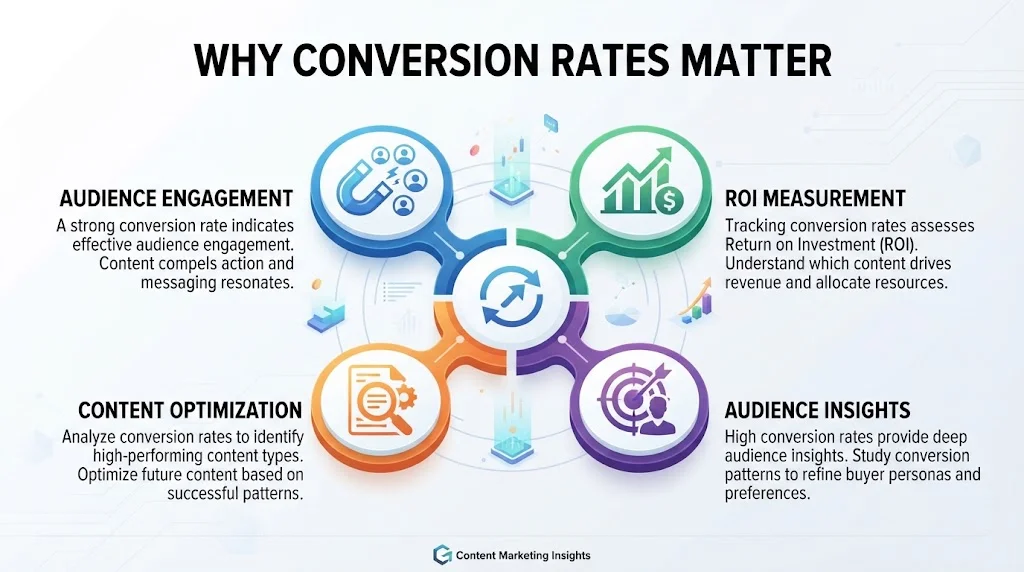
Conversion rates are not just numbers; they provide insight into the effectiveness of your content marketing strategy. Here are a few reasons why you should focus on this metric:
- Audience Engagement: A strong conversion rate indicates that your content effectively engages your audience. When visitors are compelled to take action, it shows that your messaging resonates with them.
- ROI Measurement: Tracking conversion rates allows you to assess the return on investment (ROI) of your content efforts. Understanding which pieces of content lead to conversions can help you allocate resources more effectively.
- Content Optimization: By analyzing conversion rates, you can identify which types of content perform best. This insight allows you to optimize future content based on what has proven successful.
- Audience Insights: High conversion rates can indicate a deeper understanding of your target audience’s needs and preferences. By studying patterns in conversions, you can refine your buyer personas.
Improving Your Conversion Rates
Boosting your conversion rates might seem daunting, but with these effective strategies, you can enhance your content marketing:
- Craft Compelling Calls to Action (CTAs): Your CTAs should be clear and enticing. Use action-oriented language that compels readers to take immediate action.
- Segment Your Audience: Not all visitors are the same. Tailor your content to different segments of your audience to increase relevance and responses.
- Use A/B Testing: Experiment with different content formats, headlines, and layouts to see what drives higher conversions. This iterative process helps refine your approach.
- Focus on User Experience: A clean, intuitive website makes it easier for visitors to navigate and complete desired actions. Ensure your site is user-friendly across all devices.
Analyzing Industry Benchmarks
To better understand your conversion rates, it helps to compare them against industry benchmarks. While rates can vary significantly depending on the type of business, here’s a general overview:
| Industry | Average Conversion Rate |
|---|---|
| eCommerce | 1% – 3% |
| Lead Generation | 2% – 5% |
| B2B Services | 2.5% – 5% |
| Finance | 5% – 10% |
By keeping an eye on your conversion rates in comparison to industry norms, you can identify areas where your content may need improvement or adjustment.
Tracking Tools for Conversion Rates
Several tools can assist you in tracking conversion rates effectively:
- Google Analytics: A powerful tool that offers extensive insights into website traffic and conversions.
- HubSpot Analytics: HubSpot provides comprehensive analytics designed specifically for marketers.
- Moonsy: A helpful tool to track conversions and optimize your marketing strategy.
The focus on conversion rates can significantly enhance the success of your content marketing efforts. When you strategically analyze and improve these metrics, you’re on your way to creating a more engaged audience and driving substantial results for your business.
Analyzing Audience Retention Metrics for Improved Content Strategy
Understanding your audience is key to creating successful content. One of the most important ways to assess this is through audience retention metrics. These metrics provide insight into how well your content keeps viewers engaged over time, allowing you to fine-tune your content strategies for improved performance.
Audience retention metrics include a variety of indicators that reveal how much of your content is consumed and how viewers interact with it.
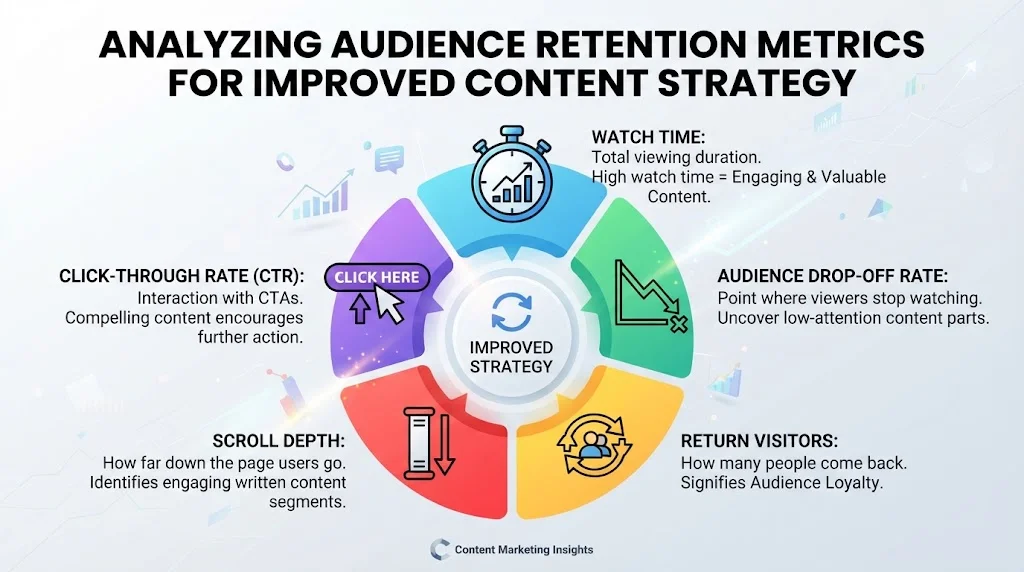
Here are some critical metrics that every content creator should analyze:
- Watch Time: This measures the total amount of time viewers spend watching your content. High watch time suggests your content is engaging and valuable.
- Audience Drop-off Rate: This metric indicates when viewers stop watching your content. By identifying this point, you can uncover which parts of your content fail to hold attention.
- Return Visitors: Tracking how many people return to your content provides insight into its longevity and value. High return visitor rates can signal strong audience loyalty.
- Scroll Depth: For written content, scroll depth measures how far down the page viewers scroll. This helps identify which segments of your articles are the most engaging.
- Click-Through Rate (CTR): This metric applies specifically to links and calls-to-action within your content. A higher CTR indicates that your audience finds your content compelling enough to interact further.
Using these metrics can help you craft better content. Analyzing these indicators can inform not only the length and format of your posts but also their subject matter and style. Here’s how you can use these metrics, specifically in a digital content strategy:
1. Identify Engagement Peaks and Valleys
By reviewing your audience retention data, you can pinpoint which parts of your content perform well and which do not. It’s essential to compare metrics across various types of content. For instance, if video content demonstrates higher audience retention than blog posts, consider investing more resources into video production.
2. Adjust Content Based on Audience Behavior
If your audience tends to drop off at specific points, investigate what might be causing this. Is the information too complex? Perhaps the visuals are not engaging. By understanding viewer behavior, you can create content that addresses these issues effectively.
3. Optimize Length and Format
Different audiences have different preferences regarding the length and format of content. Analyze how watch time or scroll depth varies with content length. Shorter videos might perform better with certain audiences, while long-form articles might resonate more with readers seeking in-depth insights.
4. Foster Community Engagement
Encouraging audience interaction can significantly boost retention. This includes comments, shares, and likes on your content. Use social media channels and email newsletters to engage directly with your audience. Ask for feedback and create polls to gather insights on what they enjoy the most.
| Metric | What it Measures | Actionable Insight |
|---|---|---|
| Watch Time | Total viewing time across all videos | Invest in content that keeps viewers engaged longer |
| Drop-off Rate | Percentage of viewers that leave at specific points | Revise sections that see high drop-off rates |
| Return Visitors | Number of viewers that come back to your content | Create similar content based on popular topics |
| Scroll Depth | How far down the page users scroll | Improve sections that lose user interest quickly |
| CTR | The percentage of clicks on calls-to-action | Refine CTAs to make them more enticing |
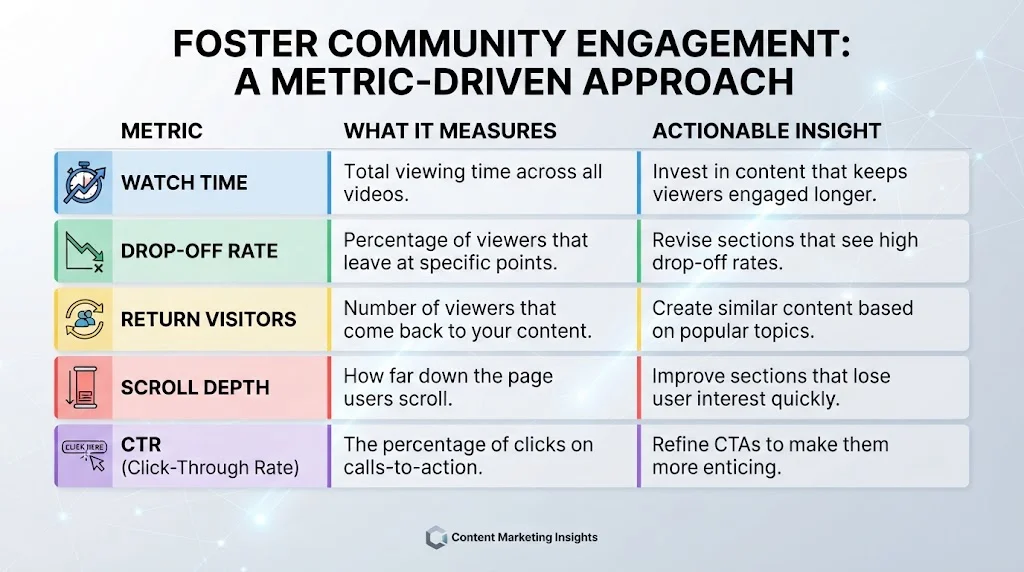
By leveraging audience retention metrics effectively, you can create content that not only attracts viewers but keeps them coming back for more. Additionally, using tools like Google Analytics and ContentSquare can offer further insights into how to enhance your strategy. In a digital landscape saturated with information, the ability to retain your audience’s attention is invaluable. Focusing on these retention metrics will enable you to better understand your audience’s preferences and improve their overall experience with your content. Audience retention metrics into your content strategy is not just a task; it’s an ongoing process that helps you nurture a loyal viewer base while continuously evolving your content to better meet your audience’s needs.
How to Use ROI Metrics to Evaluate Your Content Marketing Efforts
Knowing how to evaluate your content marketing efforts is crucial for any business looking to optimize their ROI. When you measure the right metrics, you can see what works and what doesn’t. Here’s how you can use ROI metrics effectively.
Understanding ROI Metrics
Return on Investment (ROI) metrics help you determine how effectively your content marketing is contributing to your overall business goals. Instead of guessing, these metrics provide you with data-driven insights. Some significant ROI metrics to track include:
- Revenue from Content Marketing
- Cost Per Acquisition (CPA)
- Lead Generation
- Customer Lifetime Value (CLV)
- Conversion Rates
Calculating ROI for Content Marketing
To calculate the ROI of your content, use this formula: ROI = (Net Profit / Cost of Investment) x 100
Let’s break this down:
- Net Profit: This is the revenue generated from your content marketing minus the costs associated with producing that content.
- Cost of Investment: This includes everything from content creation, distribution to promotion costs.
Key Metrics to Track
Tracking the right metrics will ensure you’re making informed decisions. Here are some key areas to focus on:
1. Website Traffic
Monitor the number of visitors your content draws to your site. Increased website traffic often indicates effective content marketing and can lead to higher conversion rates.
2. Engagement Rates
Look at the levels of interaction with your content. High engagement indicates that your audience finds your content valuable. Metrics to track include:
- Shares on social media
- Comments
- Time spent on page
3. Lead Generation
Content should lead to new leads. Track how many leads are generated through specific content pieces. This helps identify what types of content resonate with your target audience.
4. Conversion Rates
Your conversion rate is vital for measuring ROI. A higher conversion rate signifies a successful content marketing strategy, translating into more sales.
5. Customer Acquisition Cost
Understanding your customer acquisition cost gives insight into how much you spend to gain a customer through your content marketing efforts. Reducing this cost will directly improve ROI.
Assessing the Value of Content
Different types of content generate different values. For instance, a well-optimized blog post may attract organic traffic and leads over time while an email campaign might offer immediate conversions. Track various content types to assess their individual ROI.
Using Analytics Tools
Utilize analytics tools that can simplify tracking your ROI metrics. Google Analytics allows you to monitor website performance, user behavior, and conversion actions effectively. Other options include:
- Buffer for social media performance
- Hootsuite for tracking social media engagement
- HubSpot for comprehensive marketing analytics
By utilizing these tools, you can gain real-time insights and make data-driven decisions about future content strategies.
Measuring Long-term Success
While immediate metrics are vital, long-term success indicators also play a role. Monitor metrics over months and years to identify trends and sustained growth. Keep an eye on:
- Customer Retention Rates
- Brand Awareness Metrics
- Return Visitors
| Metric | Description | Importance |
|---|---|---|
| Website Traffic | The number of visitors to your website. | Indicates reach and interest. |
| Engagement Rates | Measure of how much users interact with your content. | Shows the relevance and quality of content. |
| Lead Generation | The number of new leads acquired through content. | Essential for growth. |
| Conversion Rates | The percentage of users who complete a desired action. | Directly ties to revenue growth. |
| Customer Acquisition Cost | How much it costs to acquire a customer. | Lower costs mean higher ROI. |
Using these strategies and metrics, you can effectively gauge your content marketing efforts and continuously refine your approach. As you become more adept at measuring ROI, your marketing success will increase, allowing you to invest in the content that truly drives value for your business.
Conclusion
To drive business growth successfully through content marketing, understanding key metrics is crucial. By focusing on engagement metrics, you can gauge how well your audience connects with the content you produce. High engagement often translates to a deeper interest, indicating that you’re on the right path to building relationships and trust with your audience.
Conversion rates serve as a clear indicator of your content’s effectiveness. They help you measure the impact of your efforts in terms of achieving specific goals, whether that’s sales, leads, or subscriptions. When you track these rates diligently, you get valuable insights into what resonates most with your target market.
Audience retention metrics play a vital role in refining your content strategy. They tell you how often your audience returns to consume more of your content. A high retention rate suggests that you’re providing valuable and relevant information that keeps readers coming back for more.
Evaluating your content marketing efforts through ROI metrics allows you to assess whether your investments yield the desired returns. By calculating ROI, you can identify successful tactics, refining your strategies for future campaigns to maximize your impact and efficiency.
Focusing on these essential metrics enables you to craft a robust content marketing strategy that not only speaks to your audience but also drives tangible results. By measuring what truly matters, you can continually adapt and improve, ensuring your content marketing journey aligns with your overall business objectives. Remember, it’s not just about creating content; it’s about creating meaningful connections that lead to growth and success.