
How To Optimize Category Pages for SEO

ATTENTION: Want to Learn Affiliate Marketing from Successful Affiliates?
When it comes to improving your website’s visibility on search engines, optimizing category pages is crucial. These pages act as a hub for related content, allowing users to navigate your site efficiently. Follow these best practices to make your category pages more SEO-friendly and enhance user experience. By implementing How To Optimize Category Pages for Seo strategies, you ensure your site performs at its best. Mastering How To Optimize Category Pages for Seo helps attract targeted organic traffic.
Conduct Keyword Research
Before you begin optimizing your category pages, conduct thorough keyword research. Find keywords that are relevant to the products or content you are displaying. Tools like Ahrefs or Moz can help you discover high-volume, low-competition keywords. Target long-tail keywords that your audience is likely to use when searching for items in your category.
Craft Unique and Engaging Content
Your category page should have unique content that adds value. Avoid using the manufacturer’s descriptions verbatim. Instead, write informative and compelling descriptions that highlight what makes your category special. Try to explain how your products can solve customers’ problems or enhance their lives.
Optimize Title Tags and Meta Descriptions
Title tags and meta descriptions are essential for SEO. Make sure each category page has a unique title that includes your primary keyword. Keep it under 60 characters for optimal display in search results. Additionally, write meta descriptions that not only summarize the content but also entice users to click on your link. Aim for about 150-160 characters.
Utilize Header Tags Wisely
Implement header tags (H3, H4, etc.) strategically to create a hierarchy of information. Use your primary keyword in at least one of the headers to signal search engines about the topic of the page. Headers improve readability and help users quickly find information.
Use Internal Linking
Link to relevant subcategories or related content within your site. This not only helps improve the SEO of the linked pages but also keeps users engaged longer. For example, if you have a category for “Running Shoes,” you could link to articles about “Best Running Practices” or “Running Gear.”
Optimize Images
Images can significantly enhance user engagement but must be optimized for SEO. Use descriptive file names and include alt text for each image. This practice improves accessibility for users and helps search engines understand the content of your images. An ideal alt text should contain the main keyword of the category.
Implement Schema Markup
Schema markup is powerful for enhancing your category pages. It helps search engines understand the content of your page better, leading to rich snippets in search results. Use schema.org to implement structured data specific to your categories, such as product schema or review schema.
Ensure Mobile Optimization
With the increase in mobile searches, your category pages must be mobile-friendly. Ensure that your website design is responsive. Check that all elements, including images and text, display correctly on mobile devices. Use Google’s Mobile-Friendly Test Tool to confirm your page’s performance.
Enhance Page Load Speed
Slow-loading pages are detrimental to user experience and SEO. Utilize tools like Google PageSpeed Insights to analyze and improve your load time. Compress images, leverage browser caching, and minimize CSS and JavaScript files to enhance speed.
Monitor and Analyze Performance
Regularly check your category pages’ performance through Google Analytics. Track user behavior, such as bounce rates and time spent on pages. This data helps you understand what’s working and what needs adjustment. Use this feedback to tweak titles, descriptions, and content accordingly.
Utilize Social Proof
Incorporate customer reviews or ratings on your category pages to build trust. User-generated content, like reviews, can also improve SEO by adding fresh, relevant content to your page. Highlighting positive experiences can persuade new visitors to make a purchase.
Optimizing your category pages for SEO requires a multi-faceted approach. By following these best practices, you can significantly enhance your website’s visibility and provide a better experience for your users.
The Importance of User Experience in Category Page Design
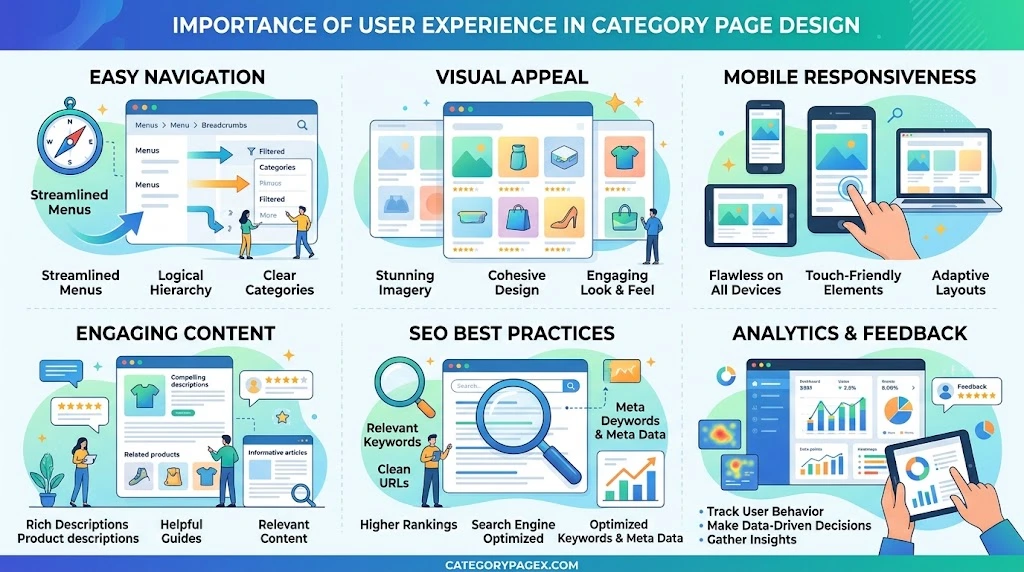
Creating a great user experience on category pages is vital for an effective website. When you design category pages with the user in mind, you improve navigation, increase engagement, and boost conversions. Let’s dive into essential elements that enhance user experience on these pages. Understanding How To Optimize Category Pages for SEO involves prioritizing usability.
Easy Navigation
Navigation is crucial for any website, especially on category pages. Users should find it simple to browse products or content. Here are a few tips:
- Clear Categories: Organize your categories logically. Use clear, descriptive names that resonate with users.
- Breadcrumbs: Implement breadcrumb navigation. This allows users to easily retrace their steps and explore related categories.
- Filters and Sort Options: Provide filters and sort options like price, popularity, and newest. Users appreciate the ability to refine their search quickly.
Visual Appeal
A visually appealing layout keeps users engaged longer. Ensure your category pages follow these design principles:
- Consistent Branding: Use consistent colors, fonts, and logo placements. This builds brand recognition and trust.
- High-Quality Images: Feature high-resolution images of products. Poor quality images can deter potential buyers.
- Whitespace: Utilize whitespace to separate sections and improve readability. A cluttered page can overwhelm users.
Mobile Responsiveness
With the rise of mobile browsing, ensuring your category pages are responsive is critical.
- Adaptive Design: Your site should adjust seamlessly to different screen sizes. Test your category pages on various devices to check usability.
- Touch-Friendly Elements: Buttons and links should be easy to tap. This enhances user experience on touch screens.
- Fast Loading Times: Optimize images and scripts to ensure pages load quickly. Slow load times can lead to higher bounce rates.
Engaging Content
Compelling content is essential on category pages to keep users interested. Consider these strategies:
- Unique Descriptions: Write unique and engaging product descriptions. Avoid using manufacturer descriptions verbatim, as this can harm SEO.
- User Reviews: Incorporate user reviews and ratings. Positive feedback builds credibility and encourages other users to make a purchase.
- Video Content: If possible, add videos that highlight products. This can provide a richer experience for users.
SEO Best Practices
Optimizing for search engines directly impacts user experience on category pages. Integrate valuable SEO strategies:
- Keyword Research: Use relevant keywords in your titles, descriptions, and metadata. Understand what phrases your potential customers are searching for.
- Meta Tags: Craft unique meta titles and descriptions for each category. This helps improve click-through rates from search engine results.
- Alt Text for Images: Use descriptive alt text for images. This not only helps with SEO but improves accessibility for all users.
Analytics and Feedback
Continuously track user behavior and gather feedback. Here are practical actions you can take:
- Analytics Tools: Use tools like Google Analytics to monitor traffic patterns, bounce rates, and user engagement on category pages.
- User Surveys: Implement quick surveys to gather user feedback on their experience. Listening to users can lead to valuable insights.
- A/B Testing: Test different layouts, content, or filter options. This helps to identify what works best for your audience.
Optimizing category pages for user experience not only improves SEO results but also fosters loyalty and trust with your customers. For those looking to delve deeper into user experience principles in web design, websites like Smashing Magazine and Nielsen Norman Group provide valuable resources and insights. Remember, building a site that prioritizes user experience is key to achieving long-term success.
Effective Keyword Research for Category Pages
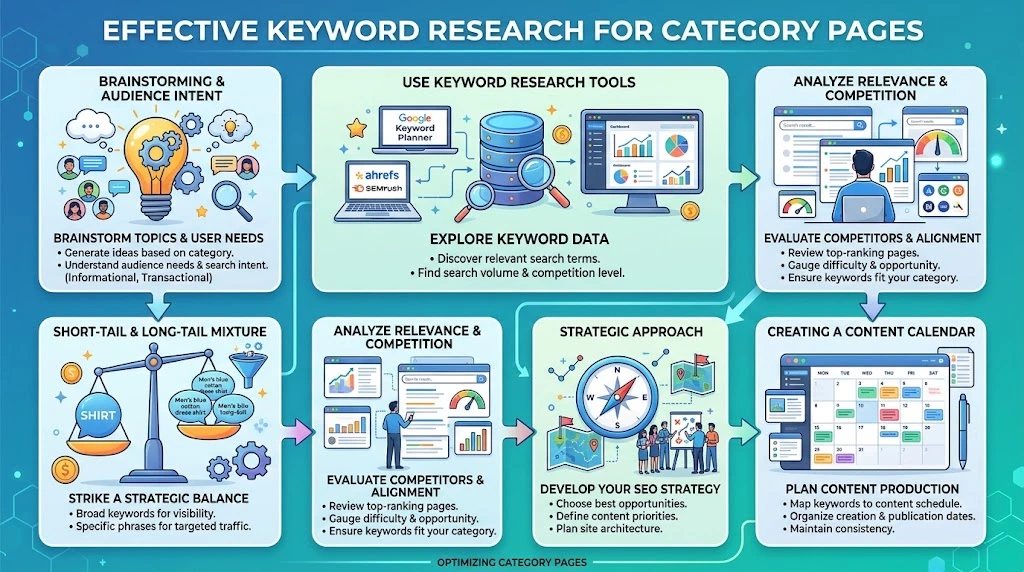 To enhance your category pages effectively, understanding keyword research is crucial. Knowing how to pinpoint the right keywords helps structure content that attracts your target audience. It can significantly boost your SEO efforts and improve your visibility on search engines.
Brainstorming
Start with brainstorming the main topics relevant to your category pages. Consider the products or services that your online store offers. Write down any terms or phrases that come to mind. Use these as a foundation for further keyword exploration.
Keyword research tools
Next, tap into keyword research tools. Tools like Ahrefs, Moz, and Keyword Tool allow you to discover search volume, related terms, and even competitive analysis. Input your brainstormed terms into these tools to find actionable data.
Mixture of short-tail and long-tail keywords
When conducting your research, aim for a mixture of short-tail and long-tail keywords. Short-tail keywords are typically more general and competitive, such as “shoes.” Long-tail keywords, on the other hand, tend to be more specific and less competitive, like “women’s running shoes for flat feet.” A healthy blend ensures you attract a diverse audience while targeting niche markets.
Analyze their relevance
Once you gather a list of potential keywords, analyze their relevance. Ensure that they align with the content on your category pages. For instance, if your category page is about “Running Shoes,” but you find keywords focused on “Basketball Shoes,” these will not resonate with your audience. This misalignment can lead to lower rankings and engagement.
Consider your audience’s intent
Consider your audience’s intent when selecting keywords. Are they looking to purchase, gather information, or compare products? Use tools like Answers The Public to understand common questions and concerns around your keywords. This knowledge allows you to tailor content that meets your visitors’ needs.
Strategic approach
Implementing keywords into your category pages requires a strategic approach. Don’t just stuff keywords; rather, integrate them naturally into your content. A few best practices include:
- Using your primary keyword in the page title.
- Including keywords in the URL structure.
- Adding keywords within H3 and H4 tags for better visibility.
- Placing keywords early in the content, primarily within the first 100 words.
- Placing keywords in image alt tags to optimize visual content.
Analyze the competition
Analyze the competition too. Look at websites that rank well for your chosen keywords. Examine how they structure their content and the keywords they focus on. Identify gaps where you can offer better content or targeted keywords. This analysis will give you insights into what your content must include to succeed.
Creating a content calendar
Creating a content calendar can help streamline your optimization process. Schedule updates for your category pages, focusing on new keywords or trends that emerge over time. You should continually revisit your keyword strategy to adapt to changing search behaviors and market dynamics.
Linking to related products
To enhance the overall performance of your category pages, consider linking them to related products or articles. This internal linking strategy keeps visitors engaged longer and improves your site’s SEO. Encourage outbound links to authoritative sources, strengthening your credibility. For further reading into category SEO optimization, you may explore Search Engine Journal for detailed guidelines.
A FAQ section on your category pages can also elevate user experience. By addressing common queries related to your keyword focus, you can directly appeal to search intent, satisfying user needs while boosting SEO performance. Effective execution of How To Optimize Category Pages for SEO involves proper keyword placement.
| Keyword Type | Description | Example |
|---|---|---|
| Short-tail | General keywords with high search volume. | Shoes |
| Long-tail | Specific keywords with lower search volume but higher intent. | Affordable running shoes for women |
To wrap up, effective keyword research for your category pages is a multi-step process. By analyzing user intent, using the right tools, and strategically placing keywords, you can significantly boost your SEO performance. Keep your content user-friendly and engaging while aligning with best SEO practices for optimal visibility and traffic growth.
Utilizing Internal Linking to Enhance Category Page Visibility
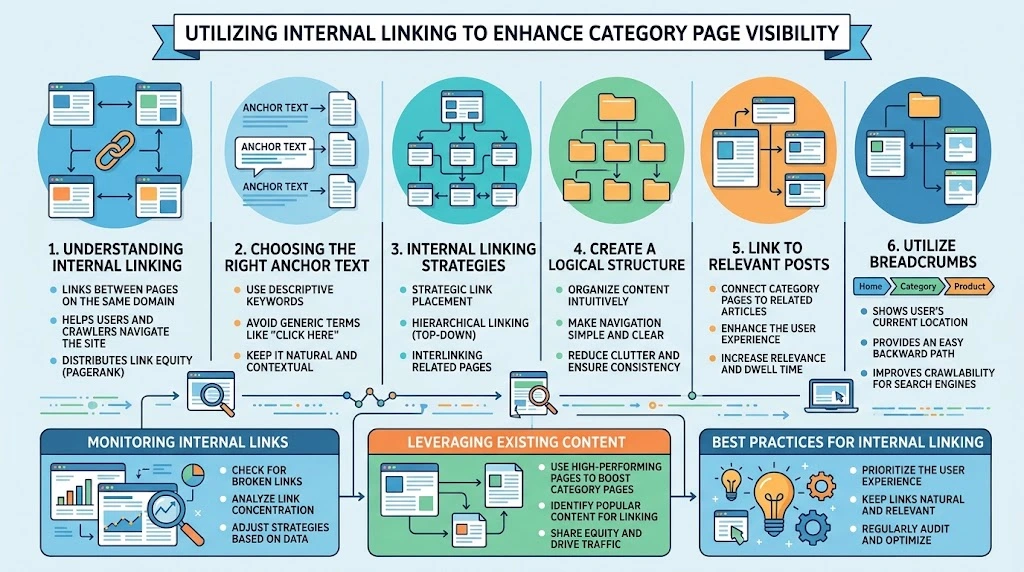
Enhancing your category page visibility through effective internal linking is a key strategy for improving your overall website SEO. This method not only helps search engines understand the structure of your website but also guides users toward discovering related content. Here are some advanced strategies to maximize the effectiveness of internal linking on your category pages.
Understanding Internal Linking
Internal linking is the process of linking one page of your website to another page within the same domain. This practice is essential for SEO and user experience. Here’s why internal links matter:
- Navigation: They help users easily navigate to related content without leaving your site.
- Distribution of Authority: Each link spreads what is often referred to as “link juice,” which helps improve the authority of linked pages.
- Enhanced Indexing: Search engines utilize internal links to understand your site’s hierarchy and prioritize certain pages during indexing.
Choosing the Right Anchor Text
When linking to category pages, using descriptive and relevant anchor text is vital. The anchor text alerts users and search engines about the content they can expect when they click the link. Here are some tips:
- Use clear and concise language that outlines the page’s content.
- Avoid generic terms like “click here.” Instead, be specific, e.g., “Men’s Running Shoes.”
- Incorporate target keywords naturally to enhance SEO.
Linking Strategies for Category Pages
To effectively utilize internal linking on your category pages, consider the following strategies:
Create a Logical Structure
Organizing your content in a hierarchical structure helps in pinpointing where to place internal links. Start with a main category that is broad, then drill down to subcategories. This logical structure reinforces relevance and authority.
Link to Relevant Posts
Whenever you create new content related to your category, ensure you link back to your category page. For example, if you write a blog post about “Best Protein Bars,” include a link to your “Nutrition” category page. This strategy encourages users to explore deeper and promotes overall engagement.
Utilize Breadcrumbs
Breadcrumbs are a simple and effective way to enhance navigation. They provide a trail for users to follow back to the main category, improving user experience. This also gives search engines deeper insights into your site’s structure.
Monitoring Internal Links
As you fine-tune your internal linking strategy, keep track of your metrics. Here’s what to monitor:
- Page Views: See which category pages attract the most clicks.
- Bounce Rate: Analyze how many visitors leave the page quickly—showing if your content is engaging.
- Conversion Rate: Understand how many users take action after visiting your category page.
Leveraging Existing Content
Don’t ignore the value of your existing posts. Review your older content for opportunities to add internal links. This not only improves visibility for category pages but also enhances the distribution of link equity across your website. Regularly revisiting these posts allows you to keep the internal linking fresh.
Best Practices for Internal Linking
Here are a few best practices that you should keep in mind when working with internal links:
- Link more important pages frequently while ensuring a natural flow.
- Avoid excessive linking as it can overwhelm users and dilute link equity.
- Regularly audit your internal links to fix any broken links, as they can harm both user experience and SEO.
Measuring the Success of Your Category Page Optimization Efforts
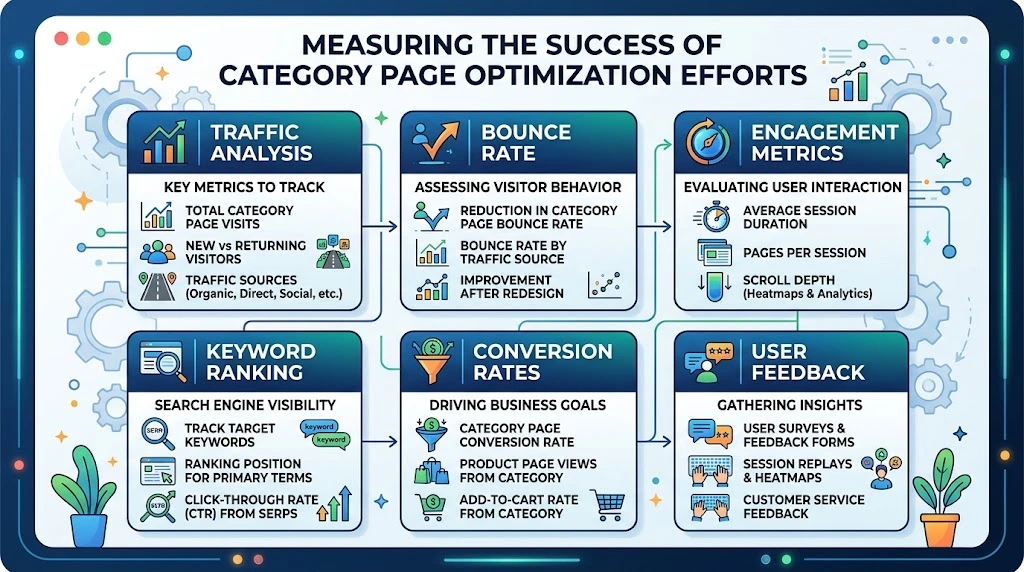
Optimizing your category pages is crucial for boosting your site’s performance in search engines and increasing user engagement. Knowing how to measure the success of your optimization efforts can help you refine your strategies effectively. Here are several metrics and methods to evaluate your category page performance. Tracking performance is a core step in How To Optimize Category Pages for SEO.
Traffic Analysis
The first indicator of success is the amount of traffic your category pages are receiving. Use tools like Google Analytics to track user visits over time. Look for trends in your traffic statistics by performing the following:
- Compare traffic before and after implementing changes.
- Monitor organic versus referral traffic.
- Identify which category pages attract the most visitors.
Increased traffic often indicates that your optimization efforts are effective. However, high traffic without engagement can signal issues that need addressing.
Bounce Rate
Bounce rate is another critical metric to consider. A high bounce rate can suggest that visitors do not find what they are looking for on your category pages. Using Google Analytics, analyze the bounce rate for each category page:
- Low bounce rates (<40%) suggest that users find the content engaging.
- High bounce rates (>70%) may indicate a mismatch between user expectations and your content.
To improve bounce rates, ensure that your content aligns with keyword searches and provides valuable information. Clear navigation and compelling visuals can help maintain visitor interest.
Engagement Metrics
Engagement metrics help you understand how users interact with your category pages. Key engagement metrics include:
- Average time on page
- Pages per session
- Click-through rate (CTR) on internal links
If users spend a considerable amount of time on your pages and navigate to other areas of your site, you’re likely providing valuable content that meets their needs. To boost these metrics, aim for clear and intuitive navigation, rich visuals, and engaging content that encourages deeper exploration.
Keyword Ranking
Tracking the rankings of your targeted keywords is vital in understanding the impact of your SEO efforts. Use tools like Moz or Ahrefs to monitor keyword positions over time. Consider:
- Which keywords are climbing in rank?
- Are your targeted long-tail keywords bringing in traffic?
- Is your content appearing for relevant searches?
Consistent monitoring can help you identify areas needing improvement and adjust your content strategy to target higher-ranking opportunities.
Conversion Rates
Your category pages should not only attract visitors but also convert them into customers. Assess the conversion rates for actions such as:
- Newsletter sign-ups
- Product purchases
- Downloaded resources
Setting up goals in Google Analytics allows you to track these conversions effectively. Make adjustments based on your findings to improve these rates, such as optimizing calls-to-action or refining your content.
User Feedback
Gathering user feedback can offer valuable insights into the effectiveness of your category pages. Consider implementing:
- Surveys to gauge satisfaction
- User testing sessions to observe interactions
- Feedback forms on category pages
User feedback can help tailor your content and layout to align better with visitor expectations and needs. By focusing on these measurable metrics, you can effectively assess the success of your category page optimization efforts. Regularly review your strategies and adapt to maintain and improve performance. For more detailed insights into SEO and website optimization, explore resources offered by Search Engine Journal and SEMrush.
Conclusion
Optimizing category pages for SEO is not just about improving search engine rankings; it’s about creating a better experience for your visitors as well. By following best practices, you ensure that your category pages are both informative and easy to navigate. A strong focus on user experience means that visitors will stay longer and engage more, which can ultimately boost your page’s performance. Knowing How To Optimize Category Pages for Seo sets you up for long-term growth.
Effective keyword research is essential in identifying terms that align with what your audience is searching for. By integrating those keywords naturally into your content, you enhance the chances of your category pages appearing in relevant search results. Additionally, utilizing internal linking is a powerful strategy that can guide users through your site, helping them discover related content and improving the overall visibility of your pages.
Measuring the success of your optimization efforts is key to understanding what works and what needs adjustment. Use analytics tools to track visitor behavior, bounce rates, and conversion rates. Each piece of data provides valuable insights that can refine your strategy.
Remember, successful optimization combines user-centric design with strong SEO practices. By putting your audience’s needs first while also applying smart optimization tactics, you’ll have category pages that not only rank well but also lead to higher engagement and satisfaction. Focus on creating a seamless experience for your users, and the search engines will recognize the value you provide, rewarding your pages with improved visibility and potential traffic growth.