Search Intent Optimization for Content Marketing

ATTENTION: Want to Learn Affiliate Marketing from Successful Affiliates?
The landscape of digital search has evolved far beyond simple keyword matching. Modern search engine algorithms evaluate contextual semantics, behavioral signals, and user satisfaction to determine which pages deserve top rankings. For digital marketers and content creators, this means that keyword volume and backlink profiles are no longer enough. Success hinges on mastering Search Intent Optimization for Content Marketing, the strategic practice of aligning your digital assets precisely with what a user wants to achieve when typing a query.
When you get search intent right, your content resonates instantly, keeping visitors engaged and signaling high relevance to search engines. When you get it wrong, even a technically pristine page with a robust backlink profile will sink to the bottom of the search results. This comprehensive manual explores how to decode, analyze, and optimize for search intent across every phase of your content marketing strategy.
Understanding the Core Pillars of Search Intent
Search intent—frequently referred to as user intent or keyword intent—represents the underlying goal or motivation driving a user’s search query. Instead of asking “What words are people typing?”, content marketers must ask “What problem are people trying to solve?”
Search engines have evolved to read behavioral clues such as dwell time, bounce rates, pogo-sticking (returning immediately to the search results page), and scroll depth to determine whether a page genuinely satisfies the user’s underlying goal. If a user lands on your page and immediately bounces back to the search engine results page (SERP) because your content format or angle missed the mark, search engines quickly demote your visibility.
To build an effective optimization framework, you must categorize queries into their primary intent groups. Understanding these distinct classifications prevents the common mistake of matching a transactional keyword with an informational blog post, or vice versa.
The Four Primary Classifications of Search Intent
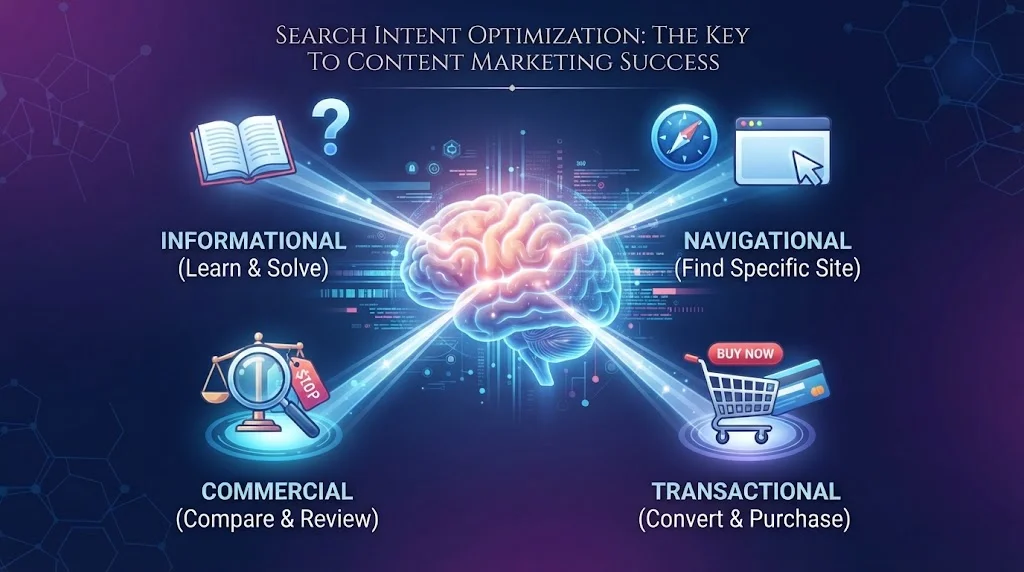
Every query entered into a search engine falls into one of four primary intent categories. Recognizing these categories dictates how you structure your text, choose your media assets, and design your conversion pathways.
1. Informational Intent
Users with informational intent are looking to learn something, answer a specific question, or solve a problem. They might search for definitions, historical background, tutorials, or troubleshooting steps.
- Common Modifiers: How, what, why, guide, tutorial, tips, examples.
- Content Formats: Comprehensive long-form blog posts, step-by-step guides, encyclopedic definitions, explanatory infographics, and FAQ repositories.
2. Navigational Intent
Navigational searches occur when a user wants to find a specific website, brand portal, or login page. They already know where they want to go; they are simply using the search engine as a shortcut instead of typing out the full URL.
- Common Modifiers: Brand names, specific product names, login, official site.
- Content Formats: Optimized homepage assets, corporate landing pages, directory listings, and clearly structured brand hubs.
3. Commercial Investigation
Commercial intent sits in the consideration phase of the buyer journey. Users know they need a product or service, but they are evaluating their options, comparing brands, and reading reviews before making a final financial commitment.
- Common Modifiers: Best, top, compare, versus (vs), review, pricing.
- Content Formats: Product roundups, comparative review matrices, “versus” articles, and expert buying guides.
4. Transactional Intent
Transactional searches happen at the bottom of the marketing funnel. The user has completed their research and is ready to make a purchase, download a resource, book an appointment, or sign up for a service.
- Common Modifiers: Buy, order, purchase, download, discount, coupon, hire, subscribe.
- Content Formats: Product category pages, transactional landing pages, streamlined checkout funnels, and service booking portals.
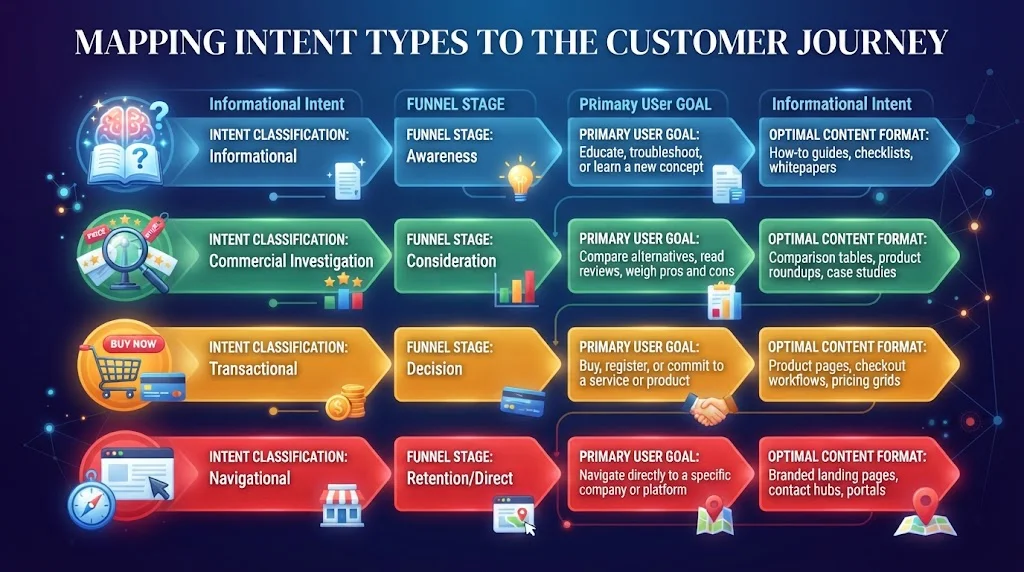
Mapping Intent Types to the Customer Journey
| Intent Classification | Funnel Stage | Primary User Goal | Optimal Content Format |
|---|---|---|---|
| Informational | Awareness | Educate, troubleshoot, or learn a new concept | How-to guides, checklists, whitepapers |
| Commercial | Consideration | Compare alternatives, read reviews, weigh pros and cons | Comparison tables, product roundups, case studies |
| Transactional | Decision | Buy, register, or commit to a service or product | Product pages, checkout workflows, pricing grids |
| Navigational | Retention/Direct | Navigate directly to a specific company or platform | Branded landing pages, contact hubs, portals |
Step-by-Step SERP Analysis: Decoding What Google Wants
Never guess search intent based solely on intuition. Search engines provide a direct blueprint of what satisfies user intent through the Search Engine Results Page (SERP). By analyzing the top-ranking results for your target keyword, you can reverse-engineer Google’s implicit expectations.
Step 1: Examine the Dominant Content Type
Type your target keyword into an incognito search window and look closely at the top five to ten organic results. Are the listings dominated by ecommerce product category pages, independent review blogs, corporate service pages, or video tutorials? If the first page consists entirely of listicles, trying to rank a static product page for that keyword will face an uphill battle. Your content format must match the dominant type.
Step 2: Analyze Content Angles and Frameworks
Look beyond the basic format and study the angle. Do the top-ranking articles share common framing, such as “for beginners,” “in 2026,” “step-by-step,” or “budget-friendly”? This consensus among top competitors reveals the specific emotional or practical angle that users expect. To learn more about overarching digital tactics, you can explore external resources like HubSpot’s Marketing Blog for additional case studies on audience research.
Step 3: Evaluate SERP Features
Take note of any special features occupying valuable screen real estate. The presence of a Featured Snippet indicates that users want a concise, direct answer structured via paragraphs, bullet points, or tables. People Also Ask (PAA) boxes provide a goldmine of secondary subtopics that you must address to make your content comprehensively satisfying.
Applying the 3 Cs Framework to Content Creation
To streamline your optimization workflow before putting pen to paper (or fingers to keyboard), apply the 3 Cs Framework of search intent. This framework filters your research into actionable structural pillars:
- Content Type: Identify whether the query demands an article, a landing page, a software tool, or a video.
- Content Format: Determine the structural presentation—such as a listicle, a how-to guide, a product review, or an ultimate masterclass.
- Content Angle: Pinpoint the unique hook or perspective required, such as beginner-focused, enterprise-level, cost-effective, or fast execution.
Structuring Content for Maximum Engagement and Retention
Once you match the intent, your formatting dictates whether users stay or bounce. Clean, scannable layouts improve user experience and help search algorithms crawl your semantic structure efficiently.
Crafting Magnetizing Headlines
Your headline serves as the gateway to your content. It must promise a clear reward while setting accurate expectations that match the search intent. Vague titles lead to high bounce rates, while specific, value-driven titles capture high-intent clicks. For instance, instead of publishing a generic post titled “Content Marketing Strategies,” a headline like “10 Advanced Content Marketing Frameworks to Scale Organic Traffic” explicitly targets commercial and informational depth.
Designing for Readability and Scannability
Online readers rarely read word-for-word; they scan. Break up dense walls of text by utilizing structured heading hierarchies (H2, H3), concise bulleted lists, and highlighted blockquotes. For structured data guidance and technical optimization tips, review documentation provided by Google Search Central.
Integrating Subtopics and Semantic Depth
A common pitfall in content marketing is answering only the surface-level question without addressing the follow-up queries lingering in the user’s mind. True search intent optimization requires comprehensive topic coverage.
When a user searches for a broad term, they often have adjacent questions regarding cost, implementation timelines, prerequisites, and common mistakes. By harvesting questions from the People Also Ask box and integrating them as subheadings (H2 or H3), you build an exhaustive resource that satisfies the user’s journey in a single session. Furthermore, incorporating strategic internal links allows you to guide readers smoothly to the next logical stage of their buyer journey.
Measuring Success: Metrics That Matter for Search Intent
Evaluating the performance of your search intent optimization efforts requires tracking metrics that reflect user satisfaction rather than vanity traffic numbers alone.
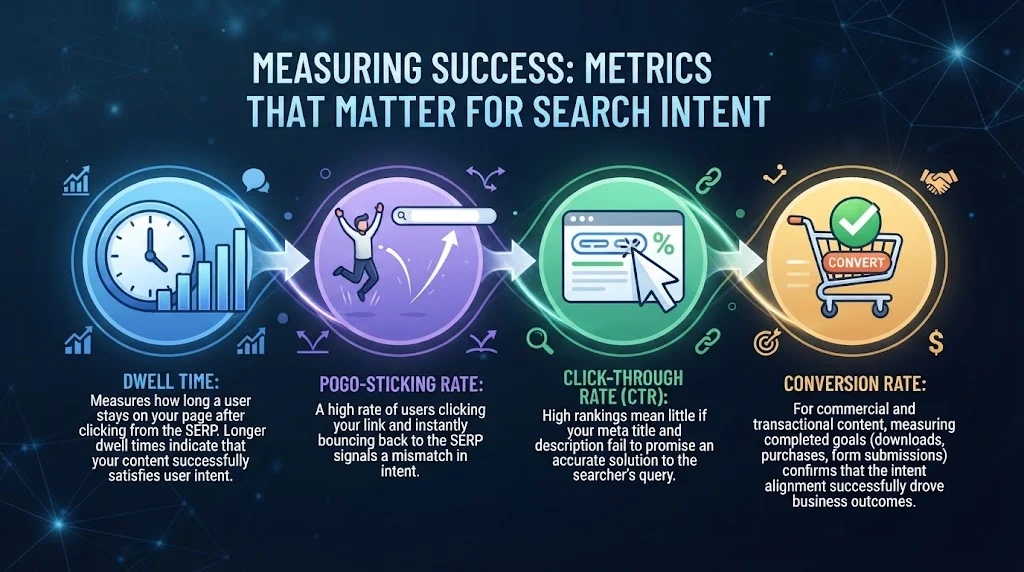
Key Performance Indicators (KPIs)
- Dwell Time: Measures how long a user stays on your page after clicking from the SERP. Longer dwell times indicate that your content successfully satisfies user intent.
- Pogo-Sticking Rate: A high rate of users clicking your link and instantly bouncing back to the SERP signals a mismatch in intent.
- Click-Through Rate (CTR): High rankings mean little if your meta title and description fail to promise an accurate solution to the searcher’s query.
- Conversion Rate: For commercial and transactional content, measuring completed goals (downloads, purchases, form submissions) confirms that the intent alignment successfully drove business outcomes.
Common Search Intent Pitfalls to Avoid
Even seasoned marketers occasionally stumble when optimizing for search intent. Avoiding these frequent missteps protects your organic visibility:
- Mixing Intent Types on a Single Page: Attempting to force an informational blog post to double as a transactional product sales page creates a disjointed user experience that satisfies neither goal. Keep your educational resources separate from your conversion landing pages.
- Ignoring the Changing SERP Landscape: Search intent is not static; it shifts as user behavior and seasonal trends evolve. A query that was purely informational two years ago might feature commercial comparison lists today. Regularly re-audit your target keywords.
- Keyword Stuffing Without Context: Focusing exclusively on literal keyword frequency while ignoring the semantic needs of the reader leads to unnatural copy and high bounce rates. Prioritize clarity and value above all else.
Future-Proofing Your Strategy with Intent-Led Marketing
As search engines incorporate conversational AI, zero-click answers, and multimodal queries into their core architectures, the importance of search intent optimization will only accelerate. Algorithms no longer rely solely on keywords; they evaluate whether a piece of content genuinely solves a human problem.
By treating search intent as the foundation of your content marketing strategy—conducting rigorous SERP analysis, matching content formats to user expectations, and maintaining comprehensive topic depth—you build an organic engine that consistently attracts, engages, and converts your ideal audience. Align your content with what your audience is truly searching for, and sustainable growth will naturally follow.
Advanced Keyword Research and Semantic Mapping for Search Intent
To truly master Search Intent Optimization for Content Marketing, you must look beyond basic keyword tools that only show search volume and keyword difficulty metrics. Modern SEO requires an intimate understanding of semantic search, latent semantic indexing (LSI) terms, and entity-based optimization. When search engines process a query, they are no longer just matching strings of text; they are identifying real-world entities, concepts, and the relational context between them.
For instance, if a user searches for “running shoes,” the search engine recognizes that the intent spans across multiple sub-categories: injury prevention, cushioning types, flat feet support, and brand comparisons. If your content only covers generic descriptions without addressing these contextual sub-entities, you will fail to capture the broader semantic footprint required to rank for competitive terms. Building a comprehensive semantic map involves dissecting the core keyword, identifying related modifiers, and mapping out the specific entities that Google expects to find on a comprehensive, authority-building page.
Leveraging Natural Language Processing (NLP) in Intent Modeling
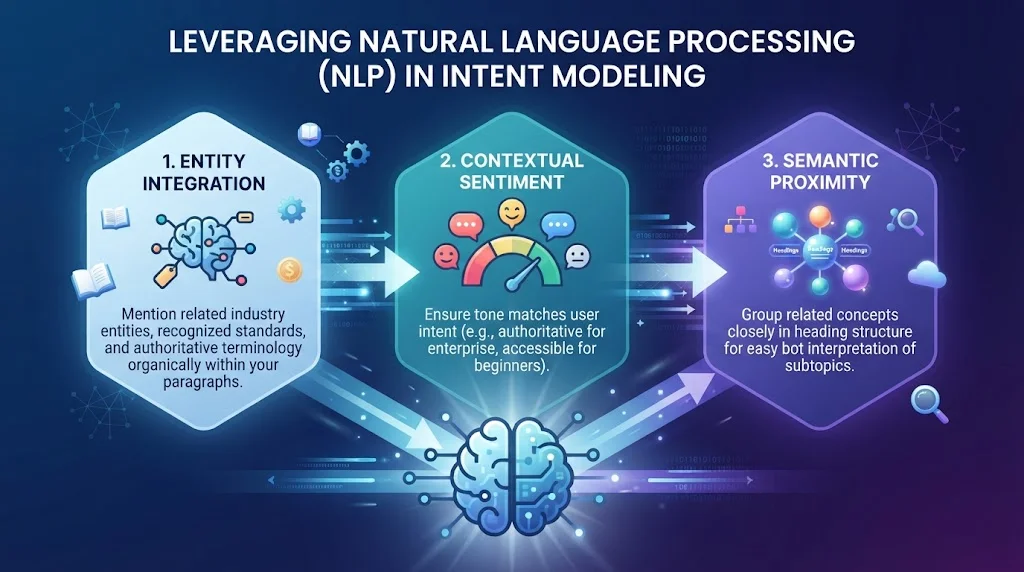
Search engines utilize advanced Natural Language Processing (NLP) models to evaluate text quality, sentiment, and contextual depth. NLP algorithms scan content to measure how naturally concepts flow and whether the text answers the implicit follow-up questions a user might have. To align with NLP-driven search algorithms, your content must embrace deep contextual coverage rather than superficial keyword repetition.
- Entity Integration: Mention related industry entities, recognized standards, and authoritative terminology organically within your paragraphs.
- Contextual Sentiment: Ensure the tone of your writing directly matches what the user seeks—authoritative and technical for enterprise topics, encouraging and accessible for beginner-level tutorials.
- Semantic Proximity: Group related concepts closely together in your heading structure so that crawling bots can easily interpret the core subtopics of your page.
Technical SEO Alignment with Search Intent
Content optimization cannot exist in a vacuum; it requires seamless collaboration with technical SEO. Even the most precisely targeted content will struggle to perform if search engines cannot crawl, index, and render the page efficiently, or if the user experience fails to meet core web vitals standards.
Core Web Vitals and User Experience Signals
Search intent is heavily tied to user experience (UX). If a user clicks a result matching their exact transactional intent, but the landing page takes eight seconds to load, the layout shifts unpredictably, and pop-ups obstruct the view, the user will immediately bounce. This behavioral signal tells the search engine that the page failed to satisfy the intent, regardless of how well-written the copy might be.
- Largest Contentful Paint (LCP): Ensure your primary hero images, charts, and headlines load within 2.5 seconds to retain the user’s initial attention.
- Cumulative Layout Shift (CLS): Prevent intrusive elements or dynamic ad banners from shifting text around while the user is trying to read or interact with the page.
- Interaction to Next Paint (INP): Guarantee fast response times when users click buttons, expand drop-down menus, or navigate through interactive comparison calculators.
Structured Data Markup and Intent Enhancement
Implementing Schema.org structured data helps search engines explicitly understand the format and purpose of your content, allowing your pages to trigger enhanced SERP features like FAQ snippets, product carousels, or review stars. By pairing Search Intent Optimization for Content Marketing with precise schema markup, you increase your chances of dominating visual real estate on the results page.
Localized and Multilingual Search Intent Dynamics
As digital markets expand globally and target hyper-local audiences, search intent behavior shifts dramatically based on geographic location, cultural nuances, and regional terminology. A query that has purely informational intent in one country might carry heavy transactional or commercial weight in another.
Adapting Content for Regional Variations
- Terminology Shifts: Recognize that synonyms vary widely across regions (e.g., “sneakers” vs. “trainers” or “apartment” vs. “flat”). Matching the local vernacular is a critical component of satisfying local search intent.
- Cultural Context: Tailor your examples, case studies, and compliance references to match the legal and cultural framework of the target audience.
- Local Intent Signals: When users append modifiers like “near me” or specify a city name, the intent shifts from broad informational to local navigational or transactional. Your content must pivot to provide physical addresses, operating hours, local reviews, and regional service availability.
Content Auditing and Intent Refinement Workflows
Websites accumulate dozens, hundreds, or even thousands of legacy blog posts and landing pages over time. Many of these pages experience drops in organic traffic not because their backlinks faded, but because user search intent has evolved while the content remained stagnant. Performing regular content audits specifically focused on intent alignment can breathe new life into underperforming assets.
Measuring Long-Term ROI and Business Impact
While metrics like dwell time, bounce rates, and organic traffic offer immediate feedback on how well your content satisfies search intent, executive leadership ultimately measures success through pipeline growth and revenue generation. Connecting your intent optimization strategy directly to business outcomes proves the financial value of organic marketing.
Building an Intent-Driven Attribution Model
By tracking user behavior across different funnel stages, you can map how informational traffic eventually transitions into commercial evaluation and final purchase transactions.
- Assisted Conversions: Recognize that informational content often acts as the critical first touchpoint in a buyer’s journey, even if the conversion happens days later via a transactional landing page.
- Content ROI Calculation: Measure the total cost of content creation and optimization against the cumulative revenue generated by organic conversions attributed to those specific pages.
- Lifecycle Engagement Tracking: Evaluate whether users who land on your optimized content go on to subscribe to newsletters, download gated whitepapers, or become repeat customers.
Key Takeaways for Immediate Implementation
- Analyze the SERP First: Always check what content formats and angles currently dominate the top five results before writing.
- Match the Format: Deliver guides for informational queries, comparison matrices for commercial queries, and streamlined funnels for transactional queries.
- Monitor Behavioral Metrics: Track dwell time, bounce rates, and pogo-sticking to measure true intent satisfaction.
What specific search intent challenges are you currently facing in your content marketing campaigns?
Mastering Search Intent Optimization for Content Marketing is an ongoing discipline that requires continuous monitoring of algorithm updates, user behavior shifts, and competitive landscapes. By anchoring every piece of content you produce in a deep understanding of what your audience truly wants to achieve, you build an enduring digital asset base that stands resilient against algorithmic volatility.