DeepSeek Harness vs Hermes: The Revolutionary AI Agent Showdown

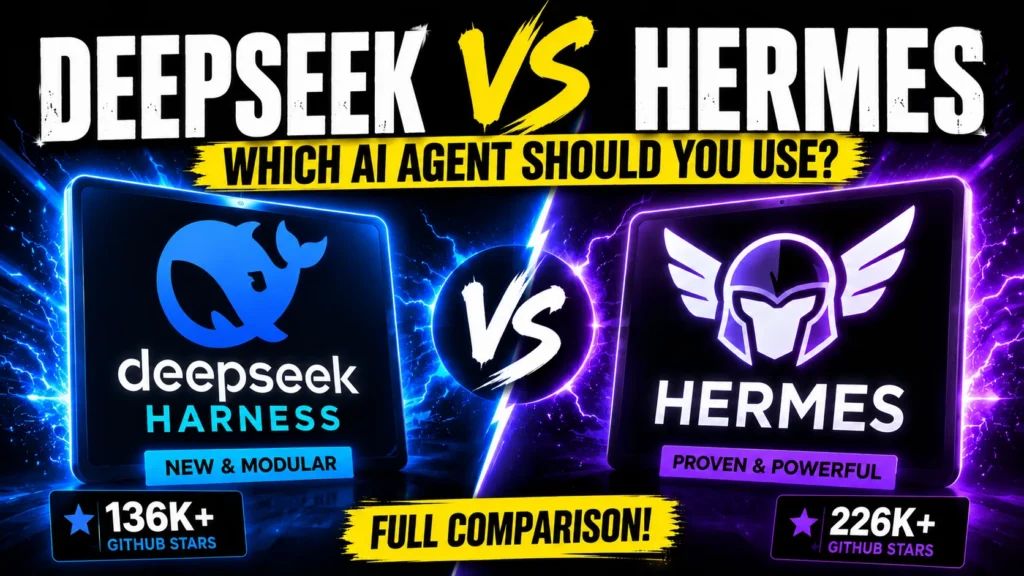
The world of AI agents is evolving at a breathtaking pace, and two open-source powerhouses are leading the charge: DeepSeek Harness and Hermes. One garnered over 113,000 GitHub stars in mere days; the other boasts over 226,000 stars and months of development. Both are free, both open-source, and both promise to transform how your business operates daily.
But which one truly delivers? And more importantly, which one is right for your workflow? We put these two titans head-to-head to uncover their strengths, weaknesses, and a surprising optimal strategy.
DeepSeek Harness: The Rapid Rise of “AI Lego”
DeepSeek Harness exploded onto the scene, quickly accumulating over 136,000 GitHub stars. This local AI agent runs directly on your computer, enabling it to read files, execute commands, modify code, and scour the web, acting as your personal AI assistant.
What makes DeepSeek Harness truly game-changing is its “everything is a plugin” philosophy, powered by the modular Cordis framework. Imagine AI as Lego:
* Swappable Components: The model it uses, the tools it calls, memory management, session logs, search functions, sub-agents, scheduling – even the core thinking loop – are all plugins.
* Unparalleled Customization: This allows every single piece to be pulled out, swapped, or replaced without touching the core code. This design means DeepSeek Harness isn’t just a tool; it’s a completely moldable platform built on years of underlying testing.
Hermes: The Self-Improving Memory System
Hermes, with its impressive 226,000 GitHub stars, has been a significant player for longer, standing out with its next-level self-improving memory system. This agent features multi-channel communication capabilities and a unique 3-layer memory system that continuously learns and refines its performance over time.
While powerful, Hermes offers a different approach, focusing on persistent learning and sophisticated recall.
Head-to-Head: DeepSeek Harness vs. Hermes
Both agents are free, open-source, and backed by large, active communities. However, daily usage reveals crucial differences that dictate their suitability for various tasks.
1. Usability & Stability: Who Breaks Less for Beginners?
- DeepSeek Harness: A clear winner for beginners. It’s significantly more stable and intuitive, especially for coding tasks. Its user experience is designed for smooth, consistent operation.
- Hermes: While powerful, Hermes can be fiddly and prone to breaking, requiring more troubleshooting and patience from users. It has a steeper learning curve for stable operation.
2. Output Quality & Speed: Coding Tasks Compared
- DeepSeek Harness: Excels in coding tasks, providing faster and superior results, particularly when paired with models like DeepSeek V4 Pro. Its stability ensures it can handle larger, more complex coding jobs without timing out.
- Hermes: Better suited for smaller, scheduled tasks. It can struggle with larger coding projects, occasionally timing out or failing to complete them efficiently.
3. Customization & Connectivity: The Plugin Advantage
- DeepSeek Harness: Its “everything is a plugin” architecture gives it an unbelievable edge. It can effortlessly replicate features found in Hermes, such as mobile connectivity, and seamlessly integrate with frontier AI models. This adaptability makes it highly future-proof.
- Hermes: While capable, it doesn’t offer the same granular level of modularity. Its features are more integrated, limiting extreme customization compared to DeepSeek.
4. Workflow Integration: Seamless vs. Disjointed
- DeepSeek Harness: Integrates beautifully into existing browser-based workflows. It runs as a local website, offering a familiar, non-disruptive experience that feels like using any other web application.
- Hermes: Often requires users to juggle multiple desktop applications, which can disrupt workflow and create a more fragmented user experience.
5. User Interface (UI) & Experience: Clean vs. Complex
- DeepSeek Harness: Presents a clean, intuitive UI reminiscent of popular platforms like ChatGPT or Claude. This familiarity reduces cognitive load and enhances user satisfaction.
- Hermes: Features a more complex, “noisy” UI that can be less user-friendly, requiring more effort to navigate and understand.
The Wild Verdict: Why Running Both Agents Wins
Instead of choosing one, the optimal strategy is to leverage both DeepSeek Harness and Hermes through an ‘Agentic Operating System.’ * DeepSeek Harness: Ideal for rapid development, complex coding, and situations demanding high stability and customization. * Hermes: Shines for tasks requiring sophisticated memory, self-improvement, and multi-channel communication for smaller, scheduled tasks.
As open-source tools and free models become increasingly powerful, combining their unique strengths creates an unstoppable AI workflow. If forced to pick just one, DeepSeek Harness offers a more intuitive, moldable, and relaxed user experience, making it a compelling choice for many.
P.S. If you want to go deeper than just tutorials and actually build a business with AI tools then join the AI Profit Boardroom. Here’s where you will find tons of tutorials, tips, tools and advanced workflows that don’t make it to YouTube. Check out the AI Profit Boardroom here: https://clinthermanlikes.com/aipb