
Content Marketing Ideas for Local Brands

ATTENTION: Want to Learn Affiliate Marketing from Successful Affiliates?
How neighborhood businesses can compete with big budgets by being unmistakably, unapologetically local.
Here’s something big national brands can never truly replicate: they don’t know your customers by name. They don’t know which regular orders the same thing every Tuesday, or which local school just won the championship, or which street still floods every time it rains. You do. And that knowledge, if you use it right, is one of the most powerful marketing assets a local brand can have.
Content marketing for local businesses isn’t about outspending the competition — it’s about out-relating them. The brands that win locally aren’t necessarily the loudest; they’re the ones that feel like part of the neighborhood rather than a business operating inside it. This guide is packed with real, usable content ideas to help you build exactly that kind of presence, one post, video, and story at a time.
What’s exciting about this approach is how accessible it is. You don’t need a marketing degree, a big production budget, or a team of specialists to start showing up meaningfully in your community’s feeds and search results. You need a smartphone, a genuine understanding of your customers, and a willingness to keep showing up consistently — even when a post doesn’t get the engagement you hoped for right away.
Why Content Marketing Matters More Than Ever for Local Brands
Local shoppers today research before they ever walk through your door. They check reviews, browse social media, and often decide whether they trust you long before they decide whether to buy from you. That’s exactly where content marketing earns its keep.
- Builds trust before the first visit — helpful, authentic content answers questions and eases hesitation before a customer ever steps inside.
- Strengthens local search visibility — regularly published, location-relevant content signals to search engines that your business is active and genuinely tied to the community.
- Creates word-of-mouth momentum — content that celebrates the community tends to get shared locally far more than generic promotional posts ever will.
- Differentiates you from national chains — big brands can’t replicate genuine local relationships, and content is how you make that difference visible.
- Costs far less than paid advertising — much of the most effective local content costs nothing but time, a smartphone camera, and a willingness to show up consistently.
The businesses thriving in local markets right now aren’t necessarily the ones with the biggest marketing budgets. They’re the ones treating content as an ongoing conversation with their community, not a one-off campaign.
Get Found Locally First: Optimizing the Foundations
Before diving into creative content ideas, make sure the basics are locked in — because even the best content won’t help if potential customers can’t find your business in the first place.
- Claim and fully optimize your Google Business Profile, including accurate hours, photos, categories, and a keyword-rich business description.
- Post updates directly to your profile — Google Business Profile allows short posts about offers, events, and news that appear right in local search results.
- Encourage and respond to reviews — a steady stream of recent, thoughtfully answered reviews is one of the strongest local trust signals available to you.
- Use local keywords naturally throughout your website and content — phrases like “in [neighborhood]” or “near [landmark]” help both search engines and readers understand your relevance to the area.
Once these fundamentals are solid, every piece of content you create afterward has a much better chance of actually reaching the local audience it’s meant for.
Tell Your Community’s Story, Not Just Your Brand’s
One of the biggest mistakes local brands make is treating content marketing like a smaller version of national advertising — polished, generic, and centered entirely on the business itself. The real opportunity lies in flipping that script.
- Feature the neighborhood, not just the storefront — content about local landmarks, history, or events tends to resonate more deeply than content that’s purely promotional.
- Highlight the people behind the business — customers connect far more with a face and a name than with a logo.
- Celebrate local milestones — a town festival, a local sports win, or a community fundraiser are all natural, authentic opportunities to create timely, relevant content.
- Share your own origin story — why you started the business, why you chose this location, and what the community means to you humanizes your brand instantly.
People don’t just want to buy from a business. They want to feel like they’re supporting someone — and something — they genuinely care about.
Content Ideas That Turn Local Customers Into Loyal Fans
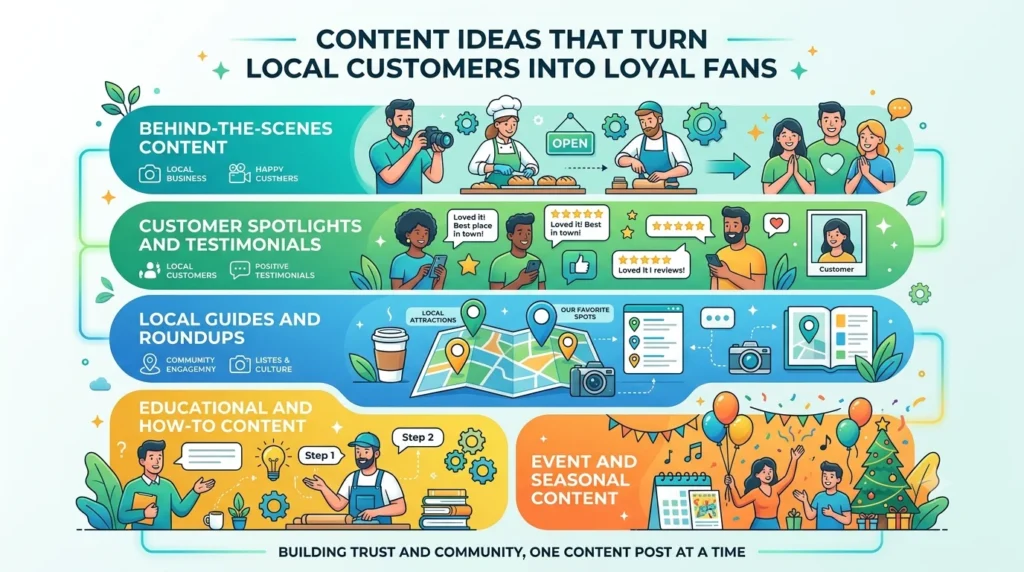
This is where things get fun. Below are content formats that consistently perform well for local brands, across nearly every industry from cafes to salons to home services.
Behind-the-Scenes Content
- Show the process — how a dish is made, how a repair is completed, how a product is prepared — people love seeing the “how” behind what they’re paying for.
- Introduce your team through short profiles or casual video clips, giving customers familiar faces to look for when they visit.
- Document a typical day at the business — mundane to you, genuinely interesting to a curious local audience.
Customer Spotlights and Testimonials
- Feature regulars — a short interview or photo series with loyal customers builds community while doubling as authentic social proof.
- Repost user-generated content whenever customers tag your business, with their permission — nothing builds trust faster than real people vouching for you.
- Share transformation stories where relevant — before-and-afters for service-based businesses are consistently high-performing content.
Local Guides and Roundups
- Create neighborhood guides — “Best Things to Do Near [Your Location]” positions your brand as a genuine local resource, not just a seller.
- Partner with other local businesses in these guides to expand your reach through their audience too.
- Publish seasonal roundups — holiday guides, summer activity lists, or “cozy spots for a rainy day” style content tends to get saved and shared repeatedly.
Educational and How-To Content
- Answer common customer questions in blog posts or short videos — this builds authority while also improving your local search visibility.
- Share maintenance or care tips related to your product or service, which keeps your brand useful to customers even between purchases.
- Host a simple FAQ series addressing hesitations new customers commonly have before their first visit.
Event and Seasonal Content
- Promote local events you’re hosting or sponsoring, treating them as genuine community contributions rather than pure marketing.
- Tie content to local seasons and traditions — a farmers market opening, a local festival, or even predictable weather patterns can all inspire timely, relatable content.
- Recap events afterward with photos and highlights — this extends the content’s life and reminds people who missed it what they can look forward to next time.
Quick tip: keep a running list of local events, holidays, and seasonal moments for the next six months. Planning content around a calendar like this removes the guesswork of “what do I post today?”
Repurpose Content to Get More Mileage From Every Idea
Local business owners are almost always stretched thin, which makes content creation feel like one more task competing for the same limited hours. The good news is that a single strong idea can be reshaped into multiple pieces of content, dramatically reducing the time needed to stay consistently visible.
- Turn one video into five posts — a single behind-the-scenes clip can become a short-form video, a few photo stills for a carousel post, a quote graphic, and a blog post expanding on the topic.
- Recycle seasonal content yearly — a well-performing holiday guide or event recap can be refreshed and reposted the following year with minimal extra effort.
- Turn customer questions into content — every question asked in person or via message is a ready-made topic for a future post, video, or blog article.
- Batch-create when possible — setting aside a couple of hours once a month to film or photograph several pieces of content at once can save considerable time compared to creating everything last-minute.
Treating content creation this way turns it from a constant scramble into a manageable, sustainable part of running the business — which matters enormously for consistency over the long run.
Leverage Local SEO Through Blogging and Guides
A blog might feel like an odd fit for a small local business, but it’s one of the most underused tools available for building long-term, organic local visibility. Every blog post is another chance to show up in search results for the exact questions your future customers are typing into Google.
- Write posts targeting “near me” and neighborhood-specific searches, such as “best coffee shop in [neighborhood]” or “affordable plumber near [city].”
- Answer hyper-local questions your customers actually ask — parking availability, accessibility, or specific local regulations relevant to your industry.
- Use Google Trends to spot rising local or seasonal search interest you can create timely content around.
- Interlink your blog posts with your service pages so visitors — and search engines — can easily explore related content across your site.
Video and Visual Content That Showcases Your Neighborhood Presence
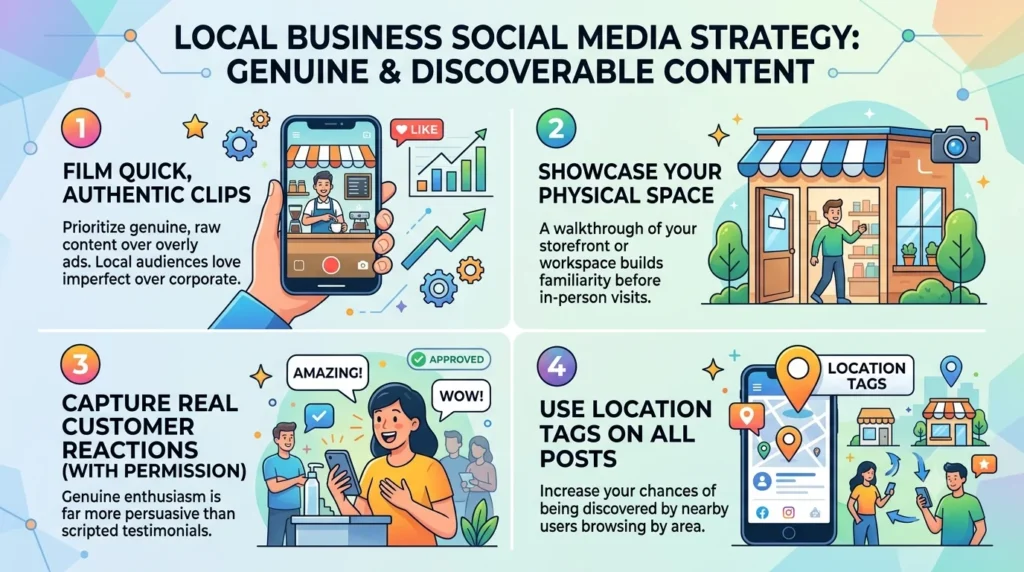
Short-form video has become one of the most powerful tools available to local businesses, largely because it requires almost no budget — just a phone, a bit of creativity, and consistency.
- Film quick, authentic clips rather than overly polished ads — local audiences respond better to genuine, slightly imperfect content than to something that feels overly corporate.
- Showcase your physical space — a walkthrough of your storefront or workspace helps build familiarity before someone ever visits in person.
- Capture real customer reactions (with permission) — genuine enthusiasm is far more persuasive than any scripted testimonial.
- Use location tags on every video and photo post across social platforms to increase your chances of being discovered by nearby users browsing by area.
Email Marketing for Local Brands: Staying Top of Mind
It’s easy to underestimate email when there’s so much focus on social media, but for local businesses, a well-maintained email list remains one of the highest-return content channels available.
- Send a simple monthly newsletter featuring updates, new arrivals, or upcoming local events — consistency matters more than frequency here.
- Segment your list by customer behavior where possible, tailoring offers to repeat customers differently than first-time subscribers.
- Highlight community involvement in your emails — sponsorships, charity partnerships, or local collaborations reinforce your role in the neighborhood.
- Keep the tone conversational, as if you’re writing to a familiar customer rather than blasting a generic promotional list.
Social Media Strategies Built for Local Engagement
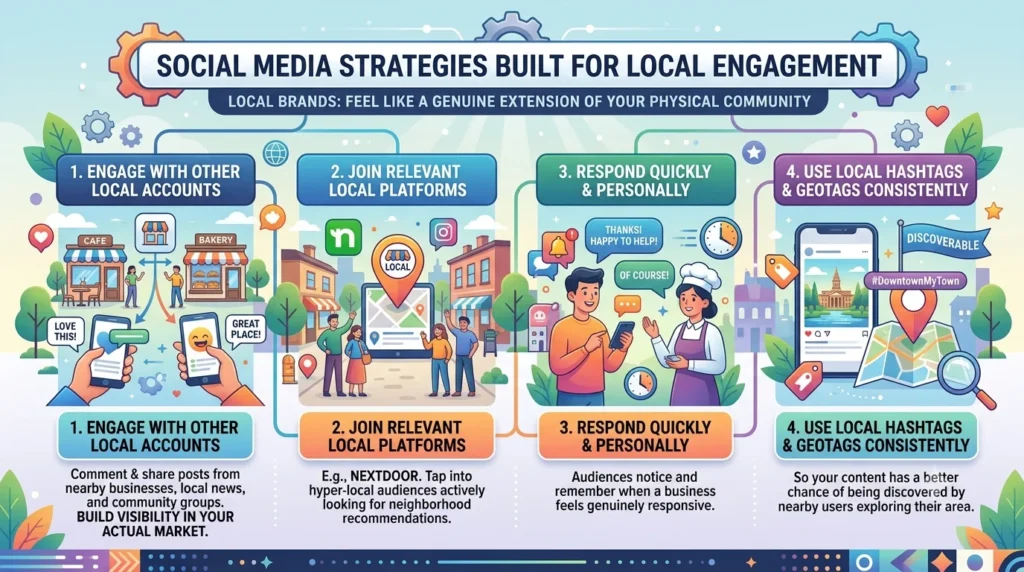
Social media for local brands works best when it feels like a genuine extension of the physical community, not a broadcast channel shouting into the void.
- Engage with other local accounts — commenting on and sharing posts from nearby businesses, local news, and community groups builds visibility within your actual market.
- Join relevant local platforms like Nextdoor, where hyper-local audiences actively look for neighborhood business recommendations.
- Respond quickly and personally to comments and messages — local audiences notice and remember when a business feels genuinely responsive.
- Use local hashtags and geotags consistently so your content has a better chance of being discovered by nearby users exploring their area.
Collaborate With Other Local Businesses and Influencers
Local businesses often make the mistake of viewing every nearby business as a competitor, when in reality, many make excellent collaborators — especially those serving a similar audience without directly competing for the same sale.
- Cross-promote with complementary businesses — a bakery and a coffee shop, or a gym and a healthy meal-prep service, naturally share overlapping audiences.
- Partner with micro-influencers in your area — a local creator with a modest but genuinely engaged following can often drive more relevant foot traffic than a much larger, less localized account.
- Co-host events or giveaways with nearby businesses to combine audiences and split the promotional workload.
- Support each other’s content by sharing, commenting, and mentioning one another regularly — this kind of visible camaraderie strengthens both brands’ local credibility.
These partnerships also tend to open doors that solo marketing efforts can’t — an introduction to a collaborator’s loyal customer base, a shared table at a community event, or simply more goodwill circulating around your name in local conversations.
Track What’s Working and Refine Your Strategy
Content marketing for local brands doesn’t need complicated analytics dashboards, but it does need consistent attention to what’s actually resonating.
- Monitor engagement patterns across your social platforms to identify which content types — behind-the-scenes, guides, customer features — consistently perform best.
- Track foot traffic and mentions tied to specific campaigns or posts, especially around events or promotions.
- Review your Google Business Profile insights regularly to see how customers are finding and interacting with your listing.
- Ask customers directly how they heard about you — this simple, low-tech feedback loop often reveals more than any analytics tool.
Build a Content Calendar Around Local Moments, Not Just Holidays
Most content calendars default to national holidays and generic industry observances, but the real opportunity for local brands lies in moments that matter specifically to your town or neighborhood — the ones a national competitor would never think to plan around.
- Map out your area’s actual rhythm — school calendars, local festivals, farmers market seasons, and even predictable weather patterns all create natural content opportunities.
- Note recurring community events — annual parades, sports seasons, or town anniversaries are worth planning content around well in advance.
- Track local news loosely — a new development opening nearby, a road closure, or a community milestone can all become timely, relevant talking points.
- Leave room for spontaneity — some of the best local content comes from reacting quickly to something happening right now, so don’t over-plan every single post months in advance.
A content calendar built this way feels noticeably different from a generic template — it reads as though it could only have been written by someone who actually lives and works in that specific community, which is exactly the impression you want to leave.
Common Mistakes Local Brands Make With Content Marketing
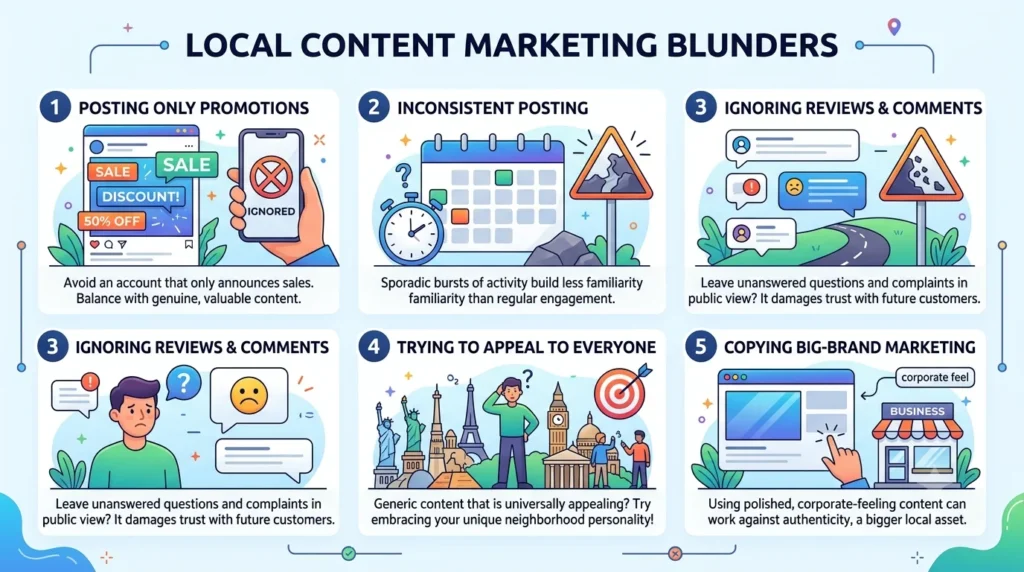
- Posting only promotions — an account that only ever announces sales quickly becomes easy to ignore; balance offers with genuine, valuable content.
- Inconsistent posting — sporadic bursts of activity followed by long silences make it harder to build the familiarity that local content marketing depends on.
- Ignoring reviews and comments — unanswered questions or complaints left in public view can quietly damage trust with future customers browsing your page.
- Trying to appeal to everyone — content that tries to be universally appealing often ends up feeling generic; embracing your specific neighborhood’s personality works better.
- Copying big-brand marketing styles — polished, corporate-feeling content can actually work against local businesses, where authenticity is often the bigger asset.
Frequently Asked Questions About Local Content Marketing
How often should a local business post content?
Consistency matters more than volume. Two to three thoughtful social posts per week, paired with a monthly blog post and newsletter, is a sustainable rhythm for most small teams — and far more effective than sporadic bursts of activity followed by long silences.
What if I don’t have a big marketing budget?
Most of the highest-performing local content costs nothing but time — a smartphone video, a customer spotlight, a neighborhood guide. Budget matters far less in local content marketing than authenticity and consistency do.
Should every local brand be on every social platform?
No. It’s far more effective to show up consistently on one or two platforms where your actual customers spend time than to spread thin, inconsistent effort across five different channels.
How do I measure whether local content marketing is working?
Look beyond likes and follower counts. Foot traffic increases, direct mentions of specific content when customers visit, growth in Google Business Profile views, and repeat customer rates are all far more meaningful indicators of real impact.
Final Thoughts: Be the Brand Your Neighborhood Actually Roots For
Content marketing for local brands isn’t about mimicking national campaigns on a smaller budget. It’s about leaning fully into what makes your business genuinely part of the community — the people, the stories, the shared history of the neighborhood you serve. That’s not something a big-box competitor can replicate no matter how much they spend.
Start small. Pick one or two content ideas from this guide that feel like a natural fit for your brand and your team’s bandwidth, and commit to doing them consistently for the next few months rather than trying to execute everything at once. Real community trust builds slowly, post by post, story by story — but once it’s built, it becomes one of the most durable competitive advantages a local business can have.
Your neighborhood is already full of stories worth telling. The businesses that thrive long-term are usually just the ones willing to keep telling them.
And remember — the goal isn’t to go viral outside your area. A modest post that genuinely resonates with the few thousand people who actually live and shop nearby is worth far more to a local brand than a broad post that reaches millions of people who will never walk through your door. Depth of connection, not breadth of reach, is what makes local content marketing genuinely pay off.