Best Strategies for Promoting Digital Planners as an Affiliate

ATTENTION: Want to Learn Affiliate Marketing from Successful Affiliates?
How to turn a niche, low-competition product into a steady stream of affiliate commissions — without sounding like a salesperson.
If you’ve been searching for a corner of the affiliate world that’s still wide open, still profitable, and still genuinely fun to work in, let me stop you right there: you’ve found it. Digital planners are one of the most underrated affiliate products on the internet right now. They’re cheap to buy, easy to demo, endlessly shareable, and they solve a problem almost everyone has — staying organized in a world that refuses to slow down.
But here’s the catch. A great product doesn’t sell itself. Even the most beautifully designed digital planner will sit untouched in someone’s cart unless the right person shows it to the right audience in the right way. That’s where you come in. This guide walks through the strategies that actually move the needle — the ones real affiliates are using right now to turn planner links into consistent income.
What makes this niche especially exciting is how forgiving it is for beginners. You don’t need a massive following, a huge advertising budget, or years of marketing experience to start earning. You need a genuine understanding of who struggles with staying organized, a willingness to show up consistently, and a handful of proven strategies you can lean on when you’re not sure what to post next. That’s exactly what you’ll find below.
Why Digital Planners Are a Goldmine for Affiliates
Before diving into tactics, it’s worth understanding why this niche works so well for affiliate marketers. Unlike physical products, digital planners have no shipping delays, no inventory issues, and no “out of stock” excuses standing between a click and a commission.
- Instant gratification for the buyer — people download and start using the planner within minutes of purchase, which makes the decision to buy feel low-risk.
- Visually driven product — planners are gorgeous to look at, which means your content practically markets itself once you show it in action.
- Recurring seasonal demand — January, back-to-school season, and even “new quarter, new me” moments create built-in buying windows all year long.
- Broad audience appeal — students, entrepreneurs, parents, teachers, and creatives all buy planners for completely different reasons, which multiplies your potential audience.
- High perceived value at a low price point — a $15–$40 planner feels like a steal compared to the productivity transformation it promises, making it an easy “yes” for buyers.
Put simply: the product practically sells itself. Your job is to get it in front of the right eyes, in a way that feels like a genuine recommendation rather than an advertisement.
Know Your Digital Planner Niche Before You Promote Anything
The biggest mistake new affiliates make is promoting digital planners to “everyone.” That’s not a strategy — it’s a shot in the dark. Successful affiliates pick a lane and go deep.
Ask yourself who you’re really talking to. A student planner buyer wants class schedules, assignment trackers, and GPA calculators. A business owner wants CRM-style trackers, invoice logs, and goal-setting templates. A busy mom wants meal planning, chore charts, and family calendars. These are not the same person, and they don’t respond to the same content.
- Pick one primary audience to build your content around, even if the planner itself is versatile.
- Speak their specific language — a college student and a corporate professional use completely different vocabulary to describe the same problem (disorganization).
- Choose planners that match your own life — authenticity converts far better than a generic pitch, so promote what you’d actually use.
Once your niche is locked in, everything downstream — your content, your captions, your email sequences — becomes ten times easier to write because you already know exactly who you’re talking to.
Build Content That Sells Without Feeling Like a Sales Pitch
Nobody wakes up wanting to be sold to. But everybody wakes up wanting to solve a problem. The strategy here is to lead with the transformation, not the transaction. Here’s how that plays out across the platforms that matter most.
Pinterest: The Quiet Traffic Machine
Pinterest is arguably the single best platform for promoting digital planners, and most affiliates still sleep on it. It’s a visual search engine, which means your planner mockups, cover designs, and “inside the planner” flat lays can rank and drive traffic for months — sometimes years — after you post them.
- Create multiple pins per planner, testing different titles, colors, and layouts to see what earns clicks.
- Use keyword-rich pin descriptions like “aesthetic digital planner for GoodNotes” or “undated digital planner for busy moms.”
- Link pins directly to a blog post or landing page containing your affiliate link rather than the bare link itself — this builds trust and gives you room to add context.
YouTube: Where Trust Actually Gets Built
A simple screen-recorded “planner walkthrough” video from Youtube can outperform almost any other content format, because it lets the viewer see exactly what they’re buying before they commit. Show yourself scrolling through the planner, tapping between tabs, filling in a weekly spread, and explaining what makes it different from the dozen other planners out there.
- Open with the pain point (“If your to-do list feels like chaos, this might fix it”) before showing the product.
- Include your affiliate link in the description and pin a comment with the link for extra visibility.
- Repurpose the same video into 3–5 short-form clips for YouTube Shorts, TikTok, and Reels.
Instagram and TikTok: Aesthetic Meets Urgency
Instagram, short-form video thrives on emotion and speed. A satisfying “planner setup” video — pastel colors, smooth stylus taps, calming music — taps into the same dopamine loop as those oddly satisfying cleaning videos. People don’t just want the planner; they want the feeling the video gives them.
- Lead with a hook in the first two seconds — a bold on-screen question or statement stops the scroll.
- Use trending audio to boost reach, even on productivity content.
- Add your link in bio and reference it clearly in the caption (“Link in bio to grab this planner”).
Blogging and SEO: The Long Game That Pays Forever
If Pinterest and social media are the spark, a well-optimized blog post is the slow-burning fire that keeps generating income long after you’ve stopped actively promoting. Comparison posts, “best of” roundups, and honest reviews consistently rank well because they answer exactly what people are typing into Google.
- Write in-depth reviews that cover pros, cons, and who the planner is actually best for.
- Create comparison posts like “Best Digital Planners for GoodNotes vs. Notability” to capture buyers still deciding.
- Embed your affiliate link naturally within the text, in a call-to-action button, and again at the end of the post.
Quick tip: whichever platform you choose, always disclose that your links are affiliate links. It’s required by law in most regions, and — counterintuitively — it actually builds trust rather than hurting conversions.
The Power of “Show, Don’t Tell” — Demo and Walkthrough Content
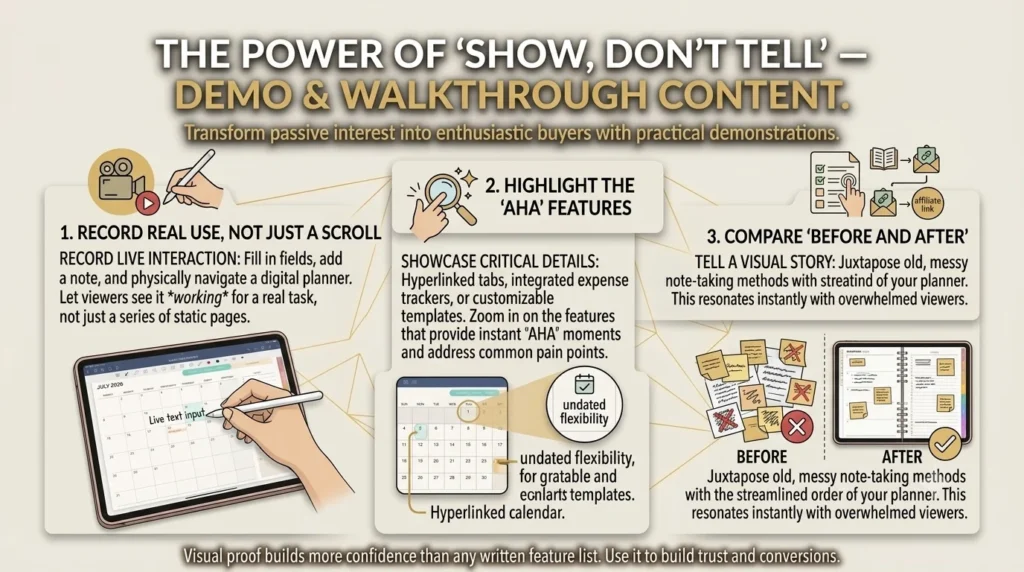
Here’s a truth that separates high-earning affiliates from everyone else: people don’t buy planners because of what you say about them. They buy because of what they see. A screen recording of you actually using the planner — checking off a habit tracker, dragging a task to tomorrow, tapping between monthly and weekly views — does more convincing than any paragraph of copy ever could.
- Record real use, not just a scroll-through — fill in a few fields live so viewers see the planner functioning, not just existing.
- Highlight the “aha” features — hyperlinked tabs, built-in calculators, or undated flexibility are the details that push hesitant buyers over the edge.
- Compare “before and after” — a messy, scattered note-taking system next to the organized planner tells a visual story that resonates instantly.
Leverage Seasonal and Trend-Based Promotion
Digital planners ride a predictable wave of seasonal demand, and smart affiliates plan their content calendar around it instead of posting randomly and hoping for the best.
- New Year, new system — late December through mid-January is prime time as people search for “2026 digital planner” and similar terms.
- Back-to-school season — late July through September brings a surge of student and teacher-focused buyers.
- Quarterly resets — many planner buyers restart their systems every quarter, so don’t let your promotion end in January.
- Black Friday and Cyber Monday — bundle deals and discount codes convert exceptionally well during this window, so prepare content in advance.
Planning your content around these windows means you’re publishing exactly when demand — and search volume — is naturally at its peak.
Build an Email List Around Productivity and Planning
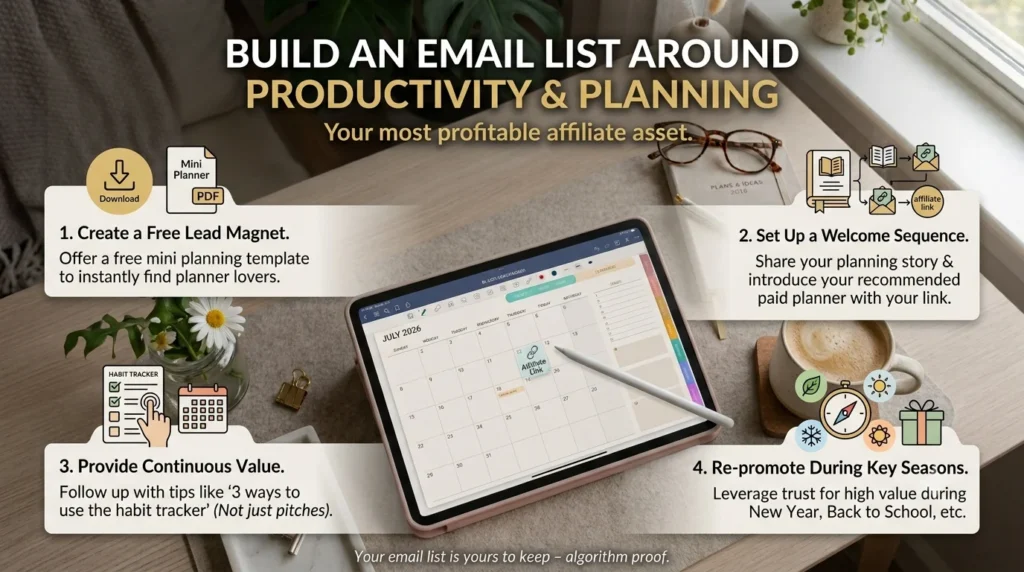
Social platforms can change their algorithms overnight, but an email list is yours to keep. This is the single most underused asset among digital planner affiliates, and it’s also one of the most profitable.
- Offer a free mini planning template as a lead magnet in exchange for an email address — this instantly qualifies your list as people who love planners.
- Send a short welcome sequence that shares your own planning story, then naturally introduces the paid planner you recommend, complete with your affiliate link.
- Follow up with usage tips (“3 ways to use the habit tracker page”) rather than repeated sales pitches — this keeps subscribers engaged long after the first email.
- Re-promote during seasonal windows — your existing list is often more valuable than new traffic, since they already trust you.
Use Bundles, Bonuses, and Comparison Content to Boost Conversions
People love feeling like they’re getting more than they paid for. Sweetening the deal — without discounting the product itself — is one of the most effective (and most overlooked) conversion tactics available to affiliates.
- Create a free bonus — a set of custom stickers, a printable checklist, or a short “how to set up your planner” guide — offered exclusively to people who purchase through your link.
- Build comparison charts that stack two or three planners side by side, making the decision easier and positioning you as a trusted guide rather than a pushy seller.
- Highlight limited-time offers from the seller (if available) to create gentle urgency without resorting to fake scarcity tactics.
The goal isn’t to manipulate anyone into buying. It’s to remove every last bit of friction between “I like this idea” and “I just bought it.”
Track, Test, and Double Down on What Works
Affiliate marketing rewards the patient and the curious far more than the loud. The affiliates earning consistent commissions from digital planners are the ones quietly watching their numbers and adjusting.
- Track click-through rates on every platform separately so you know exactly where your best traffic comes from.
- A/B test your content — try two different video hooks, two different pin designs, or two different email subject lines and compare results.
- Watch which planner style converts best — minimalist versus colorful, undated versus dated — and lean into what your specific audience responds to.
- Revisit old content — a blog post or pin that performed well six months ago can often be refreshed and relaunched for another wave of traffic.
- Use UTM parameters on your links whenever the program allows it, so you can see in your analytics dashboard exactly which piece of content sent the traffic that converted.
- Give new content time before judging it — Pinterest and SEO content especially can take weeks or months to gain traction, so resist the urge to abandon a strategy after just a few days.
Think of your affiliate content as a small, growing garden rather than a single seed you plant once and forget. Some pieces will underperform no matter how much effort you put into them, and that’s completely normal. The affiliates who succeed long-term aren’t the ones who guess correctly every time — they’re the ones who keep planting, keep measuring, and keep nurturing whatever starts to grow.
Common Mistakes to Avoid
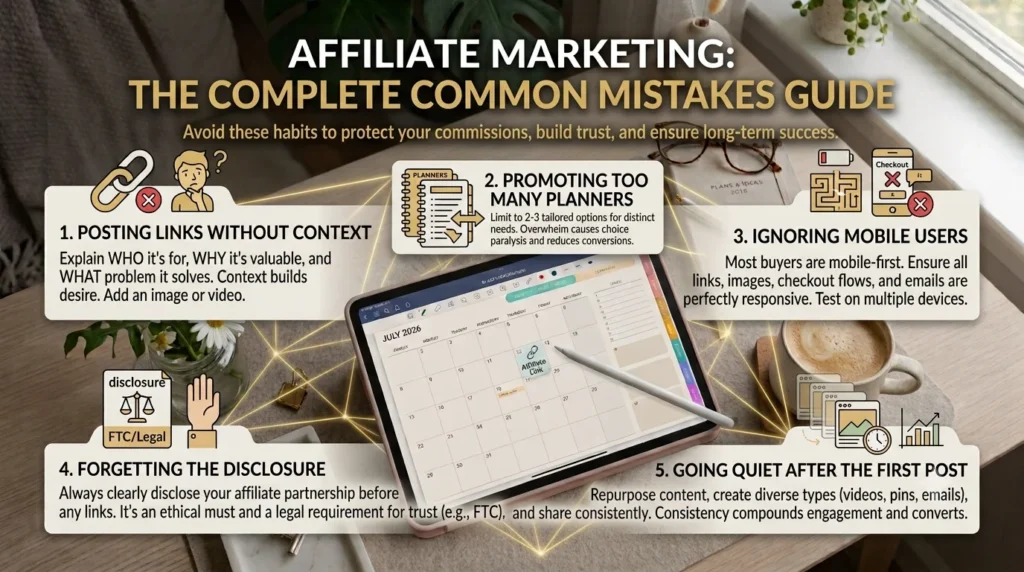
Even well-intentioned affiliates lose commissions to a handful of avoidable habits. Keep an eye out for these:
- Posting the link without context — a bare link with no explanation of who it’s for or why it’s worth buying rarely converts.
- Promoting too many planners at once — spreading yourself across ten different products dilutes your credibility and confuses your audience.
- Ignoring mobile users — most planner shoppers browse on their phones, so make sure your links, images, and checkout flow are mobile-friendly.
- Forgetting the disclosure — always be transparent that you earn a commission; it’s both an ethical and legal requirement.
- Going quiet after the first post — one video or pin rarely does the heavy lifting alone; consistency compounds over time.
Choosing the Right Affiliate Program for Digital Planners
Strategy only gets you so far if you’re promoting the wrong product to begin with. Before you invest hours into content, take a step back and vet the affiliate program itself. Not every planner creator offers the same terms, and the difference between a mediocre program and a great one can mean the difference between a hobby and a real income stream.
- Commission structure — look for programs offering at least 30–50% per sale, which is standard in the digital product space since there’s no manufacturing or shipping cost involved.
- Cookie duration — a longer cookie window (30, 60, or even 90 days) means you still get credit even if a buyer doesn’t purchase on their very first click.
- Product quality and reviews — actually buy or test the planner yourself before promoting it. Nothing damages an affiliate’s credibility faster than recommending something they haven’t personally vetted.
- Marketing support — the best creators provide ready-made mockups, swipe copy, and promotional assets, which can save you hours of production time.
- Reliable payouts — check payout thresholds and schedules so you’re not stuck waiting months for commissions to clear.
Many creators sell their digital planners through platforms like Etsy, Gumroad, or their own Shopify store, each with slightly different affiliate infrastructure. Some run their programs through networks, while others handle tracking and payouts manually. Whichever route you go, always test your affiliate link yourself after signing up to make sure it’s tracking correctly before you start driving traffic to it.
Frequently Asked Questions About Promoting Digital Planners
Do I need a big audience to succeed as a digital planner affiliate?
Not at all. This is one of the most encouraging truths about the digital planner niche: it’s built on trust and relevance, not follower count. A creator with a few hundred highly engaged Pinterest followers who genuinely love productivity content can easily out-earn a much larger, more generic account. Focus on being useful to a specific audience rather than chasing broad reach.
How long does it take to see results?
Results vary depending on the platform. Short-form video and email can generate sales within days, while SEO-driven blog content and Pinterest pins often take one to three months to gain real traction. The good news is that once that traffic starts flowing, it tends to keep flowing with minimal extra effort — which is exactly why patience early on pays off later.
Can I promote more than one digital planner at a time?
Yes, but with restraint. Promoting two or three complementary planners — say, one for students and one for professionals — can work well if you clearly separate the content and audience for each. The mistake to avoid is scattering your energy across a dozen unrelated products, which dilutes your credibility and makes it harder for any single recommendation to feel authentic.
What’s the biggest factor in whether someone clicks my affiliate link?
Trust, almost every time. People click links from creators who feel honest, knowledgeable, and genuinely enthusiastic — not from creators who feel like they’re reading a script. Showing your real face, your real handwriting on a tablet, or your real planning routine will consistently outperform polished, impersonal sales copy.
Final Thoughts: Turn Genuine Enthusiasm Into Real Income
Promoting digital planners as an affiliate isn’t about tricking anyone into a purchase — it’s about connecting a genuinely useful product with the people who’ve been searching for exactly that kind of solution. The affiliates who win in this space aren’t necessarily the ones with the biggest following. They’re the ones who show up consistently, understand their audience deeply, and present the product in a way that feels like a recommendation from a friend rather than an ad from a stranger.
Start with one platform, one niche audience, and one planner you genuinely believe in. Build content that shows the transformation, not just the tool. Then let seasonality, email, and search traffic do the compounding work over time. Do that consistently, and those small, unassuming affiliate links can turn into one of the most reliable income streams you’ve ever built.
There will be slow weeks. There will be pins that flop and videos that barely get seen. That’s simply part of the process, not a sign that the strategy is broken. Every experienced affiliate marketer has a folder full of content that never took off sitting right next to the handful of pieces that changed their income overnight. The only real difference between someone who succeeds in this space and someone who gives up is whether they kept showing up after the quiet weeks. Treat every post, pin, and email as a small investment in an audience that will keep buying from you — not just once, but for every planning season that follows.