
How to Find Brand-New Affiliate Programs Before They Get Crowded


ATTENTION: Want to Learn Affiliate Marketing from Successful Affiliates?
Why Timing Quietly Determines Your Entire Commission Ceiling
Affiliate marketing rewards early movers in ways that are easy to underestimate until you’ve experienced both sides of it.
- Search rankings compound over time. The first handful of quality reviews or comparison posts for a new product tend to keep ranking well long after hundreds of copycat posts arrive, simply because they had a head start building authority and backlinks.
- Commission rates are often highest at launch. Brands frequently offer more generous payouts or bonus incentives early on to attract affiliates and build initial momentum, then quietly reduce rates once the program is established.
- Less competition means easier conversions. When you’re one of the only voices talking about a product, your audience has nowhere else to compare prices or read reviews, which naturally increases your conversion rate.
- Relationships with brand affiliate managers form early. The first affiliates to join a new program often get personal attention, custom deals, and priority access to future promotions that latecomers never see.
None of this requires being the biggest or most established affiliate marketer. It just requires being early and paying attention to the right places.
Where New Programs Quietly Launch Before Anyone Notices
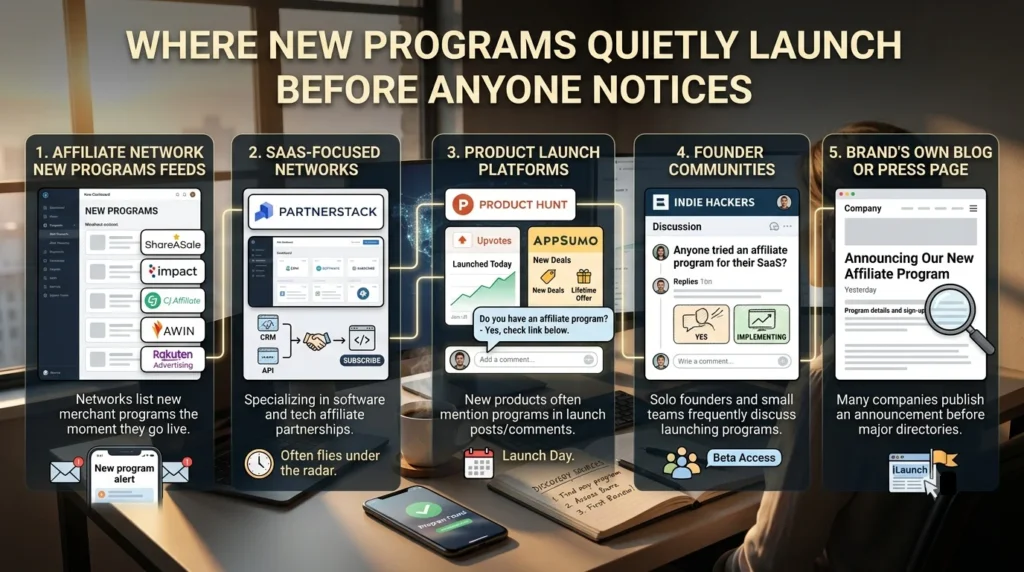
- Affiliate network “new programs” feeds, where networks like ShareASale, Impact, CJ Affiliate, Awin, and Rakuten Advertising quietly list new merchant programs the moment they go live.
- SaaS-focused networks like PartnerStack, which specializes in software and tech affiliate partnerships that often fly under the radar of traditional affiliate marketers.
- Founder and product launch platforms, particularly Product Hunt and AppSumo, where new products often mention affiliate or partner programs directly in their launch posts or comments.
- Founder communities such as Indie Hackers, where solo founders and small teams frequently discuss launching affiliate programs before they’re widely promoted anywhere else.
- The brand’s own blog or press page, since many companies quietly publish an affiliate program announcement long before it appears in any major network directory.
Checking even two or three of these sources on a regular basis puts you well ahead of affiliates who only rely on generic “top affiliate programs” listicle articles, which almost always feature programs that are already saturated.
The Early Signals That a Program Is Worth Jumping On
Not every brand-new program is worth your time, so it helps to recognize the signals that separate a promising early opportunity from a dead end.
- The product already has organic buzz — social media mentions, Product Hunt upvotes, or early user testimonials — even if the affiliate program itself is brand new.
- The brand offers a generous starting commission or a limited-time launch bonus, which signals they’re actively trying to build momentum with affiliates right now.
- There’s an active, responsive affiliate manager rather than a fully automated signup process with no human contact, which usually means the brand is genuinely invested in building affiliate relationships.
- The niche has clear buyer intent — meaning people actively search for solutions in that space, even if this specific brand hasn’t shown up in those searches yet.
- Few or no in-depth reviews exist yet, which you can quickly verify with a simple search for the product name alongside terms like “review” or “vs.”
When several of these signals stack together, you’ve likely found a genuine window of opportunity rather than a program that will quietly fade into obscurity.
Setting Up Monitoring So You Don’t Have to Search Manually Every Day
The affiliates who consistently find new programs early aren’t spending hours a day manually browsing. They’ve built simple systems that surface opportunities automatically.
- Set up Google Alerts for phrases like “new affiliate program,” “[your niche] affiliate program launch,” or “now accepting affiliates,” which deliver relevant new mentions directly to your inbox.
- Follow relevant hashtags and keyword searches on X (formerly Twitter), where many SaaS founders and DTC brands announce new affiliate programs directly to their following.
- Subscribe to network newsletters from ShareASale, Impact, and similar platforms, which often highlight newly onboarded merchants before they’re widely known.
- Join niche-specific Slack or Discord communities for affiliate marketers, where members frequently share brand-new program discoveries in real time before they hit any public listicle.
- Bookmark a rotating check-in schedule — even fifteen minutes twice a week spent browsing a few key sources consistently beats an occasional deep-dive session once a month.
The goal isn’t obsessive daily monitoring. It’s building a lightweight, sustainable habit that consistently surfaces new opportunities without eating your entire schedule.
Using Affiliate Network Dashboards Like a Pro
Most major affiliate networks have a “new merchants” or “recently joined” section buried inside their dashboard, and very few affiliates actually check it regularly.
- Sort merchant listings by join date rather than by popularity or commission rate, which immediately surfaces the newest additions to the network.
- Filter by your specific niche or category to avoid wading through irrelevant listings from unrelated industries.
- Check back on a consistent schedule, since these lists update continuously and older entries quickly get buried under new ones.
- Reach out directly to newly listed merchants rather than waiting for them to approve your application passively, since a quick introductory message often gets you noticed and approved faster.
This single habit — sorting by join date instead of popularity — is one of the simplest, most overlooked ways to consistently beat the crowd to brand-new programs.
Watching Product Launch Communities for Programs Before They’re Official
Some of the best opportunities exist in a gray area before an affiliate program is even fully built out. Product launch communities are where you’ll spot these earliest.
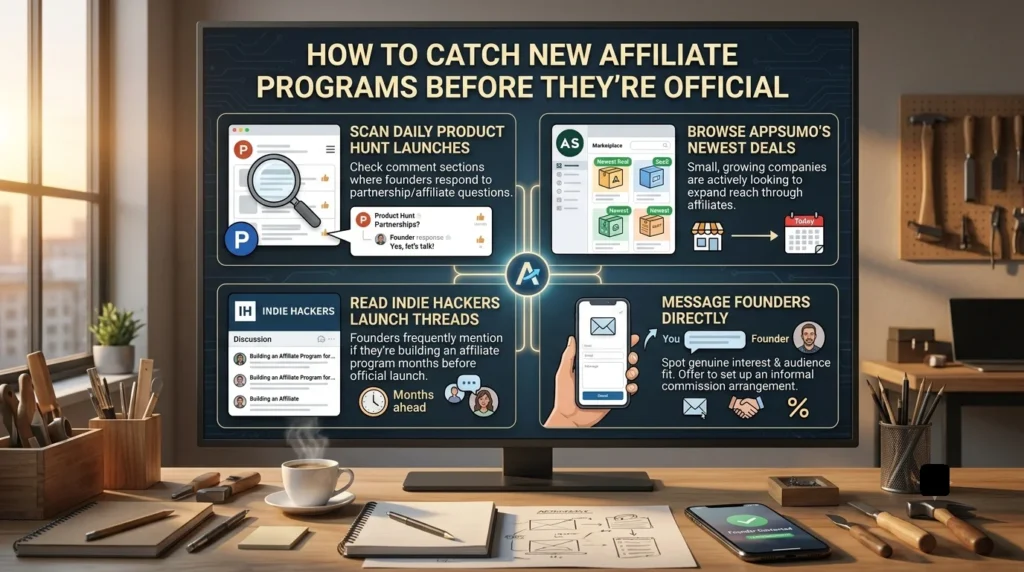
- Scan daily Product Hunt launches in your niche, checking comment sections where founders often respond to questions about partnerships or affiliate opportunities directly.
- Browse AppSumo’s newest deals, since many of the software products featured there are small, growing companies actively looking to expand their reach through affiliates.
- Read Indie Hackers launch threads, where founders frequently mention if they’re building or considering an affiliate program, sometimes months before it officially exists.
- Message founders directly when you spot genuine interest and audience fit, even if no formal affiliate program exists yet — many founders will happily set up an informal commission arrangement with an eager early affiliate.
This approach requires a bit more initiative than simply browsing a network dashboard, but it consistently surfaces opportunities that no one else has found yet, since you’re essentially getting in before the program technically exists.
Tapping Into Founder and Creator Communities
Founders talk. They talk in public Twitter threads, in LinkedIn posts, and in private communities built around startups and SaaS growth. Positioning yourself inside these spaces means you’ll often hear about new programs directly from the source.
- Follow SaaS founders and DTC brand owners in your niche on X and LinkedIn, where affiliate program announcements are frequently shared as a growth milestone.
- Join niche-specific founder communities, many of which include dedicated channels for partnership or affiliate program announcements.
- Engage genuinely before pitching yourself as a potential affiliate — thoughtful comments and real engagement make founders far more likely to remember and prioritize you when they do launch a program.
- Watch for funding announcements, since a company that just raised a funding round often ramps up affiliate and partnership marketing shortly afterward as part of its growth push.
Learning From Competitor and Influencer Behavior
Sometimes the fastest way to find a promising new program is to watch what sharp, established affiliates in your space are quietly doing before it becomes obvious to everyone else.
- Notice when a respected creator suddenly promotes an unfamiliar brand, which often signals they’ve already vetted a new program that hasn’t hit the mainstream radar yet.
- Check the affiliate disclosure links on niche blogs and YouTube descriptions you already follow, since these frequently reveal new programs before they’re widely discussed.
- Search backlink and mention tools for competitor domains to see which new brands they’ve recently started linking to or reviewing.
- Pay attention to unusually well-produced content around a lesser-known brand, since polished content often means an affiliate has already negotiated a strong deal worth the production investment.
This kind of competitive awareness isn’t about copying anyone directly — it’s about using publicly available signals to identify opportunities faster than you would on your own.
Vetting a New Program Before You Commit Your Time
Not every early opportunity is worth chasing, so a quick evaluation before diving in saves you from wasting effort on a program that fizzles out.
- Confirm the product actually solves a real problem people are searching for, rather than being a novelty with limited staying power.
- Check the company’s funding or revenue signals where available, since a well-funded or clearly profitable company is far more likely to sustain its affiliate program long-term.
- Read the program terms carefully, paying attention to cookie duration, payout thresholds, and payment schedule before investing significant content creation time.
- Test the actual product yourself whenever possible, since firsthand experience produces far more compelling, trustworthy content than secondhand speculation.
- Ask the affiliate manager directly about upcoming plans, average affiliate performance, and any bonus structures, since a responsive, transparent manager is a strong sign of a program built for the long haul.
Mistakes That Quietly Cost Affiliates Their First-Mover Advantage
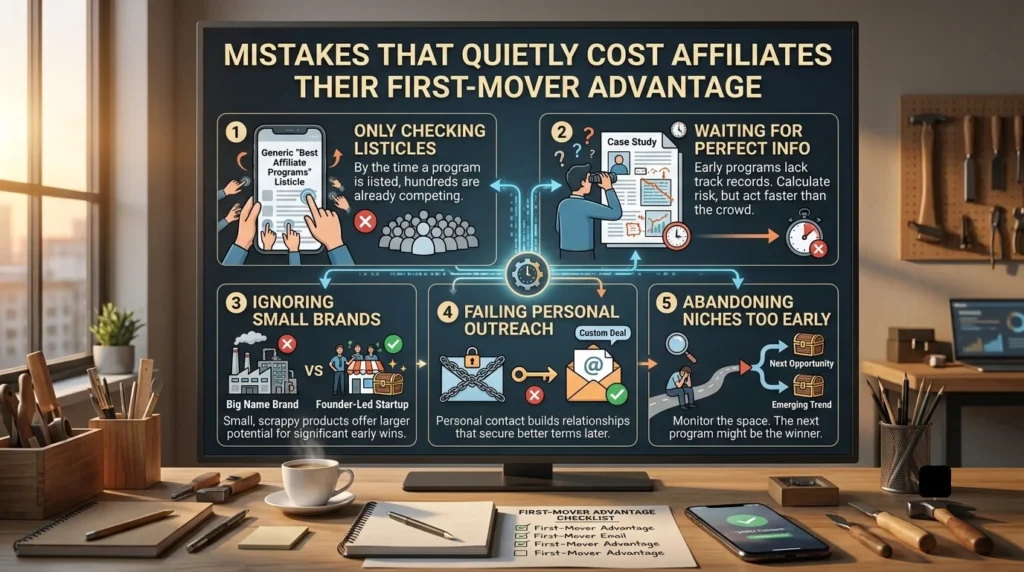
- Only checking generic “best affiliate programs” listicles. By the time a program appears on one of these lists, hundreds of other affiliates have usually already found it.
- Waiting for perfect information before committing. Early programs rarely come with extensive case studies or proven track records — some calculated risk is part of the advantage.
- Ignoring smaller, founder-led products in favor of only chasing big-name brands, even though small, scrappy products are often where the biggest early wins happen.
- Failing to reach out personally to new merchants, missing out on relationship-building opportunities that later translate into better deals and priority treatment.
- Abandoning a promising niche too early simply because the first program you tried didn’t perform, rather than continuing to monitor that space for the next emerging opportunity.
A Realistic Example of How This Plays Out
Picture an affiliate marketer who checks a handful of new-merchant feeds and founder communities twice a week as part of a simple routine. One afternoon, they spot a small SaaS tool on Indie Hackers that just crossed a modest revenue milestone, with the founder mentioning in a comment thread that they’re “thinking about setting up an affiliate program soon.” Rather than waiting for an official announcement, the affiliate sends a short, genuine message: they’ve used similar tools before, they run a blog in that exact niche, and they’d love to be one of the first affiliates once something is set up.
Two weeks later, the founder replies with a simple commission structure and a unique tracking link, months before the program is ever listed on a major network. The affiliate publishes an in-depth, first-hand review, and because almost nothing else exists online about this tool yet, that single article starts ranking within weeks. By the time the product gains wider traction and dozens of other affiliates discover it through a network listing, this early article is already established, trusted by search engines, and quietly converting.
None of this required special access or luck — just consistent monitoring, a genuine outreach message, and a willingness to act before there was a polished, official program to point to.
Turning Your Early Discovery Into Content That Actually Ranks
Finding a brand-new program early is only half the advantage. What you do with that head start determines whether it actually pays off.
- Publish a genuine, first-hand review as quickly as possible once you’ve tested the product yourself, since being among the very first pieces of content gives you a meaningful head start in search rankings.
- Target long-tail, specific keywords related to the exact product name rather than broad category terms, since there’s typically far less competition for branded searches early on.
- Build comparison content once a second competitor emerges, positioning yourself as the resource that already understands both options before anyone else has written that comparison.
- Update your content regularly as the product evolves, since search engines favor content that stays current, and early affiliates who let their reviews go stale eventually lose ground to newer, more current competitors.
- Build an email list around your niche so you can personally notify your audience the moment you discover the next promising early opportunity, turning your monitoring habit into a repeatable content and promotion advantage.
Being early only matters if you convert that head start into real content, real trust, and real rankings before the rest of the field catches up.
A Simple Weekly Checklist to Keep the Habit Going
Consistency beats intensity with this entire strategy. Rather than trying to remember every source and signal covered in this guide, build a short recurring checklist you actually follow.
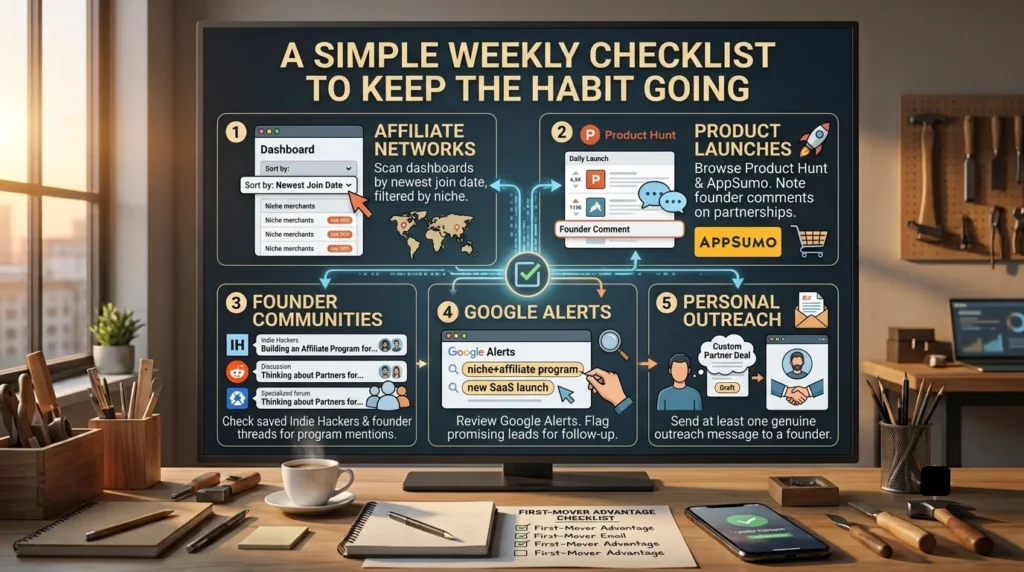
- Scan two or three affiliate network dashboards sorted by newest join date, focused specifically on your niche category.
- Browse that day’s or week’s top Product Hunt and AppSumo launches relevant to your audience, noting any founder comments about partnerships.
- Check in on your saved Indie Hackers and founder community threads for any mention of new or upcoming affiliate programs.
- Review your Google Alerts inbox for anything matching your saved search phrases, flagging promising leads for follow-up.
- Send at least one genuine outreach message to a founder or small brand you’ve identified as a strong early fit that week.
Turning this into a fifteen-to-twenty-minute weekly ritual, rather than an occasional deep dive, is what actually compounds into a steady stream of early opportunities over time. The affiliates who consistently land the best early programs aren’t necessarily the most skilled writers or the most technically savvy marketers — they’re simply the ones who show up to look, week after week, long after everyone else has stopped paying attention.
Frequently Asked Questions About Finding New Affiliate Programs Early
How often should I check for new affiliate programs?
A light but consistent schedule works best — checking your key sources two or three times a week is generally enough to catch new opportunities without turning it into a full-time task. Automated tools like Google Alerts help fill the gaps between manual check-ins.
Is it risky to promote a brand-new program with no track record?
There’s inherently more uncertainty compared to an established, proven program, but that uncertainty is exactly what creates the early-mover advantage. Vetting the product quality and the company’s stability, as outlined above, significantly reduces that risk while still letting you capture the upside of being early.
Should I focus on big brand launches or small founder-led products?
Both have value, but small, founder-led products often present the biggest early advantage, since competition is virtually nonexistent and founders tend to be highly responsive and willing to negotiate favorable terms with early affiliates.
What’s the fastest way to get noticed by a brand-new affiliate program?
Reach out directly and personally rather than simply submitting a generic application. Mention specific ways you plan to promote the product and reference genuine interest in what they’ve built — founders remember affiliates who engage thoughtfully rather than blending into a pile of automated signups.
How do I know when a niche is getting too crowded to bother with anymore?
Watch for a sudden flood of near-identical review and comparison content appearing within a short window, along with declining commission rates or tightened program terms. When those signals appear together, it’s usually time to shift your early-mover energy toward the next emerging opportunity instead.
Get There First, and the Rest Gets Easier
Finding brand-new affiliate programs before they get crowded isn’t about having insider access or lucky timing — it’s about consistently watching the right sources, recognizing genuine opportunity when you see it, and moving quickly enough to establish yourself before hundreds of other affiliates catch up. Build the monitoring habits outlined here, stay curious about smaller and founder-led products, and you’ll consistently find yourself first in line for the programs that everyone else discovers months too late.
The window is always there. Most people just aren’t looking in the right places to see it open.